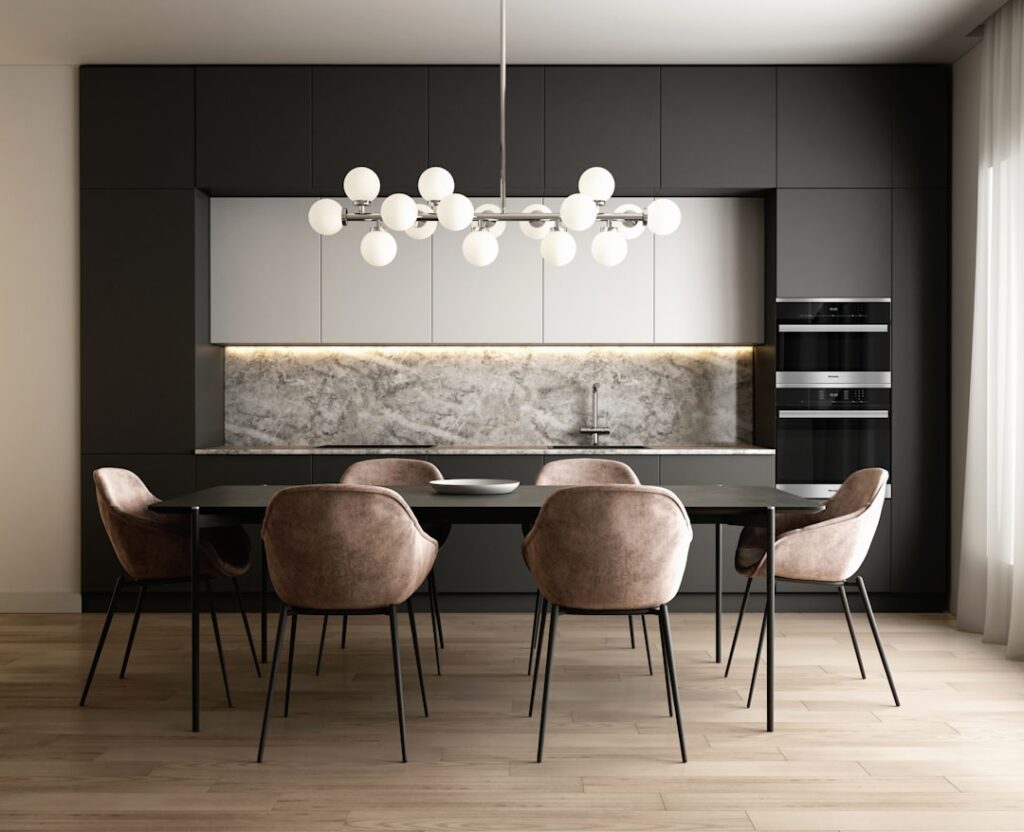
The wrong stool height leaves guests perched too high with knees jammed under the counter, or hunched too low with the overhang above their heads. Choosing black stools for kitchen island seating well starts with matching seat height to your counter, then spacing them correctly and picking a material that shrugs off kitchen spills. Black is the most versatile color for the job, and this guide covers all of it: heights, spacing, styles, and materials.
Part of our Kitchen Remodeling guide — explore the full guide →
- Why Black Is the Safe, Versatile Choice
- Get the Height Right First
- Spacing: How Many Stools Fit
- Backless vs. With a Back
- Materials That Survive a Kitchen
- Matching Black Stools to Your Kitchen
- Fixed Height vs. Adjustable Stools
- Comfort Details That Matter
- Popular Black Stool Styles
- Caring for Black Stools
- Bringing It Together
Why Black Is the Safe, Versatile Choice
Black stools work in nearly every kitchen because they read as a neutral. They anchor a light or white kitchen with contrast, disappear into a dark or moody scheme, and pair with wood, stone, and metal alike. Practically, black hides scuffs, fingerprints, and the inevitable splashes better than white or pale upholstery. Whether your style is modern, farmhouse, industrial, or transitional, there is a black stool that fits.
Get the Height Right First
This is the number one decision, and it depends entirely on your island’s counter height, not on guessing. Measure from the floor to the top of your countertop, then choose a stool that leaves about 9 to 12 inches between the seat and the underside of the counter. The three standard categories:
| Counter type | Counter height | Stool seat height |
|---|---|---|
| Standard counter | 36 in | 24–26 in (counter stool) |
| Raised bar | 42 in | 29–32 in (bar stool) |
| Tall / extra-high | 44–47 in | 33–36 in (spectator/tall) |
Most kitchen islands are a standard 36 inches, which calls for a counter-height stool around 24 to 26 inches. If your island has a raised eating bar, you need taller bar stools. Always measure your specific island before buying.
Spacing: How Many Stools Fit
Cramming too many stools along an island makes it uncomfortable to sit and get up. Plan for roughly 24 to 30 inches of counter width per stool, measured center to center, so elbows and shoulders have room. To figure out how many fit:
- Measure the usable length of the island’s seating side.
- Leave about 6 inches of clearance at each end so end stools are not crammed against a wall or corner.
- Divide the remaining length by 24 to 30 inches per stool.
For example, a 72-inch island with seating on one side comfortably holds two to three counter stools. Also confirm you have at least a 12-inch knee overhang on the island so legs tuck under.
Backless vs. With a Back
The back style changes both comfort and how the kitchen looks:
- Backless stools — tuck fully under the overhang, keep sightlines open, and look clean and minimal. Best for quick perching and small kitchens where you want the island to feel uncluttered.
- Low-back or full-back stools — more comfortable for lingering meals and homework. They take up more visual space and do not slide as far under the counter.
- Swivel stools — a back plus a swivel seat makes getting in and out easy, great for older users and busy family kitchens.
Match the choice to how you actually use the island: quick breakfasts favor backless; family dinners favor backs.
Materials That Survive a Kitchen
Black comes in every material, and the choice affects durability and feel:
- Powder-coated metal — an industrial-style black steel frame is nearly indestructible and wipes clean. Ideal for busy households and modern or farmhouse looks.
- Solid or engineered wood — painted or stained black wood adds warmth. Durable but can chip at the feet over time.
- Faux leather / vinyl upholstery — a padded black seat wipes clean easily, unlike fabric, and adds comfort. Look for a commercial-grade vinyl for longevity.
- Woven rattan or rope with black frame — mixes texture into an otherwise sleek stool for a coastal or boho vibe.
For a kitchen, wipeable surfaces win. A powder-coated frame with a vinyl or wood seat is the most practical combination.
Matching Black Stools to Your Kitchen
Because black is neutral, you have freedom, but a few pairings look especially sharp:
- White or light kitchen: black stools create crisp, high-contrast punctuation, especially with black hardware or light fixtures to tie it together.
- Wood tones: black metal with a natural wood seat bridges warm and cool for a transitional look.
- Dark or navy cabinets: matte black stools blend for a sophisticated, low-contrast feel; add a metal or leather texture so they do not vanish entirely.
Repeat the black elsewhere, in the faucet, pendant lights, or cabinet pulls, so the stools look intentional rather than random.
Fixed Height vs. Adjustable Stools
Most kitchen stools are a fixed height, which gives the cleanest look and the sturdiest build. But adjustable gas-lift stools, the kind that raise and lower with a lever, are worth considering in a few situations. They flex between a counter-height and bar-height island, adapt to family members of very different sizes, and let guests fine-tune their seat. The trade-offs are that they typically swivel and have a five-star or round base that takes more floor room, they can look more office-like than furniture-like, and the gas cylinder is one more part that can eventually wear out. For a standard 36-inch island where everyone sits at the same level, fixed-height black stools usually look better and last longer. Reserve adjustable models for spaces where the flexibility genuinely solves a problem, such as a multi-generational household or an island you might reconfigure later.
Comfort Details That Matter
Beyond height, small features make daily use better. A footrest ring or bar supports the feet and is essential on taller bar stools. A seat with a slight contour or a cushion is far more comfortable for meals than a flat, hard disc. Floor glides or rubber feet protect your flooring, especially important on hardwood or luxury vinyl plank. If your kitchen floor is a hard tile or wood, felt-lined glides prevent scratches when stools slide.
Popular Black Stool Styles
Black works across nearly every design vocabulary, so the shape you pick sets the personality of the kitchen. The most popular directions:
- Industrial metal — a black steel frame with a flat or saddle seat, often with visible bracing and a footrest bar. Pairs with butcher block, concrete, and Edison-bulb lighting.
- Modern minimalist — a sleek matte-black stool with clean lines and no ornamentation, ideal for handleless flat-panel cabinets.
- Farmhouse — a black wood stool, sometimes distressed, with turned legs or an X-back, softening the contrast in a white shaker kitchen.
- Upholstered contemporary — a black vinyl or leather seat on tapered legs for a more comfortable, refined look.
- Windsor or spindle-back — a classic black spindle stool that reads traditional and timeless.
Pick a style that echoes your cabinets and lighting rather than fighting them, and the stools will feel like part of the design rather than an afterthought.
Caring for Black Stools
One irony of black is that while it hides scuffs and food splashes better than white, it can show dust, lint, and dried water spots more visibly, especially on matte finishes. Keeping them sharp is easy with a few habits. Wipe metal and wood frames with a slightly damp microfiber cloth to lift dust, and dry them so hard water does not leave spots. For vinyl or faux-leather seats, a mild soap-and-water wipe removes kitchen grease; avoid harsh solvents that can crack the coating. Check and tighten the seat and leg bolts a couple of times a year, since daily use loosens fasteners over time, and confirm the floor glides are intact so the stools do not scratch your flooring. Matte black frames occasionally get a scuff that shows; a dab of matching touch-up paint makes it disappear.
Bringing It Together
Start by measuring your island height and choosing counter-height or bar-height stools that leave 9 to 12 inches of legroom. Space them 24 to 30 inches apart, decide between backless and full-back based on how you use the island, and pick a wipeable material like powder-coated metal or vinyl. Do that, and black stools for kitchen island seating will be comfortable, durable, and a stylish neutral anchor that works with almost any kitchen you build around them.