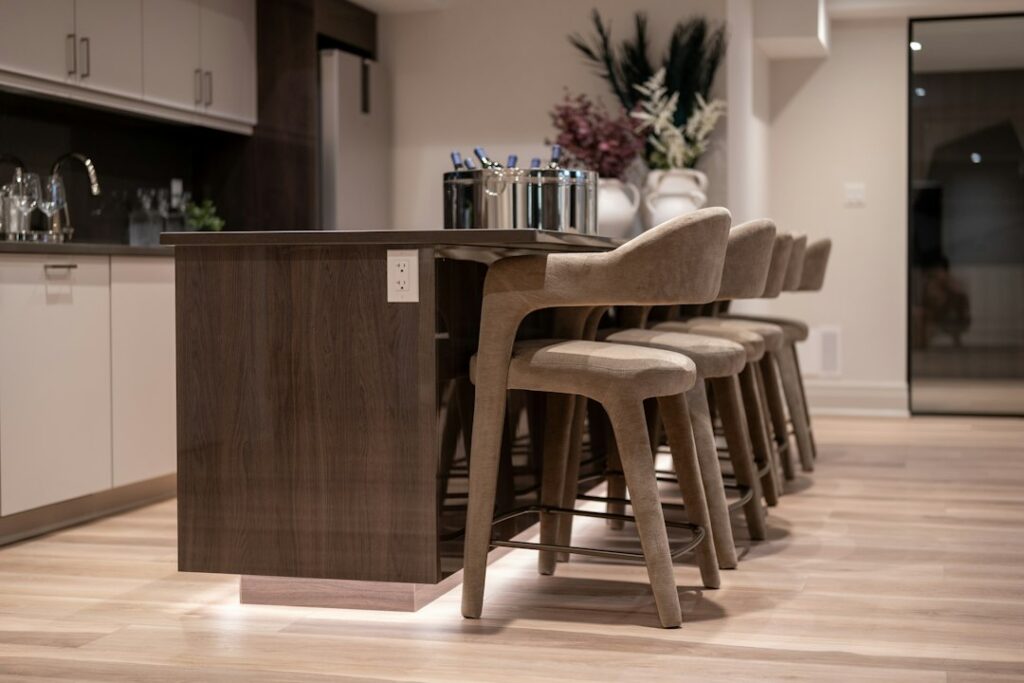
Swivel stools for kitchen island seating combine comfort and convenience in a way fixed stools cannot, letting people turn easily to join conversation, get up without scooting, and reach across the counter without twisting. The rotating seat is a small feature that makes daily use noticeably more comfortable, which is why swivel models are a favorite for busy island counters.
Part of our Kitchen Remodeling guide — explore the full guide →
Choosing the right ones means getting the height correct, deciding on style and material, and figuring out how many will fit. This guide walks through each decision so your island seating is both comfortable and correctly proportioned.
- Getting the Height Right
- Benefits of a Swivel Design
- Adjustable vs. Fixed Height
- Backless vs. Stools With Backs
- How Many Stools Fit Your Island
- Materials and Style
- Comfort and Practical Features
- How Many You Actually Need
- Durability and Maintenance
- Matching Stools to Your Kitchen Style
- Common Sizing Mistakes to Avoid
- Caring for Your Stools
- Making Your Selection
Getting the Height Right
Height is the single most important factor, and buying the wrong height is the most common mistake. Stool height must match your counter or island height:
- Counter-height stools (24 to 27 inch seat) — for standard kitchen islands and counters around 36 inches tall. This is the most common island height.
- Bar-height stools (28 to 33 inch seat) — for raised bar counters around 42 inches tall, often a second tier on an island.
- Extra-tall or spectator stools (34 to 36 inch seat) — for unusually high counters around 45 to 48 inches.
The rule of thumb is to leave 9 to 12 inches between the seat top and the underside of the counter so legs fit comfortably. Measure your counter height first, then subtract about a foot to find the ideal seat height.
Benefits of a Swivel Design
The rotating seat is more than a novelty; it offers real everyday advantages over fixed stools:
- Easier entry and exit — turn the seat outward to sit or stand without scooting the whole stool.
- Better for conversation — face the cook, the TV, or other guests without twisting your body.
- Convenient reach — rotate to grab something from the counter or pass a dish without straining.
- Kid- and guest-friendly — the flexibility suits people of different sizes and mobility.
These small conveniences add up in a busy kitchen where people are constantly sitting down, getting up, and turning to talk.
Adjustable vs. Fixed Height
Some swivel stools for kitchen island use a gas-lift mechanism that adjusts height like an office chair, while others are a fixed height. Adjustable stools offer flexibility if your counter height is unusual or if different family members prefer different heights, and they often pair swivel with height adjustment. Fixed-height stools tend to look more like furniture and come in a wider range of styles, so choose based on whether you value adjustability or a more traditional, built appearance.
Backless vs. Stools With Backs
Whether to have a backrest is both a comfort and a space decision:
- Backless swivel stools tuck fully under the counter when not in use, keeping sightlines clean and the kitchen open. They suit short sits and small spaces.
- Stools with backs are more comfortable for lingering meals and conversation, offering support, but they take more room and do not fully hide under the overhang.
- Low-back or bucket styles split the difference, offering some support while staying relatively compact.
How Many Stools Fit Your Island
Crowding stools together defeats the purpose, so plan spacing carefully. Allow about 26 to 30 inches of counter width per stool, measured center to center, so people have elbow room and the stools can swivel without knocking. To estimate:
- Measure the usable seating length of your island (the overhang side).
- Divide by roughly 28 inches per stool.
- Round down for comfort rather than cramming in an extra seat.
Also confirm the counter overhang is deep enough — ideally 12 to 15 inches — so knees fit under the counter.
Materials and Style
Stools are furniture as much as seating, so the look matters. Common material combinations include:
- Metal frames — durable and available in industrial, modern, or vintage finishes like brushed nickel, matte black, or brass.
- Wood frames — warm and traditional, matching cabinetry or dining furniture.
- Upholstered seats — fabric or leather for comfort; choose performance fabrics or wipeable leather for a kitchen where spills happen.
- Molded plastic or resin — easy to clean and available in bold colors for modern kitchens.
Match the stool style to your kitchen’s overall design, and consider a finish that coordinates with your cabinet hardware and lighting.
Comfort and Practical Features
Beyond looks, several features affect everyday satisfaction:
- Footrests — a built-in ring or bar supports feet and makes taller stools far more comfortable.
- Smooth 360-degree swivel — check that the mechanism turns easily and returns smoothly.
- Padded or contoured seats — better for long sits than a flat hard seat.
- Floor protection — felt pads or rubber feet prevent scratches, important on hardwood or tile.
- Weight capacity — confirm the rating suits everyone who will use them.
How Many You Actually Need
Beyond what physically fits, think about how you use the island. A family that eats casual meals at the counter may want a stool for every household member, while an island used mainly for occasional coffee or homework might need only two or three. Consider entertaining, too — a couple of extra seats accommodate guests during gatherings. It is generally better to have slightly fewer, well-spaced stools than to cram in an extra seat that leaves everyone crowded. If you occasionally need more seating, lightweight backless stools that tuck fully under the counter are easy to add and store, giving you flexibility without permanent crowding.
Durability and Maintenance
Kitchen stools take heavy use, so build quality pays off. Look for sturdy welded metal or solid wood joints rather than flimsy assembly, and confirm the swivel mechanism is well made since it is the part most likely to wear. For upholstered seats, choose stain-resistant or wipe-clean materials, and check that covers can be cleaned or replaced. A quality set of stools should last many years even with daily use.
Matching Stools to Your Kitchen Style
Stools do double duty as functional seating and visual accents, so coordinating them with your kitchen ties the whole room together. Some pairings that work well:
- Modern kitchens — sleek metal or molded stools in neutral or bold colors with clean lines.
- Farmhouse and rustic kitchens — wood-frame stools or metal industrial styles with a weathered finish.
- Traditional kitchens — upholstered stools with turned wood legs and classic finishes.
- Transitional spaces — a mix of wood and metal with simple upholstery bridges modern and traditional looks.
Coordinate the stool finish with your cabinet hardware, lighting, and faucet for a pulled-together result, and consider how the seat color works with your countertop and flooring.
Common Sizing Mistakes to Avoid
A few errors trip up buyers and lead to uncomfortable or crowded seating. The most frequent is buying bar-height stools for a standard counter-height island, or vice versa, which leaves legs cramped or dangling. Another is placing too many stools along the counter so people bump elbows and cannot swivel freely. Overlooking the counter overhang depth is common too — without enough overhang, knees have nowhere to go. Finally, forgetting to check the seat-to-counter clearance results in stools that are too tall to slide under comfortably. Measuring carefully and following the height and spacing guidelines avoids all of these problems.
Caring for Your Stools
Because kitchen stools sit in a high-traffic, spill-prone area, a little care keeps them looking good. Wipe upholstered or leather seats promptly after spills, and choose performance fabrics or wipeable materials if you have kids. Periodically tighten any bolts on the frame and swivel mechanism, since regular use can loosen them over time. Check and replace floor-protecting pads on the feet to prevent scratches on hardwood or tile. For metal and wood frames, an occasional wipe with an appropriate cleaner maintains the finish. With this simple upkeep, a quality set of swivel stools stays comfortable and attractive for many years of daily use.
Making Your Selection
Choosing swivel stools for kitchen island seating starts with measuring your counter height and picking the matching seat height, then deciding backless versus backed based on comfort and space, and finally planning how many fit with proper spacing. From there, select a material and finish that complement your kitchen and prioritize a footrest, a smooth swivel, and durable construction. Get the fundamentals right and you will have island seating that is comfortable, good-looking, and easy to live with every day.