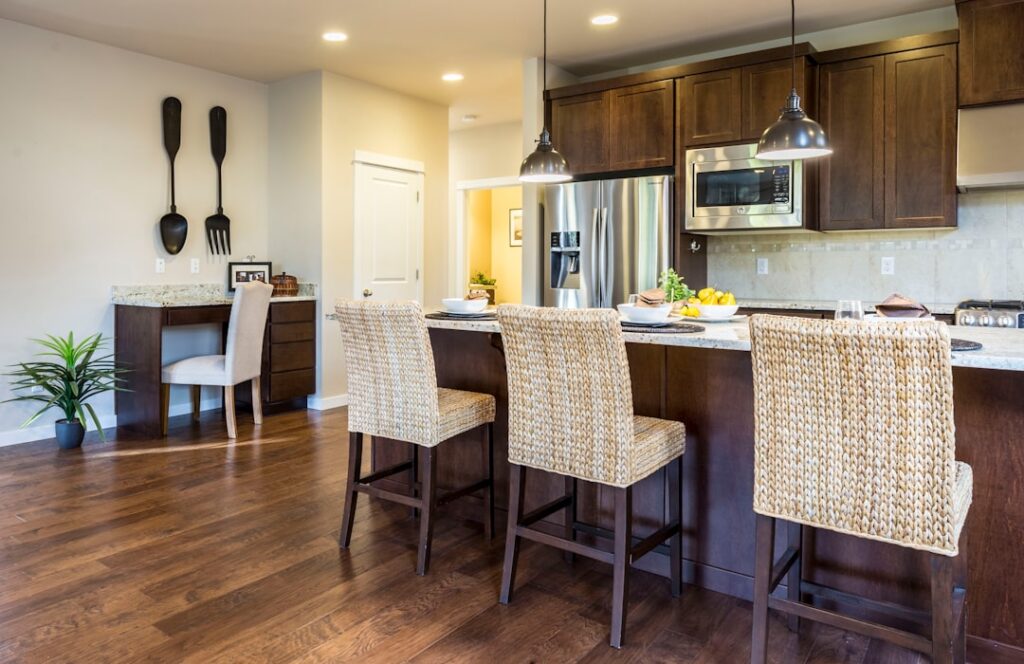
Getting kitchen island chairs right comes down to two measurements most people skip: the height of your countertop and the width you give each seat. Nail those, and every other decision — material, back or backless, swivel or fixed — falls into place. Miss them, and you end up with stools that either bang your knees or leave your family perched awkwardly at chin level.
- Measure Your Island First
- How Many Stools Fit
- Backless vs. Stools With Backs
- Materials and What They Cost
- Swivel, Adjustable, and Other Features Worth Paying For
- Style: Matching Chairs to Your Kitchen
- Common Mistakes to Avoid
- Comfort Details That Get Overlooked
- Weight Capacity and Build Quality
- How Much to Budget
This guide walks you through the exact numbers, then gets into materials, styles, and what you should actually spend so your island seating looks intentional instead of leftover.
Measure Your Island First
Pull out a tape measure and record the height from the floor to the top of your island in inches. That single number tells you which stool category you need:
- Counter height: countertop is 35–39 inches. Buy stools with a 24–27 inch seat height.
- Bar height: countertop is 41–43 inches. Buy stools with a 28–33 inch seat height.
- Table height: surface is 28–30 inches. Buy chairs with an 18–19 inch seat, same as a dining chair.
The reliable rule is a 9-to-13 inch gap between the seat and the underside of the counter. That leaves room for thighs and lets people cross their legs. A 36-inch island paired with a 25-inch stool gives you an 11-inch clearance — right in the sweet spot.
How Many Stools Fit
Give each stool 24 inches of counter width for comfortable elbow room, and never squeeze below 21 inches. Backless stools tuck closer, so you can sometimes stretch to three across a 66-inch overhang where backed stools would only take two.
Standard math: a 4-foot (48-inch) island overhang seats two, a 6-foot (72-inch) run seats three, and an 8-foot (96-inch) island comfortably seats four. Leave 6 inches of dead space at each end so stools aren’t jammed against a wall or the range side.
Your overhang matters too. You want at least 10 to 12 inches of countertop overhang for knees to slide under. Anything less and the stools will stick out into the walkway.
Backless vs. Stools With Backs
Backless stools disappear under the counter, keep sightlines open, and cost less — often $60 to $120 each. They’re ideal for small kitchens and quick-perch use like morning coffee or homework.
Stools with backs cost more and take up more room, but they change how long people are willing to sit. If your island doubles as the dinner table or a work-from-home desk, spend on backs. A low arc back adds support without blocking the view; a full high back turns the stool into a real chair. Expect $130 to $350 each for a solid backed stool.
Materials and What They Cost
Your material choice drives both durability and price. Here’s how the common options stack up for a busy kitchen:
- Solid wood (oak, ash, walnut): warm, repairable, refinishable. $120–$400 each. Walnut runs at the top of that range.
- Metal (powder-coated steel, brushed nickel legs): tough, industrial look, wipes clean. $80–$250 each.
- Upholstered seats: most comfortable for long sits. Choose performance fabric or full-grain leather if you have kids. $150–$450 each.
- Faux leather (PU/vegan leather): the easiest to wipe and the best value for families. $90–$200 each. Look for at least 1.0 mm thickness so it doesn’t peel in two years.
- Rattan or woven: light, coastal, breathable. $110–$260 each, but harder to clean crumbs out of.
For a household with young kids, performance fabric with a stain rating or wipeable faux leather beats real wood-topped seats that stain from juice cups.
Swivel, Adjustable, and Other Features Worth Paying For
A few upgrades genuinely earn their cost:
- Swivel (usually 360 degrees): makes getting on and off easy, especially for older adults and kids. Adds roughly $30–$60 per stool.
- Gas-lift adjustable height: one stool covers a 24–29 inch range. Great when you’re unsure of your counter height or want flexibility, but the pneumatic look reads more office than kitchen.
- Footrest bar or ring: non-negotiable for bar-height seating. Without it, feet dangle and kids fidget.
- Floor glides or rubber tips: protect hardwood and vinyl plank floors from scratches. Replace nylon glides with felt on wood floors.
Style: Matching Chairs to Your Kitchen
Your island chairs are one of the most visible pieces in an open-plan kitchen, so treat them like furniture, not an afterthought. A few pairings that consistently work:
- Modern/contemporary islands: low-back leather or molded seats with slim metal legs in matte black or brass.
- Farmhouse or transitional: ladder-back or windsor wood stools in a warm oak or painted finish.
- Coastal: woven rattan seats with light wood frames.
- Industrial: backless powder-coated metal stools, often with a distressed wood seat cap.
An easy designer trick: pick up one finish already in the room. If your cabinet pulls are brushed brass, choose stool legs in the same tone. If your island is painted navy, a natural wood stool warms it up rather than matching it exactly.
Common Mistakes to Avoid
The errors show up again and again, and they’re all preventable:
- Buying bar stools for a counter-height island. A 30-inch stool under a 36-inch counter leaves only 6 inches of leg room. Always match the category.
- Crowding. Three 20-inch-wide stools on a 60-inch run means constant elbow bumping. Buy fewer, better seats.
- Skipping the footrest at bar height. Dangling feet make any stool uncomfortable within minutes.
- Forgetting the overhang. Order the stools only after you know your counter overhang; otherwise knees won’t fit.
- All hard surfaces, no cushion. If people will linger, at least a padded seat pays off.
Comfort Details That Get Overlooked
Two stools can share the exact same seat height and feel completely different once you sit down. The variables that decide comfort are seat depth, seat shape, and edge contour. Aim for a seat depth of 15 to 18 inches — deep enough to support the back of the thigh, shallow enough that shorter family members aren’t perched on the front edge. A slight scoop or saddle contour in the seat keeps you from sliding forward, which matters more than any amount of padding.
Padding thickness is its own decision. A firm 1.5-to-2-inch foam seat stays comfortable for a full meal, while a thin token pad flattens within months. If you go fully upholstered, check the foam density rating; anything under 1.8 pounds per cubic foot compresses fast under daily use. For bar-height stools, the footrest position matters as much as the seat — you want it roughly 18 inches below the seat so knees bend near 90 degrees.
Weight Capacity and Build Quality
Cheap stools fail at the joints first. Look for a stated weight capacity of at least 250 pounds, and favor stools with a metal frame or corner-blocked wood joinery over ones held together with a few screws and glue. Welded steel frames outlast bolted ones. Give any assembled stool a firm shake in the store or after unboxing; a solid seat shouldn’t rock or creak. Cross-stretchers between the legs add rigidity and double as informal footrests on counter-height stools.
Feel the finish, too. On metal legs, powder coating resists chips far better than spray paint, and on wood, a catalyzed lacquer holds up to kitchen humidity better than a thin oil wipe. These details separate a stool that lasts a decade from one you replace in two years.
How Much to Budget
For a set of three good kitchen island chairs, plan on $250 to $400 total at the value end, $450 to $900 for solid mid-range wood or upholstered stools, and $1,000-plus for designer or full-leather sets. Buy all your stools in one order so the finish and height match exactly — reordering a single stool later almost never lands the same dye lot or measurement.
Start with your counter height, give each seat 24 inches, choose a material that survives your household, and add a footrest and swivel if the budget allows. Do that, and your island seating will look built-in and get used every single day.