
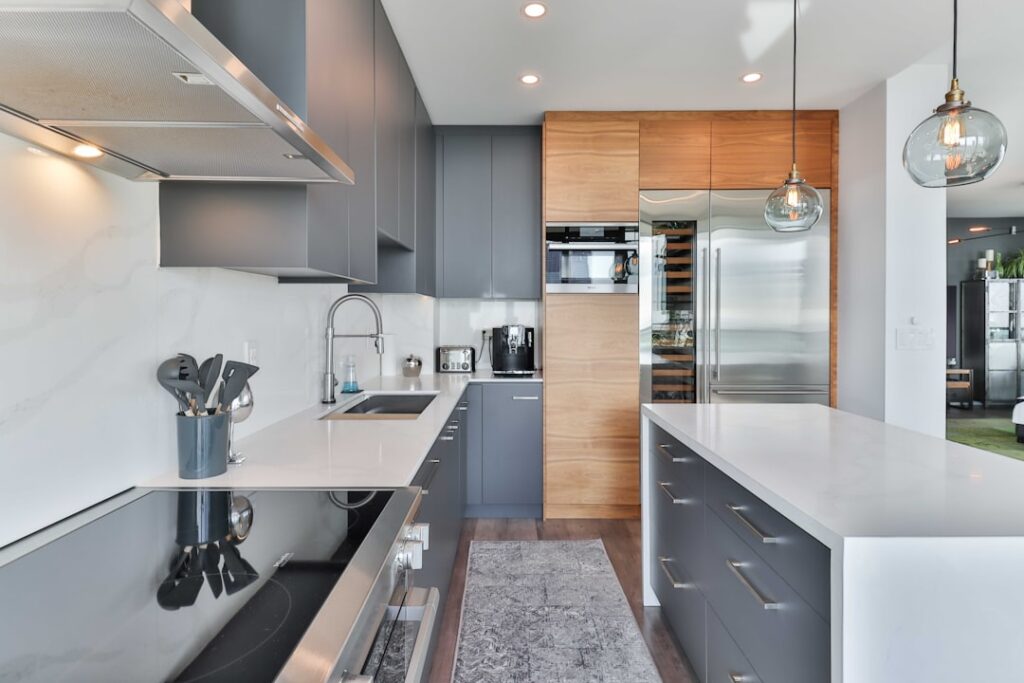
Nothing transforms a kitchen from apartment-grade to custom faster than a refrigerator that looks like cabinetry instead of a hulking white box. A well-planned built in fridge cabinet delivers that seamless look, but the dimensions, clearances, and ventilation requirements are unforgiving. Get the opening too tight and your $8,000 Sub-Zero will cook itself within 18 months. Get it too loose and the gap around the unit destroys the built-in illusion.
Part of our Kitchen Remodeling guide — explore the full guide →
True Built-In vs. Panel-Ready vs. Cabinet-Depth
Before specifying anything, understand the three product categories that all get called built-in. A true built-in refrigerator like Sub-Zero, Thermador, or Monogram is 83 to 84 inches tall, 24 inches deep without the door, and designed to sit flush against a 24-inch-deep cabinet face. It requires top-mount compressor cooling that vents through a grille above the unit.
Panel-ready refrigerators accept custom wood panels that match your cabinetry. They are the premium category, running $7,000 to $15,000 before panels. Counter-depth refrigerators are a budget compromise at $1,500 to $3,500 that sits flush with standard 24-inch base cabinets but still has visible sides and uses a bottom-mount compressor. Each category requires different cabinet framing.
Standard Opening Dimensions
Every brand publishes a specification sheet with exact opening dimensions, and those dimensions are non-negotiable. Call them up before the cabinet order goes in, not after. Here are the ranges you will typically encounter.
- 36-inch built-in side-by-side: 36-1/4 inch width, 84 inch height, 24 inch depth.
- 42-inch built-in side-by-side: 42-1/4 inch width, 84 inch height, 24 inch depth.
- 48-inch built-in side-by-side: 48-1/4 inch width, 84 inch height, 24 inch depth.
- 36-inch panel-ready column: 36-1/8 inch width, 84 inch height.
- Counter-depth freestanding: 36-inch width plus 1/2-inch side clearances.
The 1/4-inch allowance on each side is critical. Framing opening tighter than spec and the unit will not slide in. Framing looser and the gap shows. Measure the actual delivered cabinet opening before the refrigerator arrives, because cabinet shops sometimes build to different tolerances than you expect.
Ventilation: Where Most DIY Installs Fail
A built-in refrigerator generates heat from its compressor just like any fridge, but unlike a freestanding unit that vents out the back, built-ins vent through a grille on top. That grille needs a clear path for air to exit, typically 70 to 100 square inches of free airflow area through the toe kick intake and the top grille exhaust.
Block the vent with crown molding, a cabinet soffit, or an enclosed space above the refrigerator and the compressor overheats. The unit will run constantly, food will not stay cold, and the compressor will fail well short of its expected 15-year lifespan. Every manufacturer provides a ventilation diagram in the spec sheet. Follow it exactly, including the minimum 1-inch depth of the top grille chamber.
Cabinet Framing and Finishing
The cabinet that surrounds a built-in refrigerator is more structural than storage. It needs to support the weight of the unit, which runs 600 to 900 pounds for a 48-inch model, plus the weight of whatever sits in the enclosure. Use 3/4-inch plywood rather than particleboard for the gables and back panel. Secure the cabinet to the wall studs with at least six 3-inch screws.
Face-frame cabinet shops build the surround with face frames that match the rest of the kitchen. Frameless European cabinets require a flush scribe panel on the exposed side so the refrigerator sits flush with finished cabinetry. Measure, scribe, and trim that panel on site rather than trusting shop dimensions.
Electrical and Plumbing Requirements
Built-in refrigerators draw 15 to 20 amps and require a dedicated 120-volt outlet on its own circuit. That outlet usually sits in the cabinet behind the unit, accessible through a small access panel or by pulling the fridge forward on its rollers. Put the outlet too low and the plug will not reach. Too high and it fouls the vent path. Most spec sheets call for the outlet at 66 to 72 inches above the finished floor.
Water supply for the ice maker runs through a 1/4-inch PEX or copper line with a shutoff valve accessible without pulling the unit. Add a second shutoff at the ice maker hookup behind the fridge. Budget an additional $150 to $300 for a plumber if you are running new water supply to the location.
Panel-Ready Doors and Custom Cabinetry
Panel-ready refrigerators accept 1/4-inch to 3/4-inch-thick wood panels depending on the brand. Sub-Zero typically uses 3/4-inch panels with specific back-routing for handles and hinges. The panels must match the weight limits published by the manufacturer because the door hinges are calibrated for a specific range.
Have your cabinet shop build the refrigerator panels at the same time as the rest of the kitchen, from the same wood species and finish batch. Separate orders often produce visible color variation that undermines the built-in effect. Expect $400 to $1,200 for a pair of panels in painted MDF, or $800 to $2,500 in stained hardwood.
Cost Breakdown
A realistic budget for a built-in refrigerator install runs $9,000 to $20,000 all in for a premium brand, or $3,500 to $7,500 for a counter-depth approximation of the look. That total includes the refrigerator ($7,000 to $15,000 for built-in, $1,500 to $3,500 for counter-depth), custom cabinetry surround ($1,200 to $3,000), panels if panel-ready ($500 to $2,500), delivery and installation ($300 to $800), and any electrical or plumbing upgrades ($200 to $600).
Where the counter-depth option saves real money is not just the appliance price but the cabinetry. A standard 36-inch upper cabinet spans the space above a counter-depth fridge, whereas a true 84-inch built-in requires custom cabinetry and a finished top with ventilation framing. That upgrade alone accounts for $1,500 to $3,000 of the difference between the two approaches.


