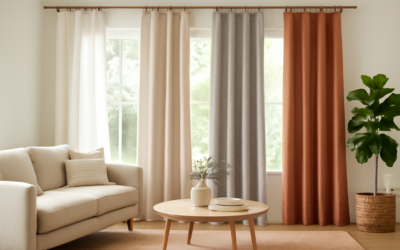
Cafe curtains spent decades stuck in the kitchens of mid-century homes — a half-window treatment for breakfast nooks and 1950s bungalows. They have made a quiet return to the living room over the past three years, especially in homes that prioritize natural light, street-level privacy, and a slightly French or English countryside aesthetic. Cafe curtains for living room use require some specific decisions about height, fabric, and pairing that do not apply to kitchen versions. Get those right and the result feels intentional and elegant; get them wrong and the room reads dated.
What Defines a Cafe Curtain
A cafe curtain covers only the lower half of the window — typically from the sill or apron up to roughly the mid-rail. The upper portion of the window stays uncovered, allowing full daylight from above while providing privacy at sitting and standing eye level.
The traditional version uses a tension rod or simple iron rod hung at the meeting rail of a double-hung window. Modern versions often use brass or matte black rods on hardware brackets for a more upscale look.
Why They Work in Living Rooms
Three problems cafe curtains solve in living spaces:
- Street privacy — for ground-floor or close-to-sidewalk rooms, you can sit on the sofa unseen while the upper window still floods the room with light
- Daylight preservation — full-length panels block more light when closed; cafe curtains keep ceilings bright
- Window framing — cafe curtains visually divide a tall window into two zones, which can break up oversized fenestration
They also pair beautifully with traditional architecture — mullioned windows, deep window casings, and historical millwork.
When Cafe Curtains Are the Wrong Choice
Living rooms with these features are usually not cafe curtain candidates:
- Floor-to-ceiling or oversized contemporary windows — half-coverage looks awkward
- Modern minimalist interiors — cafe curtains read traditional
- Rooms needing complete blackout for TV viewing or daytime sleep
- Windows with no upper sash divider line — the curtain has nothing logical to align with
- Large picture windows where the curtain creates a visual “belt” across the view
Fabric Selection
Living room cafe curtains can be more substantial than kitchen versions. Common fabric choices:
Linen is the most-photographed option — soft drape, slightly translucent, casual but elegant. White linen, oatmeal, and natural flax tones all work. Look at Pottery Barn Belgian Flax, Restoration Hardware Belgian Linen, or Etsy custom linen at $40 to $150 per panel.
Cotton voile provides the lightest filtered look — sheer enough to glow with daylight, opaque enough for privacy. Best in white or ivory. $25 to $80 per panel.
Cotton chintz or printed cotton for traditional and English country styles. Floral prints, ticking stripes, or small geometric patterns all suit the cafe format. $40 to $150 per panel.
Velvet or heavy linen for more formal living rooms. The richer fabric balances ornate furniture and chandeliers. $80 to $250 per panel.
Rod and Hardware Choices
The hardware affects the entire look as much as the fabric does. Match the rod finish to other metals already in the room.
- Unlacquered brass — develops patina, traditional and warm, very Pinterest-popular in 2026
- Polished brass — formal, brighter, better for evening-lit rooms
- Matte black — modern transitional, works with farmhouse
- Oil-rubbed bronze — versatile, slightly traditional
- Tension rod (no brackets) — most casual, lowest profile, fits inside the window frame
Avoid silver and chrome unless your other room hardware is already that finish.
Hanging Height and Length
Where you hang the rod determines whether the room reads tall and elegant or short and dated.
For traditional cafe curtains, hang the rod at the meeting rail of a double-hung window — usually 38 to 42 inches off the floor. The curtain extends from the rod to the bottom of the window casing or 2 inches below the sill.
For a slightly elevated modern take, hang the rod 2 to 4 inches above the meeting rail. This makes the window feel taller and the curtain proportions more current.
The bottom of the curtain should fall exactly at the windowsill, the bottom of the apron, or 1 to 2 inches below the apron. Anywhere in between looks accidental.
Layering With Full-Length Drapes
The most-photographed living room cafe curtain installations layer the cafe with full-length panels mounted high and wide on the casing. The cafe handles privacy, the panels add height and frame the window. This works beautifully for tall ceilings and traditional bay windows.
Use solid panels (linen or velvet) with patterned cafes, or vice versa. Avoid double-pattern unless one is very subtle. Hang the upper drape rod 4 to 6 inches above the window frame and extend the rod 6 to 10 inches beyond each side.
Mounting and Installation
Inside-mount cafe curtains require deep enough window jambs (at least 2 inches) to clear the curtain from the glass. Outside-mount uses brackets attached to the casing or wall around the window. Outside-mount usually looks better for living rooms because you can choose decorative brackets and the curtain reads as intentional rather than stuffed inside the frame.
For a 36 inch window, a single panel typically works. For 48 inch and wider, use two panels that close in the middle.
Common Mistakes
Three errors dominate. Hanging the rod too low — at the bottom third of the window — makes the cafe look stunted. Choosing fabric too heavy or too patterned for the small visible area, which makes the room feel cramped. Skipping pairing with full-length panels when the room actually needs more vertical drama, leaving the windows feeling unresolved.
Cost to Plan For
Budget for living room cafe curtains:
- Tension rod and basic linen panels — $50 to $120 per window
- Quality outside-mount setup with brass rod and linen panels — $200 to $450 per window
- Custom-made linen with matched hardware — $400 to $900 per window
- Layered with full-length drapes — add $200 to $800 for panels plus rod
For a typical living room with two windows, total budget runs $200 to $1,500 depending on quality tier.
Care and Cleaning
Most linen and cotton cafe curtains can be machine washed cold and hung to dry. Re-iron while damp for the cleanest look. Velvet and chintz typically require dry cleaning. Vacuum cafe curtains with a brush attachment monthly to prevent dust buildup, especially in pet households where they sit at fur-flick height. With proper care, a quality linen panel lasts 8 to 15 years before fading or thinning becomes noticeable.