The single biggest reason DIY carpet develops ripples and loose spots is skipping the one tool that pulls it drum-tight. A carpet power stretcher rental costs less than a nice dinner out, yet it is the difference between a floor that stays flat for 15 years and one that buckles within months. A knee kicker alone will never tension a room correctly, no matter how hard you slam it. If you are laying stretch-in carpet over a pad, renting a power stretcher is not optional. Here is what it costs, where to get one, and how to use it without damaging the carpet.
What a Power Stretcher Rental Costs
Rental pricing is refreshingly affordable for such an important tool. Expect these typical rates:
- 4-hour rental: $20 to $40
- Full day (24 hours): $30 to $55
- Weekend rate: $50 to $90
- Deposit (refundable): $50 to $150 or a card hold
Most home carpet jobs fit comfortably in a 4-hour or single-day window, so a typical room or two costs around $30 to $45 to stretch properly. Many rental counters bundle a knee kicker with the power stretcher for a small added fee, and I always recommend taking both since you need the kicker for corners and starting edges.
Where to Rent One
You have several reliable options, and availability is usually good outside of holiday weekends.
Home Improvement Stores
The Home Depot and Lowe’s tool rental centers carry power stretchers at many locations. Home Depot’s rental typically runs about $32 for 4 hours and $46 for a full day, though prices vary by region. Call ahead to confirm the specific store stocks one, since not every location has a rental desk.
Local Equipment Rental Yards
Independent rental yards and chains like Sunbelt often have flooring tools and sometimes better rates or newer equipment. They are also more likely to walk you through the setup if you have never used one.
Flooring Suppliers
Some carpet retailers and flooring wholesalers rent or loan stretchers to customers who bought materials from them. It never hurts to ask when you pick up your carpet and pad.
Power Stretcher vs Knee Kicker: Know the Difference
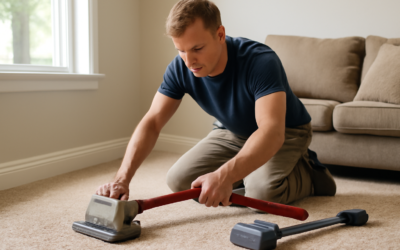
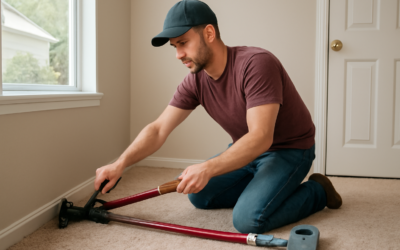
These two tools are not interchangeable, and confusing them is the classic beginner mistake. A knee kicker is a short tool you strike with your knee to grip and nudge carpet a few inches, mainly for hooking carpet onto the tack strip at edges and in corners. A power stretcher is a long tool that spans the room, using a lever and extension poles to apply steady, powerful tension across the entire width of the carpet.
The physics matter. A knee kicker moves carpet locally with quick bursts; a power stretcher pulls the whole field of carpet tight and holds it while you tuck it onto the strip. Relying on the kicker alone leaves the carpet under-tensioned, and that slack becomes wrinkles the first hot, humid week of summer.
What Else You Will Need
Before you start, gather the full kit so you are not making a second trip mid-install:
- Knee kicker for corners, doorways, and starting walls
- Carpet tucker or stair tool to push edges onto the tack strip
- Utility knife with sharp hook and straight blades
- Row-running knife for clean seams
- Tack strip already nailed around the perimeter, gripper pins facing the wall
- Quality carpet pad stapled or glued down
- Seaming iron and seam tape if the room needs more than one carpet width
How to Use a Power Stretcher Step by Step
Take your time setting up. A power stretcher works by bracing against one wall and pushing tension toward the opposite wall, so the sequence matters.
- Hook the starting corner. Use the knee kicker to attach the carpet to the tack strip along two adjoining walls in one corner, forming your anchored base.
- Set the tail block. Place the padded tail block of the power stretcher against the anchored wall, using a scrap of plywood to protect the baseboard from the pressure.
- Extend the poles. Connect extension tubes until the head reaches about 6 inches from the far wall you want to stretch toward.
- Set the teeth. Adjust the head so the pins grip the carpet backing without punching through the face fibers. Start with the pins on a shallow setting for thin carpet.
- Push the lever. Press the handle down smoothly to apply tension. You want firm, even pull, not a violent yank. The carpet should visibly draw tight and flat.
- Hook it onto the strip. While the stretcher holds tension, use the knee kicker and tucker to secure the stretched edge onto the tack strip.
- Work around the room. Release, reposition, and repeat in a planned pattern, stretching from your anchored corner toward each far wall so tension stays consistent.
Pro Tips to Avoid Ripples and Damage
A few habits separate a professional-looking result from a callback. Stretch on a warm day when the carpet is flexible, ideally with the room at 68 to 75°F, because cold carpet resists tensioning. Never over-set the pins so hard they tear the backing; test on a scrap first. Always protect baseboards with a plywood scrap behind the tail block, since the force can crack trim or dent drywall.
Work methodically across the whole room rather than fully finishing one wall before touching another. Carpet needs even tension in both directions, so alternate your stretches to distribute the pull. And if you find ripples in an existing carpet, a power stretcher can often re-tension and save it without a full replacement, which is one more reason a $35 rental pays for itself.
Buy vs Rent: Which Makes Sense
For a one-time job, renting is the clear winner. A new power stretcher costs $150 to $400, and an entry-level one that spans a room well runs at least $180. Against a $35 rental, you would need to install carpet in five or six rooms before buying pays off. Most homeowners do one or two rooms and never touch the tool again, so the rental math is easy.
Buying starts to make sense only if you are a landlord turning over multiple units, a serious flipper, or someone re-carpeting a whole house room by room over a season. In that case, look at a mid-range mechanical power stretcher rather than the cheapest model, since the flimsy budget versions flex under load and waste your tension. Everyone else should rent, use it for the weekend, and hand it back.
Common Mistakes That Ruin a Stretch
Even with the right tool, a few errors show up again and again on DIY jobs. Avoid these and your carpet will lie flat for the life of the floor:
- Stretching cold carpet: a chilly room leaves fibers stiff and under-tensioned. Warm the space to around 70°F first.
- Anchoring the wrong corner: always lock two adjoining walls before you push, or the carpet slides instead of stretching.
- Setting the pins too deep: punching through the backing tears the carpet and weakens the grip. Match pin depth to carpet thickness.
- Yanking the lever: smooth, firm pressure tensions evenly; a violent jerk can pop the carpet off the tack strip or damage the backing.
- Skipping the plywood shield: the tail block can crack baseboards and dent drywall without a scrap of plywood behind it.
One more overlooked step: return the tool clean and on time. Most rental counters charge a cleaning fee or a full extra day if you bring it back late or caked in carpet fuzz, which quietly erases the savings that made renting smart in the first place.
The Bottom Line
A carpet power stretcher rental is the cheapest insurance you can buy on a DIY carpet job. For $30 to $45 and a few hours of careful work, you get the drum-tight, ripple-free result that a knee kicker alone cannot deliver. Rent one from Home Depot, Lowe’s, or a local yard, pick up a knee kicker to go with it, warm the room, and take your time working corner to wall. Do it right once and your carpet will lie flat for the life of the floor.