If your carpet has grown ripples, waves, or a wrinkle you keep tripping over, you don’t need a whole new floor. You need to pull the carpet tight again, and for that you’ll want to rent a carpet stretcher for a day rather than buy one you’ll use once. A power stretcher costs a few hundred dollars new but rents for the price of lunch, which makes renting the obvious move for a one-time fix or a single-room install.
Below I’ll walk you through where to rent, what it costs, the difference between the two main stretching tools, and exactly how to re-stretch a carpet yourself without wrecking it.
Where to Rent a Carpet Stretcher
You have more options than you might think, and availability varies by location, so call ahead before you drive over.
- Home Depot Tool Rental: most stores stock power stretchers and knee kickers behind the pro desk. Easy to reserve online.
- Lowe’s: many locations rent flooring tools, though carpet-specific gear is less consistent than Home Depot.
- Sunbelt Rentals and United Rentals: national equipment houses with well-maintained tools, better suited to pros but open to homeowners.
- Local independent tool rental yards: often the best value and the most flexible on daily versus half-day rates. Worth a phone call.
Bring a valid ID and a credit card for the deposit. Some outlets require a refundable hold of $50 to $150 on top of the rental fee, returned when you bring the tool back clean and undamaged.
Rental Costs
Stretching tools are cheap to rent, which is the whole appeal. Expect these ballpark daily rates, with regional variation.
- Power stretcher: $25 to $50 per day, sometimes with a discounted half-day or weekly rate
- Knee kicker: $15 to $25 per day
- Combined kit: some yards bundle both plus a stair tool for $40 to $60 per day
Compare that to buying: a quality power stretcher like a Roberts or Crain model runs $150 to $400 new, while a decent knee kicker is $40 to $90. Unless you’re doing several rooms across multiple weekends, renting wins easily. For a one-room fix, you’re looking at roughly $30 to $60 total in tool cost.
Power Stretcher vs Knee Kicker
These two tools look related but do different jobs, and understanding the difference is the key to a floor that stays flat.
Knee kicker
The knee kicker is a short tool, about 18 inches long, with a padded end you strike with your knee and a toothed head that grips the carpet. It moves carpet a few inches at a time and is perfect for closets, small rooms, stairs, and tucking corners. On its own it cannot generate enough force to tension a full room, so carpet set with a kicker alone tends to loosen and buckle within a year.
Power stretcher
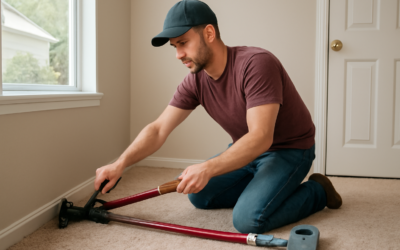
The power stretcher is the heavyweight. It uses a series of extension poles that span the room, bracing against one wall while its toothed head grips and pulls the carpet drum-tight across to the opposite wall. A lever multiplies your force so the carpet stretches evenly and stays that way. For anything wider than about 12 feet, this tool is not optional if you want the job to last. When people talk about professionally stretched carpet, this is the tool doing the work.
The short version: use the power stretcher to tension the whole room, and the knee kicker to fine-tune corners and short walls the big tool can’t reach.
When You Actually Need One
Renting a stretcher makes sense in a few clear situations.
- Fixing ripples and wrinkles: loose carpet that has waved up over time, usually from a poor original stretch or humidity
- New carpet installation: any DIY install of a full room needs proper tensioning
- Carpet pulling from tack strip: edges that have let go and need re-hooking under tension
- After moving heavy furniture: that dragged and bunched a section
If you’ve only got a small ripple in a closet, a knee kicker alone may handle it. Anything spanning a real room calls for the power stretcher.
What Else You’ll Need
The stretcher is the star, but a few supporting tools make the job possible. Gather these before you start so you’re not stopping mid-project.
- Knee kicker for corners and edges the power stretcher can’t reach
- Carpet knife with fresh blades for trimming excess along the walls
- Stair tool or putty knife for tucking trimmed edges under the baseboard
- Replacement tack strip if the existing strip is rusted or the pins are worn ($0.20 per linear foot)
- Pry bar and pliers for lifting carpet off the old strip and pulling it free
- Knee pads because you’ll be on the floor for hours
How to Re-Stretch Carpet Step by Step
Here’s the process for pulling a rippled room tight again. Give yourself an afternoon and take your time.
- Clear the room. Remove all furniture so you have open floor from wall to wall.
- Detach one edge. Using pliers, pull the carpet loose from the tack strip along the wall opposite the ripples. Pull straight up so you don’t tear the backing.
- Set the power stretcher. Brace the padded tail block against the wall where the carpet is still hooked. Extend the poles across the room so the toothed head sits about 6 inches from the opposite wall.
- Sink the teeth. Adjust the head so its pins grab the carpet, not just the pad, then press the lever down. You’ll feel the carpet pull taut across the whole span.
- Hook it down. With the carpet under tension, use the knee kicker to push the stretched edge onto the tack strip, working along the wall. The pins grip and hold the tension.
- Reposition and repeat. Move the stretcher a few feet along the wall and repeat until the entire width is tensioned and hooked. Then rotate and do the other direction so the carpet is stretched on two axes.
- Trim and tuck. Cut off the excess with the carpet knife, leaving enough to tuck cleanly, then press the edge under the baseboard with the stair tool.
Done right, the ripples vanish and the floor feels tight underfoot with no give when you push it with your foot.
Tips and When to Hire Instead
A few things I’ve learned the hard way. Stretch on a warmer day if you can, around 70°F, because carpet fibers relax slightly and hold tension better. Always stretch toward the walls, never toward the room’s center. And overstretch just a hair, since carpet relaxes a bit after you release the tool.
That said, know your limits. If the room has a large seam that needs to be re-joined with a hot iron, if the carpet is a delicate Berber that snags easily, or if the space is so large that renting turns into a two-day ordeal, a pro installer charging $0.50 to $1.50 per square foot may be worth it. But for a straightforward single-room ripple fix, choosing to rent a carpet stretcher and spend an afternoon on it will save you hundreds and leave you with a floor that looks and feels new again.