A loose, wrinkled carpet that develops ripples after a few years is one of the most common and most fixable flooring problems in any home. A carpet kicker rental from a hardware store costs $15 to $35 per day and lets you re-stretch your own carpet in 2 to 4 hours of work — the same job a professional charges $200 to $450 to handle. The challenge is using the tool correctly without damaging the carpet face, the tack strips, or your knee. This guide walks through where to rent, what it costs, and how to use a kicker safely on your own re-stretch project.
Where to Rent a Carpet Kicker
Most major hardware chains and tool rental yards stock knee kickers. Compare daily rates and tool quality before booking:
- Home Depot Tool Rental: $20 for 4 hours, $25 per day, $100 per week. Available at most stores with a tool rental counter.
- Lowes Tool Rental: $15 to $25 per day depending on location. Stock varies by store — call ahead.
- Sunbelt Rentals: $30 to $40 per day for a contractor-grade Roberts kicker. Offers power stretchers as well.
- United Rentals: $35 per day, mostly contractor-focused. Good if you also need a power stretcher.
- Local hardware stores: Often $12 to $18 per day, but inventory limited to one or two units.
For most DIY homeowners, the Home Depot 4-hour rental is the sweet spot. A typical living room re-stretch takes 90 minutes once you know what you are doing.
Knee Kicker vs. Power Stretcher
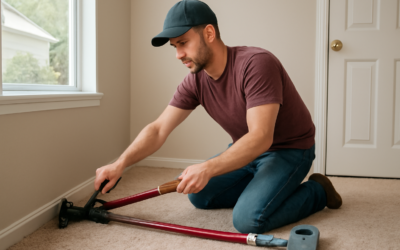
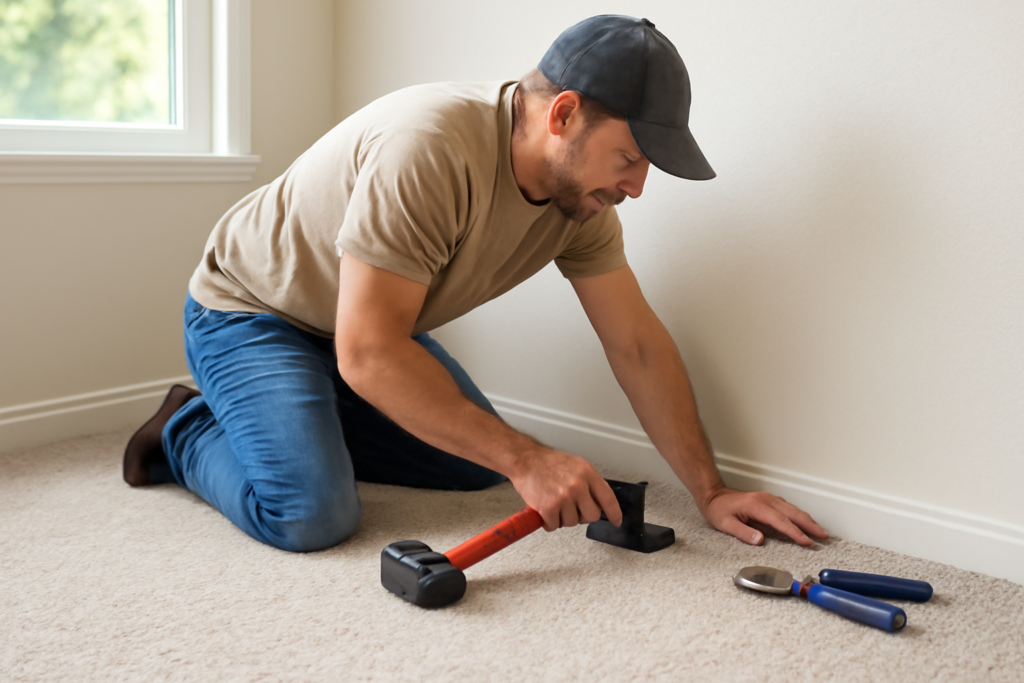
The knee kicker is what most homeowners need. It is a 2-foot tool with a head full of small spikes (called pins) on one end and a padded cushion on the other. You hook the pins into the carpet, pad the other end against your inner knee, and “kick” forward to push the carpet onto the tack strips along the wall.
A power stretcher is a different beast — a pole-and-lever system that braces against one wall and stretches carpet across an entire room in one pass. Pros use power stretchers for new installations because they tension the carpet evenly. For re-stretching existing carpet in a single room, a knee kicker is enough. For re-stretching carpet in a 400+ square foot room, rent both.
What Else You Need Besides the Kicker
The kicker is only one part of the toolkit. Plan to also rent or buy:
- Carpet tucker ($8 to buy): A flat blade for pushing carpet edges down between the wall and tack strip
- Utility knife with hook blades ($15): For trimming excess carpet at the wall
- Stair tool ($12): A wider, flat tool for forcing carpet against the tack strip on stairs
- Knee pads ($20): Essential — kicking with bare knees on a hardwood subfloor will end the project early
- Pliers and a hammer: For repairing or replacing damaged tack strip sections
- Replacement tack strip ($1 per linear foot): If existing strip is rotted or broken
Step-by-Step: How to Use a Knee Kicker
Start by clearing the room completely. Furniture, baseboards (if removable), and any small items off the carpet. Pull up one corner of the carpet near the wall using pliers — gently, since aggressive yanking rips the backing.
Once the carpet is loose along one wall, work the kicker. Set the head of the kicker about 6 inches back from the wall. Push the pins into the carpet face by leaning down on the head — they will sink in about a half inch. Brace the padded end against your inner thigh just above the knee. Drive your knee forward in one firm motion. The carpet will move 1 to 2 inches with each kick. Move the kicker along the wall in 6-inch increments and repeat until that wall is fully re-stretched.
Hook the Carpet Onto the Tack Strips
After kicking the carpet tight against the wall, push it down onto the tack strip with a stair tool or carpet tucker. The carpet should hook firmly onto the angled pins of the strip. Check that the carpet is taut — push down with one hand and you should feel resistance, not slack.
Trim any excess carpet with a hook-blade utility knife. Run the blade along the wall keeping it angled toward the baseboard. Do not pull the carpet up to cut — leave it under tension and slice with the blade resting flat against the wall. After trimming, tuck the cut edge into the gap between the wall and tack strip with the carpet tucker.
Common Mistakes to Avoid
Carpet kicking has a learning curve. The mistakes that wreck projects:
- Kicking with the leg fully extended: Use a short, controlled motion from the inner thigh — full leg kicks do not generate enough force
- Not adjusting the pin depth: Set the kicker dial so pins penetrate the carpet face but not all the way through to the backing
- Stretching only one direction: Pull the carpet diagonally first (corner to corner), then re-stretch perpendicular walls
- Skipping knee pads: A bruise develops by kick #20 and stops the job
- Using on plush or shag carpet: Kickers work best on low-pile and Berber; high-pile carpet may need pin head adjustment
- Hooking weak tack strips: Replace any strip that pulls free from the floor before stretching new carpet onto it
When You Should Call a Pro Instead
A carpet kicker rental is the right call for: single-room ripples, basement carpets that came loose after flooding, and post-pet re-stretches. A pro is the right call when: the carpet has multiple seams that are pulling apart, the room is over 400 square feet, the tack strips are mostly rotted, or the carpet has buckled in three or more directions.
Pros use a power stretcher and have years of experience reading where the slack is. For a complex repair, the $300 to $450 they charge is cheaper than the time and patience cost of trying to figure it out yourself.
How Long the Repair Lasts
A properly re-stretched carpet stays tight for 5 to 8 years on average. The factors that shorten the lifespan: heavy furniture moves, pets that paw at edges, and humidity swings that expand and contract the backing. To extend the lifespan, vacuum in the same direction the carpet was stretched and avoid dragging furniture across the floor.
If your carpet is more than 12 years old and starting to show wear at the seams, factor that into the rent-versus-replace math. Spending $25 on a kicker rental to extend the life of an already-aging carpet by 18 months may not be worth it compared to a fresh installation.