If your carpet has ripples, loose edges, or wrinkles that never seem to go away, the fix almost always involves a carpet knee kicker. This compact tool is what installers use to stretch carpet snug and hook it onto the tack strips around a room’s perimeter. It is simple, affordable, and one of the few specialty tools that makes a DIY carpet job genuinely doable.
A knee kicker will not replace a full power stretcher on a large room, but for closets, small bedrooms, stair landings, and re-stretching loose sections, it earns its keep. Here is how it works and how to use it without bruising yourself.
What a Knee Kicker Is and How It Works
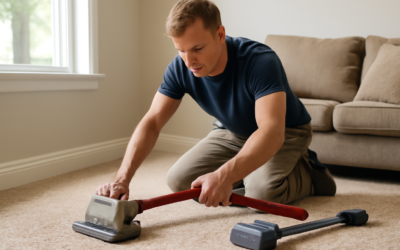
A knee kicker is a short tool, roughly 18 inches long, with two parts: a padded cushion at one end that you strike with your knee, and a head fitted with adjustable gripping teeth at the other. The teeth bite into the carpet pile and backing. When you bump the cushion with your knee, the tool drives forward and stretches the carpet a few inches toward the wall, where you hook it onto the tack strip.
The teeth depth adjusts with a dial. Set them deep enough to grab the backing on thick carpet, but shallow on low-pile or delicate carpet so you do not tear it. Most knee kickers cost $25 to $50 to buy, or a few dollars a day to rent from a home center.
Knee Kicker vs. Power Stretcher
Both tools stretch carpet, but they serve different scales of work:
- Knee kicker: Best for small rooms, edges, corners, closets, and stairs. Powered by your knee, so reach and force are limited.
- Power stretcher: A long, lever-operated tool that braces against one wall and stretches carpet across an entire room. Required for proper installation in any large room to avoid future wrinkling.
Professionals use both together: the power stretcher for the main pulls and the knee kicker to set edges and corners. For a small space, a knee kicker alone is often enough. For anything over about 12 by 12 feet, rent a power stretcher too, or the carpet will likely buckle within a year.
Step-by-Step: Using a Knee Kicker
Stretching carpet is straightforward once the tack strips and pad are in place:
- Set the carpet loosely in the room with excess running up the walls.
- Hook one corner of the carpet onto the tack strip to anchor it.
- Adjust the kicker’s teeth to grip the backing without tearing.
- Place the head about 2 to 3 inches from the wall you are stretching toward.
- Bump the cushion firmly with your knee, not your shin, driving the carpet toward the wall.
- Hold the stretch and tuck the carpet onto the tack strip with a stair tool or putty knife.
- Work along the wall in sections, then move to the adjacent walls.
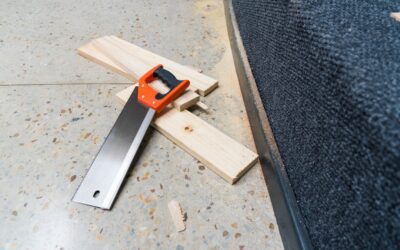
Trim the excess with a carpet knife and tuck the edge into the gap between the tack strip and the baseboard.
Protecting Your Knee and Your Carpet
The name is literal, and so is the bruising if you do it wrong. Strike with the meaty part above the kneecap, never the kneecap itself, and wear a knee pad to cushion the blow. Use a controlled bump rather than a violent slam; consistent pressure stretches better than brute force and saves your joint.
For the carpet’s sake, set the teeth correctly. Too deep and you snag or tear the backing; too shallow and the tool slips without stretching. Test on a hidden corner first and adjust before committing to the main field.
Choosing a Knee Kicker to Buy or Rent
If you decide to own one, look for a few features that separate a usable tool from a frustrating one. A comfortable, well-padded cushion saves your knee over a long session. An adjustable tooth dial with a clear range lets you dial in the bite for different carpet thicknesses. A telescoping or extendable model helps reach across wider sections without crawling.
For occasional use, renting makes more sense than buying. Home centers and equipment yards rent knee kickers, often alongside power stretchers, for a few dollars a day. If you are doing a single room, rent both together so you have the right tool for the field and the edges. Owning pays off only if you re-stretch carpet or install it across multiple rooms or rental units over time.
Whichever you choose, inspect the teeth before starting. Worn, bent, or gummed-up teeth will not grip properly and can damage the carpet. A quick brush to clean them and a check that the adjustment dial moves freely takes a minute and prevents slips mid-stretch.
Setting Up the Room Before You Stretch
A knee kicker only works as well as the prep around it. Before stretching, the tack strips need to be securely nailed around the room’s perimeter, with the angled pins facing the wall so they grip the carpet backing. The carpet pad should be cut and stapled or glued inside the tack strips, not over them, so the carpet hooks cleanly onto the pins.
Lay the carpet loosely with a few inches of excess running up every wall, and let it relax for a bit so it is not fighting you. Starting from a hooked corner gives the kicker something to pull against. Clear the room of furniture and obstacles so you can move freely and apply consistent knee pressure without awkward angles, which is where slips and missed stretches happen.
When to Reach for the Knee Kicker Later
Carpet loosens over time, especially in high-traffic areas and over radiant or seasonal subfloor movement. When ripples appear, you often do not need to replace the carpet, just re-stretch it. A knee kicker, or a knee kicker paired with a rented power stretcher, can pull those wrinkles flat again in an afternoon.
For a single loose edge or a small ripple, the knee kicker handles it solo. For widespread waves across a large room, re-stretch the whole field properly. Either way, a carpet knee kicker is the tool that turns a loose, wrinkled floor back into a smooth, tight one, and at its price it pays for itself the first time you use it.