Wall-to-wall broadloom looks great the day it goes in, but one coffee spill or a rolling chair worn through the pile means ripping up the whole room. That is why commercial spaces switched to modular tiles decades ago, and it is why carpet squares for office use have become the smart choice for home offices too. When one tile gets stained or frayed, you pull it and drop in a spare, no seams to cut and no installer to hire. This guide covers sizes, brands, adhesives, traffic ratings, and cost so you can outfit an office floor that survives real work.
Why Modular Carpet Tiles Win in an Office
An office floor takes concentrated abuse in predictable spots: under the desk chair, along the main walking path, in front of the printer. With broadloom, wear in those zones ruins the whole carpet. With carpet tiles, you swap out only the worn squares, which is why facilities managers have used them for decades. For a home office, that means you can buy a box of extras and keep your floor looking new for years.
Tiles also handle uneven subfloors and around-the-obstacle layouts better than a single giant sheet. You can carry a box of tiles up the stairs to a second-floor office yourself, whereas a roll of broadloom needs two people and a truck. And because tiles come in patterns and colors you can mix, you can lay a subtle checkerboard or a solid field without custom fabrication.
Standard Sizes and How Many You Need
Carpet tiles come in a few standard sizes. The two most common are 18-by-18 inches and 24-by-24 inches, with 24-inch being the commercial standard because it covers ground faster with fewer seams. An 18-inch tile covers 2.25 square feet, and a 24-inch tile covers 4 square feet. Some lines also offer 12-by-36-inch and 25-by-100-centimeter planks for a modern linear look.
To estimate quantity, measure your office in square feet and divide by the coverage per tile, then add 10 percent for cuts along the walls plus a handful of spares for future replacements. A 12-by-12-foot office is 144 square feet, which is 36 of the 24-inch tiles, so buy about 40 to cover waste and keep replacements on hand.
Commercial Brands Worth Knowing
Not all carpet tiles are equal, and the commercial names earn their reputation. Shaw and Mohawk are the two giants of American commercial flooring, both offering durable, stain-resistant office tiles with strong warranties. Milliken makes premium patterned tiles favored in corporate design work. Interface pioneered the modular carpet category and leads on sustainability with recycled backings.
For home offices, FLOR is the consumer-facing brand you will find easiest to buy, sold in stylish sample-friendly tiles that ship to your door, typically $5 to $6 per square foot. The contract lines from Shaw and Mohawk often run cheaper per square foot when bought through a flooring dealer. Buying a commercial-grade tile rather than a bargain residential one is the single best way to guarantee the floor survives chair casters and daily traffic.
Peel-and-Stick, Glue-Down, and Loose Lay
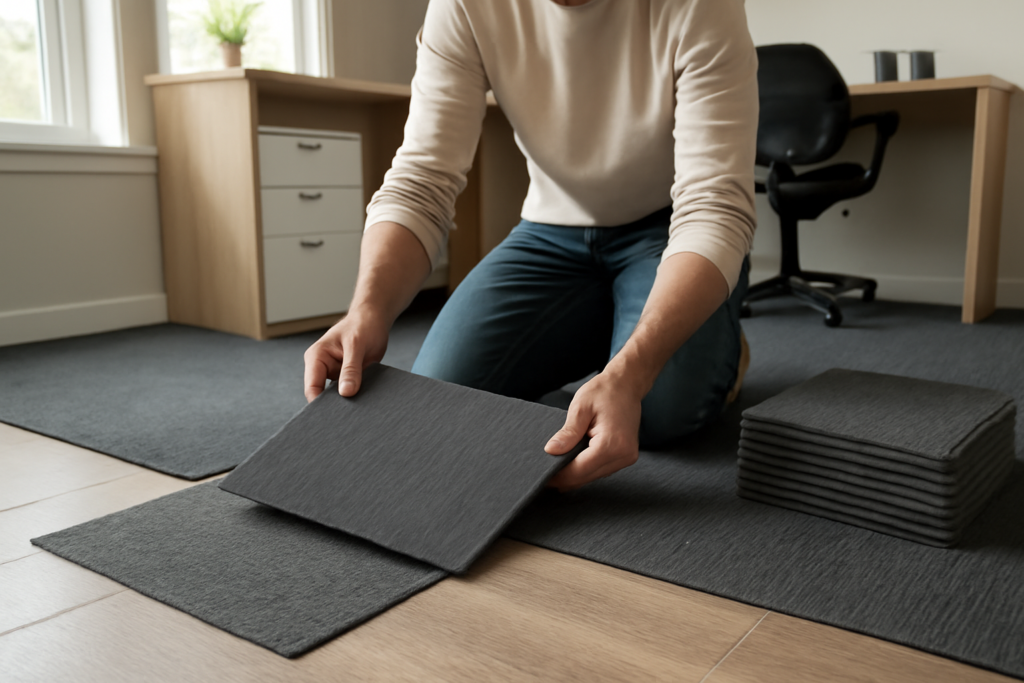
There are three ways to fasten office carpet tiles, and the right one depends on your subfloor and how permanent you want it. Peel-and-stick tiles have adhesive on the back; you pull a release liner and press them down. They are the easiest DIY option and great for a home office over concrete or plywood, though the bond is only as good as how clean and dry the subfloor is.
Glue-down tiles use a separate trowel-applied or spray adhesive, or increasingly a pressure-sensitive release adhesive that holds the tile firmly but still lets you lift it later. This is the commercial standard for high-traffic areas because the tiles will not shift. Loose-lay tiles rely on their heavy backing and interlocking edges or adhesive tabs at the corners, letting you install with almost no mess and lift individual tiles instantly.
Foot-Traffic Ratings and Durability
Commercial carpet tile is rated for traffic, and reading the label saves you a costly mistake. Look for tiles rated for heavy commercial or severe commercial traffic if the office sees daily use, especially under rolling chairs. The face fiber matters too: solution-dyed nylon resists stains and fading far better than polypropylene, and a dense low-pile loop construction stands up to chair casters better than a plush cut pile.
Pile height for an office should be low and dense, around 1/8 to 1/4 inch, because tall plush pile crushes under chairs and traps dirt. A tight loop pile is the classic office choice for exactly this reason. Many commercial tiles also carry a lifetime commercial warranty against wear, edge ravel, and delamination, which tells you the maker expects them to last.
Cost Breakdown
Carpet tiles span a wide price range. Budget peel-and-stick residential tiles start around $1 to $2 per square foot, mid-grade commercial tiles run $2 to $4, and premium designer or patterned tiles from FLOR and Milliken reach $5 to $6 or more. For a typical 150-square-foot home office, materials land somewhere between $200 and $900 depending on grade.
Compare that to broadloom, where you pay for the carpet plus pad plus professional installation, and the DIY-friendly tile often comes out even or cheaper once you factor labor. Because you can install carpet squares for office spaces yourself over a weekend, you skip the installer bill entirely, and the spare-tile replacement model saves you from re-carpeting the whole room down the line.
Cable Management and Installation Tips
One underrated advantage of modular tiles is cable management. Lift a tile and you can run power and data cables underneath, then drop the tile back, which is far cleaner than taping cords along baseboards. Some commercial systems pair with low-profile raceways or access flooring, but even basic tiles let you tuck a cable run under the walking path and lift a tile later if you need to reroute.
When installing, start from the center of the room and work outward so any cut tiles land evenly at the walls, and follow the directional arrows printed on the tile backs, either laying them all the same way for a monolithic look or quarter-turning them to hide seams and traffic patterns. Let the tiles acclimate in the room for 24 hours first, keep the subfloor clean and dry, and cut edge tiles with a sharp utility knife and a straightedge.
Protect the finished floor from the two things that wear an office carpet fastest: chair casters and rolling loads. A hard chair mat or a set of soft rubber casters spreads the load and keeps a single tile from crushing under the desk. Vacuum the traffic lanes weekly with a machine set for low-loop commercial pile, and blot spills quickly rather than scrubbing, since solution-dyed nylon releases most stains with plain water. Done right, carpet squares for office use give you a professional, durable, endlessly repairable floor for a weekend of work.