Carpet tiles solved a real problem for budget-minded homeowners: soft flooring you can install yourself, one square at a time, and replace piece by piece when it stains. But the search for the cheapest carpet tile hides a trap, because the rock-bottom options often mat down or peel within a year. After flooring dozens of basements and offices with carpet squares, I have learned exactly which cheap tiles are worth buying and which are a waste of money.
Part of our Tile & Grout guide — explore the full guide →
Here is how to get the lowest price without ending up with a floor you regret in twelve months.
- What Carpet Tiles Actually Cost
- Peel-and-Stick vs Interlocking vs Glue-Down
- Where to Find the Cheapest Carpet Tiles
- Which Cheap Tiles to Avoid
- Installing Carpet Tiles to Save Even More
- Making Budget Tiles Look Better
- Residential vs Commercial Carpet Tiles
- How Long Cheap Carpet Tiles Last
- The Smart Way to Buy Cheap
What Carpet Tiles Actually Cost
Carpet tiles are sold by the box and priced per square foot, and the range is wide. Knowing the tiers helps you spot a genuine bargain:
- $0.50 to $1 per sq ft: Bottom-tier olefin tiles and big-box clearance lots. Cheapest available, shortest lifespan.
- $1 to $2 per sq ft: Mid-grade residential tiles, often nylon-blend. The best value for most homes.
- $2 to $4 per sq ft: Commercial-grade tiles built for offices and heavy traffic.
A standard tile covers 1 to 4 square feet, so a $0.79 tile measuring 18 by 18 inches works out to roughly $1.40 each. For a 12-by-12-foot room, the cheapest tiles can floor the space for around $75.
Peel-and-Stick vs Interlocking vs Glue-Down
The attachment method affects both price and how long the floor stays put. Peel-and-stick tiles are usually the cheapest and simplest, with adhesive backing you press onto a clean subfloor. Interlocking tiles snap together like puzzle pieces and float over the floor, which is ideal for basements where moisture might lift adhesive. Glue-down tiles cost the least per tile but require buying separate adhesive, adding to the total.
For the cheapest reliable result, peel-and-stick wins on a dry, smooth concrete or plywood floor. In a damp basement, spend slightly more on interlocking tiles that will not lift.
Where to Find the Cheapest Carpet Tiles
Price varies more by retailer than most people realize. The best hunting grounds for budget squares are:
- Flooring liquidators and overstock outlets: Discontinued commercial tiles at $0.50 to $1 per sq ft.
- Big-box clearance aisles: Home Depot and Lowe’s regularly mark down discontinued colors.
- Online marketplaces: Bulk lots of commercial carpet tile, sometimes lightly used, for pennies per square foot.
- Restaurant and office liquidations: Closed businesses offload nearly new tiles cheap.
Commercial-grade tiles sold as clearance are often the best deal of all: built to survive office traffic, marked down simply because the color was discontinued.
Which Cheap Tiles to Avoid
Some bargains cost more in the long run. Avoid pure olefin (polypropylene) tiles for any room with regular traffic, because they crush flat and never recover. Skip tiles with a thin, flimsy backing that curls at the corners. And be wary of unbranded peel-and-stick tiles with weak adhesive, which release at the edges within months in any humidity.
A genuinely cheap tile that survives five years beats a cheaper one you replace twice.
Installing Carpet Tiles to Save Even More
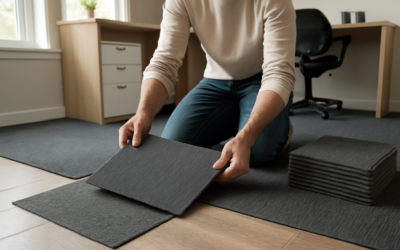
The real savings come from doing it yourself, and carpet tiles are among the easiest flooring to install. You need only a utility knife, a straightedge, a tape measure, and a chalk line. Start by finding the center of the room, snap perpendicular chalk lines, and work outward so cut tiles land symmetrically at the walls.
Most homeowners can lay 150 square feet in two to three hours. Save the trimmed-off pieces; they make perfect replacements for the inevitable stained square down the road.
Making Budget Tiles Look Better
A few tricks elevate cheap carpet tile. Lay tiles in a quarter-turn checkerboard pattern, rotating each tile 90 degrees, to disguise wear and pile direction. Mix two complementary colors for a custom look at no extra cost. Add a contrasting border row around the room’s edge to make a clearance floor look intentional.
These no-cost design moves are what separate a thoughtful budget floor from one that looks like an afterthought.
Residential vs Commercial Carpet Tiles
One of the best-kept secrets in budget flooring is that commercial-grade carpet tiles are often the cheapest durable option, not the most expensive. Because offices and retailers replace flooring on a schedule, huge lots of high-quality commercial tile flood the liquidation market in discontinued colors. These tiles are engineered to survive years of rolling chairs and constant foot traffic, far tougher than residential squares, yet they sell for under a dollar a square foot.
Commercial tiles usually feature a dense, low-loop pile and a stiff bitumen or PVC backing that lies dead flat. The trade-off is that they feel firmer underfoot and come in more muted colors. For a basement, garage gym, or home office, that durability is exactly what you want, and the price is unbeatable.
How Long Cheap Carpet Tiles Last
Lifespan depends almost entirely on fiber and traffic. A bottom-tier olefin tile in a hallway may mat down within a year, while a discontinued commercial nylon tile in a low-traffic office can look fresh after a decade. As a rough guide, budget olefin tiles last 3 to 5 years, mid-grade nylon-blend tiles last 7 to 10 years, and commercial-grade clearance tiles can exceed 12 years.
The replaceable nature of tiles stretches that even further. Because you can swap a single damaged square, a floor’s effective life often outlasts the individual tiles, which is a real advantage over broadloom carpet that must be replaced all at once.
The Smart Way to Buy Cheap
The cheapest carpet tile that actually lasts is usually a discontinued commercial-grade nylon square from a liquidator, snagged for under a dollar per square foot. Pair it with DIY installation and a clever layout pattern, and you get a comfortable, replaceable floor for a fraction of broadloom carpet’s cost. Chase value, not just the lowest sticker price, and your budget floor will still look good long after the bargain bin is empty.
Prefer to explore on your own?
See how new flooring looks in your actual room in seconds — free, no signup.
Try the free Floor Studio →