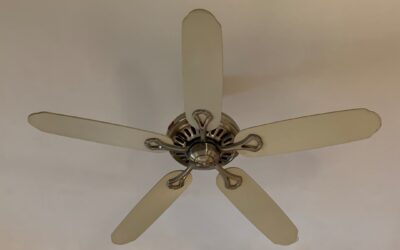
Most people flip a ceiling fan on and never touch the little switch on the motor housing, which means half the year their fan is spinning the wrong way. Running a ceiling fan counterclockwise is what actually cools you in summer, pushing a column of air straight down to create a wind-chill effect on your skin, while reversing it to clockwise in winter quietly recirculates warm air trapped near the ceiling. Getting this one setting right can let you raise the thermostat several degrees and shave real money off your heating and cooling bills.
- Why Counterclockwise Cools You Down
- How to Tell Which Way Your Fan Is Spinning
- Changing the Direction
- The Winter Setting: Clockwise on Low
- Seasonal Direction at a Glance
- Does Fan Direction Really Save Money?
- Troubleshooting a Fan That Feels Weak
- Room-by-Room Direction Tips
- Getting the Most From Your Fan
Why Counterclockwise Cools You Down
Here’s the physics in plain terms. When you stand below a fan and the blades rotate counterclockwise as you look up at them, the angled blades scoop air and force it downward. That moving air sweeps across your skin and accelerates the evaporation of moisture, which is exactly how sweat cools the body. The room temperature doesn’t actually change, but you feel three to four degrees cooler.
The Department of Energy estimates that this wind-chill effect lets you raise your thermostat about 4°F with no loss of comfort. Since air conditioning is one of the biggest summer energy costs, that adjustment can trim cooling expenses by up to 15 percent. The key word is presence: a fan only cools people, not rooms, so there’s no point running it counterclockwise in an empty room. Turn it off when you leave.
How to Tell Which Way Your Fan Is Spinning
Stand directly beneath the fan and look up while it runs on a medium or high speed. If you feel a distinct breeze pushing down on you, it’s turning counterclockwise and set correctly for summer. If you feel little or no downward air, it’s likely spinning clockwise. Another quick test is to watch the leading edge of the blades. In counterclockwise mode, the higher, angled edge leads and the lower edge trails, chopping air downward.
If you can’t tell from the breeze alone, hold a light ribbon or a tissue below the fan. A strong downward pull confirms counterclockwise. Barely any movement means the airflow is being pushed up toward the ceiling instead, which is the winter setting.
Changing the Direction
Reversing a fan takes about thirty seconds. Nearly every standard fan has a small horizontal toggle switch on the side of the motor housing, just below the blades. Always stop the blades completely before touching it, then flip the switch to the opposite position and turn the fan back on.
- Pull-chain and toggle fans — Locate the slide switch on the motor housing, wait for the blades to stop, and flip it. Restart and confirm the airflow direction.
- Remote-controlled fans — Look for a dedicated reverse or direction button on the handheld remote, often marked with a circular arrow.
- Smart and app-controlled fans — Open the fan’s app, such as those from Hunter or Haiku, and toggle the direction setting in the fan’s menu.
If your fan has no switch at all, it may only run in one direction, or the reverse function may be built into a longer press of the wall control. Check the manual, but the vast majority of fans made in the last twenty years have a simple physical toggle.
The Winter Setting: Clockwise on Low
Come cold weather, flip the fan to clockwise and run it on the lowest speed. Warm air naturally rises and pools near the ceiling, sometimes 10 to 15 degrees warmer up there than at floor level. A slow clockwise spin gently pulls cool air up the center of the room and pushes the trapped warm air down along the walls, mixing it back into the living space without creating a chilly draft.
Done right, you’ll feel the difference within minutes, and you can often lower the thermostat a degree or two. The trick is keeping the speed low. Run a fan too fast in winter and you’ll create the same wind-chill breeze that cools you in summer, defeating the entire purpose.
Seasonal Direction at a Glance
Commit this simple rule to memory and you’ll never guess again. In warm months, run the fan counterclockwise at medium to high speed to push cooling air down onto people. In cold months, run it clockwise at low speed to circulate warm air without a draft. A helpful way to remember: counterclockwise for comfort in the cooling season, clockwise when it’s chilly.
Does Fan Direction Really Save Money?
Skeptics often ask whether a spinning fan actually lowers bills or just moves air around. The answer depends entirely on using it with your thermostat, not instead of it. A ceiling fan uses very little electricity, typically 15 to 90 watts depending on size and speed, which is a fraction of the 3,000 or more watts a central air conditioner draws. So running a fan while nudging the thermostat up a few degrees is almost always a net savings.
The math works out favorably in most climates. If raising your summer thermostat setpoint by 4°F cuts cooling runtime by 10 to 15 percent, and your monthly cooling bill is $150, that’s $15 to $22 saved for pennies of fan electricity. The winter benefit is smaller but real: mixing trapped ceiling heat back down lets a furnace cycle less often. The key discipline, again, is turning fans off in empty rooms, because a fan running with no one to feel the breeze is pure waste.
Troubleshooting a Fan That Feels Weak
If your fan is set counterclockwise but the breeze feels feeble, a few things could be wrong. Dust buildup on the blades adds weight and disrupts the airfoil shape, so wipe each blade with a damp cloth every few months. Blades pitched too flat move less air; quality fans use a blade angle of 12 to 15 degrees, and cheap fans with nearly flat blades simply can’t push much air no matter the direction.
Mounting height and room size matter too. A fan crammed against a 12-foot ceiling loses much of its cooling effect by the time air reaches you, which is why a downrod that drops the fan to 8 or 9 feet makes such a difference. And an undersized fan in a large room will disappoint no matter how it spins, so match blade span to square footage before blaming the direction switch.
Room-by-Room Direction Tips
The counterclockwise-for-summer rule holds everywhere, but a few rooms deserve extra thought. In bedrooms, run the fan counterclockwise on medium overnight in summer for a steady cooling breeze, but keep it on the lowest comfortable speed so it doesn’t dry out your eyes or rustle bedding. In a kitchen, where cooking adds heat, a counterclockwise fan helps pull that warmth off you, though keep it clear of open flames and away from gas ranges where a strong downdraft could disturb a burner.
Living rooms and great rooms with tall ceilings benefit most from a downrod-mounted fan set counterclockwise, since the extra drop puts the cooling airflow where people actually sit. On covered porches and patios, a damp-rated fan spinning counterclockwise keeps bugs at bay and makes summer evenings far more pleasant. In every case, the seasonal logic is identical: down-flow to cool in warm months, gentle up-flow to redistribute heat in cold ones.
Getting the Most From Your Fan
Direction is only part of the equation. Mounting height matters too. Blades should hang 8 to 9 feet above the floor and at least 18 inches from any wall for proper air movement. In rooms with ceilings above 9 feet, use a downrod to bring the fan into that ideal zone rather than leaving it hugging the ceiling.
Size the fan to the room as well. A 44-inch fan suits a bedroom up to about 225 square feet, while a great room of 400 square feet or more needs a 52 to 60-inch blade span, or even two fans. Balance the blades if you notice wobble, keep them dusted so they move air efficiently, and pair the fan with a properly set thermostat. Do all of that, keep the counterclockwise setting locked in for summer, and a ceiling fan becomes one of the cheapest comfort upgrades in the house.