
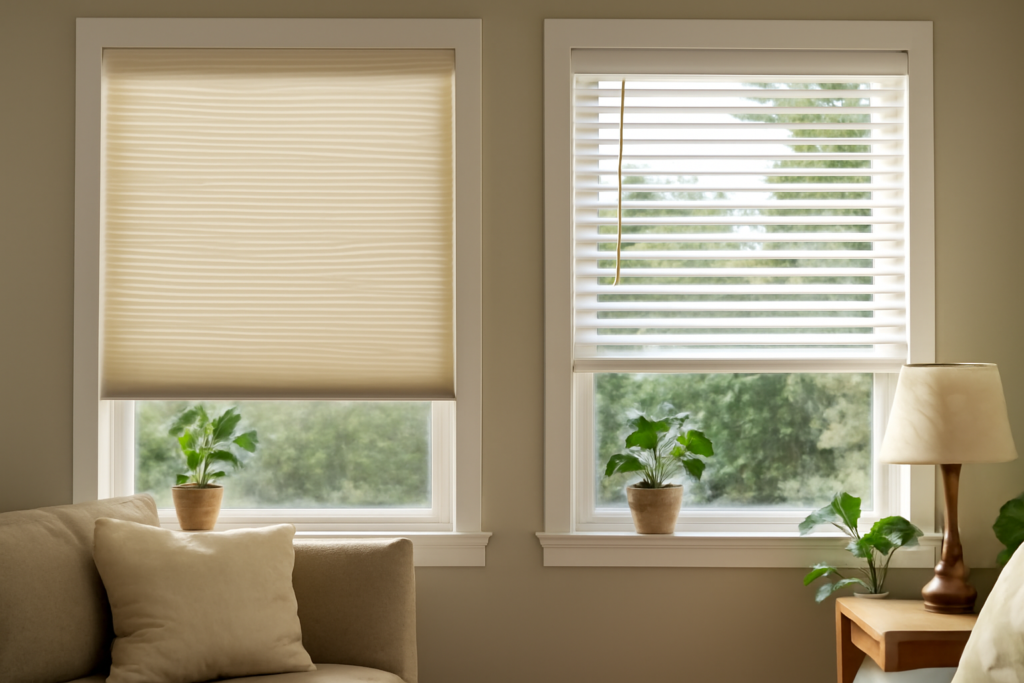
Choosing cellular shades vs blinds comes down to what you want most from a window: energy efficiency and a soft look, or precise light control and a lower price. Cellular (honeycomb) shades trap air to insulate, while blinds use tilting slats you can angle. The cellular shades vs blinds decision differs room by room, so here’s a side-by-side breakdown across the factors that actually matter.
The Quick Answer
Pick cellular shades for bedrooms, energy savings, and a clean modern look. Pick blinds for precise light angling, humid rooms, and a tighter budget. Both cover windows well; they just prioritize different things.
Energy Efficiency and R-Value
This is the clearest win for cellular shades. Their honeycomb cells trap a layer of still air against the window, adding insulation that reduces heat loss in winter and heat gain in summer. A single-cell shade adds roughly R-2 to R-3 at the window, and double-cell blackout versions go higher, meaningfully cutting drafts and HVAC load.
Blinds, by contrast, are slatted and full of gaps, so they provide almost no insulation value. Air passes freely between the slats even when closed. If lowering energy bills at the window is a priority, cellular shades win decisively.
Winner: Cellular shades.
Light Control
Blinds take this category. Because slats tilt, you can angle light precisely, letting in a sliver, bouncing it toward the ceiling, or blocking it entirely while keeping the blind lowered for privacy. That granular control is blinds’ signature strength.
Cellular shades move only up and down; you can’t tilt them. You choose a fabric opacity, from sheer to blackout, and then it’s all-or-nothing between raised and lowered, though top-down-bottom-up models add flexibility by letting light in up high while covering the bottom. For true blackout in a bedroom, cellular blackout fabric beats blinds, which always leak light through the slat gaps and route holes.
Winner: Blinds for daytime angling; cellular shades for blackout.
Price
Blinds are generally cheaper, especially faux wood and aluminum. Expect:
- Faux wood / aluminum blinds: roughly $25 to $70 per standard window.
- Real wood blinds: $50 to $120.
- Cellular shades: $30 to $70 stock, $50 to $160 custom, more for double-cell blackout or motorized.
For a whole house on a budget, basic blinds cost less. Cellular shades cost more but return some of that through energy savings over time.
Winner: Blinds.
Cleaning and Maintenance
Blinds have exposed horizontal slats that collect dust and need wiping slat by slat, which is tedious. In kitchens they can pick up grease. However, hard blinds (faux wood, aluminum, vinyl) tolerate humidity and wipe clean easily, making them the practical pick for bathrooms and kitchens.
Cellular shades have fewer surfaces to dust and are quick to vacuum with a brush attachment, but the fabric cells can trap dust inside and are harder to deep-clean; heavy soiling or moisture can stain or distort them. In a very humid or greasy room, blinds are easier to keep clean.
Winner: Tie, blinds for humid/greasy rooms, cellular for everyday low-dust upkeep.
Look and Style
Cellular shades read soft, clean, and modern, with a seamless fabric face and no hardware clutter. Raised, they stack into a tidy, compact bundle at the top. They suit contemporary and minimalist rooms and soften a space.
Blinds read more structured and traditional, especially wood blinds, which bring warmth and a classic look. Aluminum blinds skew utilitarian. The right style is subjective, but cellular shades generally feel more current while wood blinds feel more timeless.
Winner: Personal preference.
Privacy
Both offer good privacy when closed, but differently. Closed blinds block the view yet leave small gaps between slats. Cellular shades, being solid fabric, give more complete privacy when lowered, and top-down-bottom-up models uniquely let you cover just the lower half so passersby can’t see in while daylight still enters up top, ideal for street-facing rooms.
Winner: Cellular shades, especially top-down-bottom-up.
Durability
Hard blinds are tough; slats can bend but the mechanism lasts for years and stands up to kids, pets, and humidity. Cellular shade fabric is more delicate, a crushed or stained cell is hard to fully restore, though the lift mechanisms are reliable and cordless versions remove the fragile cord entirely.
Winner: Blinds.
Side-by-Side Summary
- Energy efficiency / R-value: Cellular shades.
- Daytime light angling: Blinds.
- Blackout: Cellular shades.
- Price: Blinds.
- Humid/greasy rooms: Blinds.
- Privacy: Cellular shades.
- Modern soft look: Cellular shades.
- Durability: Blinds.
Child and Pet Safety
Corded window coverings are a documented strangulation hazard for young children and pets, and this is worth weighing. Both cellular shades and blinds are widely available in cordless versions, so the safe choice exists in each category. Cordless cellular shades operate by pushing the bottom rail up or pulling it down, with no dangling cord at all, which makes them a popular pick for nurseries. Cordless blinds exist too, but traditional corded blinds are still common and cheaper, so if you buy blinds for a home with kids or pets, specifically choose a cordless or motorized model. On safety, cellular shades have a slight edge simply because cordless is more often the default, but a cordless blind is equally safe.
Room-by-Room Recommendations
- Bedrooms: cellular shades in blackout fabric, for darkness, insulation, and privacy. Add side channels to kill edge light.
- Living rooms: either works; cellular for a soft modern look and energy savings, or wood blinds for warmth and light angling.
- Kitchens: faux wood or aluminum blinds, which wipe clean of grease and shrug off humidity.
- Bathrooms: faux wood blinds or a moisture-tolerant covering; avoid delicate cellular fabric in a steamy room.
- Home offices: blinds for precise glare control on a screen, or top-down-bottom-up cellular shades for privacy with daylight.
- Large or drafty windows: double-cell cellular shades for the best insulation against heat loss.
Lifespan and Value Over Time
Blinds cost less upfront and their hard slats hold up for many years, though slats can bend and the string ladders eventually wear. Cellular shades cost more but return part of that through energy savings, and their cordless mechanisms are reliable, with fabric being the main wear point over a decade. For a rental or a quick refresh, blinds deliver more coverage per dollar. For a home you will keep, where comfort and energy bills matter, cellular shades often justify their higher price across their service life. Neither is disposable when bought in decent quality, so match the spend to how long you plan to keep the window treatment.
Installation and Fit
Both mount the same way and take about 15 minutes per window with a drill and level, using either an inside mount inside the frame or an outside mount on the wall above. The practical difference is frame depth: cellular shades have low-profile headrails that fit shallow frames, while some blinds, especially wood, need more depth to clear the tilt mechanism and stack of raised slats. Measure the flat frame depth before ordering either. Cellular shades also stack into a smaller bundle when raised, clearing more of the glass, whereas raised blinds pile their slats into a thicker stack at the top. For very shallow frames or where maximum clear view matters when open, cellular shades hold a slight edge on fit.
When to Pick Each
- Choose cellular shades if: you want lower energy bills, true bedroom blackout, maximum privacy, and a clean modern look, and you’re spending on rooms where comfort matters.
- Choose blinds if: you want precise light angling, you’re outfitting bathrooms or kitchens, you need durability around kids and pets, or you’re covering many windows on a budget.
Many homes mix both: cellular shades in bedrooms and living rooms for warmth and darkness, faux wood blinds in kitchens and baths for easy cleaning and light control. In the cellular shades vs blinds debate, the best answer is often to use each where it’s strongest rather than picking one for the whole house.


