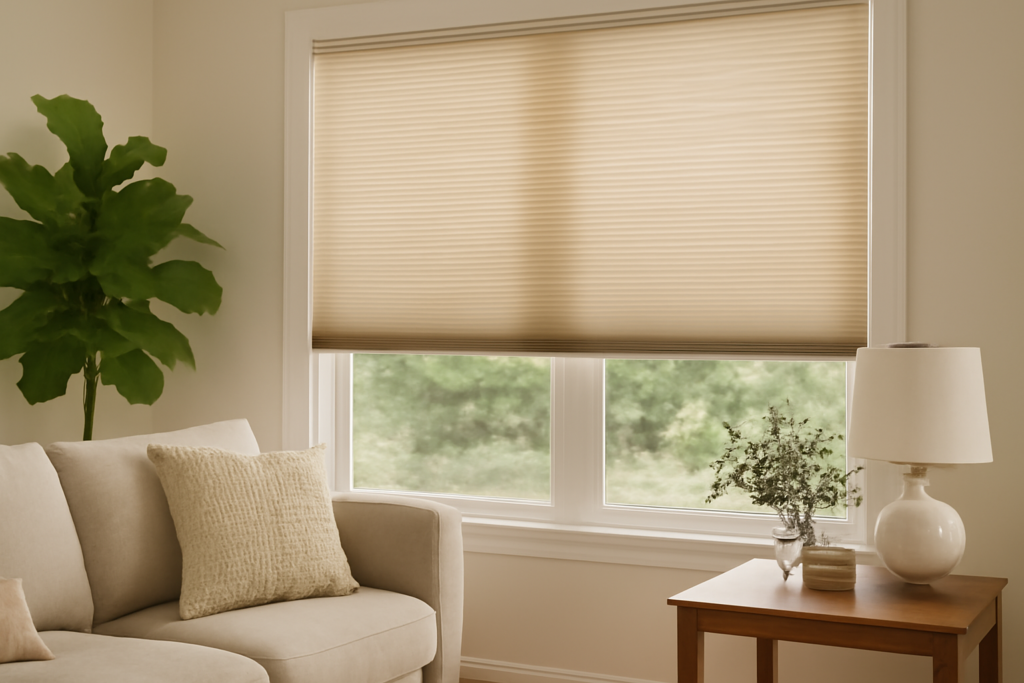
Levolor cellular shades use a honeycomb structure that traps air to insulate windows, cutting heat loss in winter and heat gain in summer. Sold widely at home centers and online, Levolor cellular shades come in single-cell and double-cell versions with a range of opacities and cordless or top-down-bottom-up lift options. This guide explains the cell types, energy performance, sizing, and what you’ll actually pay.
- What Makes Cellular Shades Different
- Single Cell vs Double Cell
- Opacity: Light Filtering vs Blackout
- Energy Performance and R-Value
- Lift Options
- Measuring and Mounting
- Typical Costs
- Installation and Care
- Cell Size: Which to Choose
- Color and Light Glow
- Measuring Frame Depth for Inside Mount
- Levolor vs Other Cellular Brands
- Bottom Line
What Makes Cellular Shades Different
Cellular, or honeycomb, shades are built from pleated fabric that forms hollow cells when viewed from the side. Those cells trap a layer of air against the window, which is the insulating mechanism. Unlike flat roller shades or hard blinds, this air pocket gives cellular shades their signature energy efficiency. Levolor is one of the most recognized brands in the category, sold under its own name and through retailers like Lowe’s.
Single Cell vs Double Cell
The core Levolor choice is how many rows of air pockets the shade has:
- Single cell: one row of honeycomb pockets. Lighter, less bulky when stacked at the top, and less expensive. Good insulation for most rooms and milder climates.
- Double cell: two rows of pockets stacked front to back, trapping more air for higher insulation. Best for very hot or cold climates and large windows where energy loss matters most.
Levolor also offers different cell sizes, roughly ⅜ inch and ¾ inch. Smaller cells suit narrow windows and a tailored look; larger cells cover big windows with fewer pleats and slightly more insulation.
Opacity: Light Filtering vs Blackout
Levolor cellular shades come in several light levels:
- Sheer / light filtering: glows softly, keeps privacy during the day, brightens the room.
- Room darkening: a denser fabric that blocks most light with some edge leakage.
- Blackout: an opaque liner inside the cells that stops nearly all light through the fabric, ideal for bedrooms and media rooms. Blackout cellular shades also insulate the best because the extra liner adds another still-air barrier.
Energy Performance and R-Value
Cellular shades are the most energy-efficient common window covering, and this is Levolor’s main selling point. The trapped-air cells raise the window’s effective insulation, expressed as R-value. A single-cell shade typically adds roughly R-2 to R-3 at the window; a double-cell blackout can push higher. In practical terms, cellular shades can cut heat loss through windows by a meaningful margin in winter and reduce solar heat gain in summer, which trims heating and cooling bills over a season.
For the best energy result, choose double-cell blackout and mount inside the frame with a snug fit, or add side tracks, so warm or cool air can’t slip around the edges. In a cold climate, the difference at a large north-facing window is noticeable to the touch.
Lift Options
Levolor offers several operating styles, and the cord-free ones are both safer and cleaner:
- Cordless: push the bottom rail up or pull it down. No dangling cords, safest around kids and pets, and the standard recommendation.
- Top-down-bottom-up: the shade lowers from the top or raises from the bottom, letting you cover the lower half for privacy while daylight enters up high. Excellent for street-facing rooms.
- Continuous cord loop: for very large or heavy shades, secured with a tension device.
- Motorized: battery or hardwired motor with remote and smart-home control, for tall or numerous windows.
Measuring and Mounting
Levolor sells both stock and made-to-measure cellular shades. For a custom fit:
Inside mount gives the built-in look and best insulation but needs adequate frame depth, generally around 1 to 1.5 inches minimum for shallow-profile headrails. Measure width at top, middle, and bottom and use the narrowest; measure height and use the longest.
Outside mount overlaps the opening for maximum darkening and works on shallow frames. Add 2 to 3 inches of overlap on each side and above.
Levolor’s ordering process applies factory deductions, so provide exact opening dimensions for inside mounts and desired coverage for outside mounts.
Typical Costs
- Stock single-cell light filtering, standard window: roughly $30 to $70 each.
- Custom single-cell: $50 to $110 each depending on size and opacity.
- Double-cell or blackout, custom: $80 to $160 each.
- Top-down-bottom-up upgrade: add $15 to $40.
- Motorized: add $100 to $250 per shade.
Large windows, blackout liners, and motorization drive the price up. Ordering several windows at once often lowers the per-unit cost.
Installation and Care
Installation is quick: mount the brackets level with a drill, snap in the headrail, and test the lift. Most windows take about 15 minutes. For care, dust cellular shades regularly with a vacuum brush attachment or a hair dryer on the cool setting to blow dust out of the cells. Spot-clean fabric with a mild soap and a damp cloth; avoid soaking, which can distort the pleats. If a cell gets crushed, gentle steam can help it recover.
Cell Size: Which to Choose
Beyond single versus double cell, Levolor offers different cell sizes, and the choice affects both looks and function:
- ⅜-inch cells: smaller pockets give a finer, more tailored appearance and stack into a very compact bundle at the top, so they clear more of the glass when raised. Best for smaller and standard windows.
- ¾-inch cells: larger pockets cover big windows with fewer pleats, trap slightly more air for insulation, and read as a cleaner, less busy face on tall windows. Best for large expanses and patio-adjacent windows.
For most homes, ⅜-inch cells on ordinary windows and ¾-inch cells on the largest ones strike the right balance of looks and performance.
Color and Light Glow
Cellular shade fabric color changes the mood of a room more than people expect, because light-filtering fabrics glow with the daylight passing through them. Whites and creams cast a bright, airy glow and make rooms feel larger; deeper tones like gray or taupe filter softer, cozier light. For blackout fabrics, color is mostly aesthetic since no light passes through, though the room-side color still sets the tone. If you want the shades to disappear, match them to the wall or trim color; if you want them as a feature, choose a contrasting shade.
Measuring Frame Depth for Inside Mount
Inside-mount cellular shades give the cleanest built-in look and the best insulation, but they need enough window frame depth for the headrail to sit inside the recess. Levolor’s low-profile headrails fit shallow frames better than bulky blinds, often needing only about an inch of flat depth for a flush mount, with less for a partial mount. Measure the flat, unobstructed depth from the front of the frame to any crank, lock, or glass before ordering. If the frame is too shallow, switch to an outside mount, which also improves darkening by overlapping the opening. Always measure width at the top, middle, and bottom, and use the narrowest, because window openings are rarely perfectly square.
Levolor vs Other Cellular Brands
Levolor is one of several cellular shade brands, and knowing where it sits helps you shop. Levolor is widely available through home centers and online, offers a broad range of stock and custom options at mid-market prices, and is easy to order and replace. Premium brands like Hunter Douglas Duette cost more and offer more specialty operating systems and designer fabrics, while budget online-only brands undercut Levolor on price but with fewer showroom options and less consistent support. For most homeowners, Levolor hits the sweet spot: better quality and selection than bargain brands, at a fraction of the premium-brand price. If you want top-tier motorization or unusual specialty shapes, compare against Hunter Douglas; for everyday windows and solid value, Levolor is hard to beat.
Bottom Line
Levolor cellular shades are the go-to when energy efficiency and a clean, soft look matter more than an outside view. Pick double-cell blackout for the best insulation and darkening, single-cell light filtering for everyday rooms, and cordless or top-down lift for safety and flexible privacy. Budget $30 to $70 for stock and $50 to $160 for custom, mount inside the frame with a snug fit, and you’ll feel the draft difference at the window all winter.