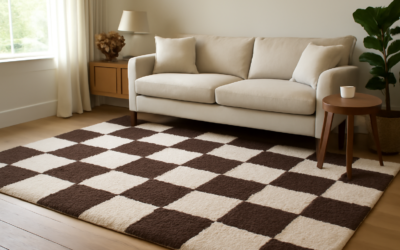
Diners, 1950s kitchens, and luxury bathrooms have one thing in common, and it sits underfoot in a grid of contrasting squares. Checkerboard laminate flooring brings that look home for a fraction of what ceramic, marble, or VCT would cost, but the install has quirks that catch first-time buyers off guard. Get the tile size and pattern alignment right and the room reads like a magazine spread. Get them wrong and the eye picks up every misaligned seam from across the kitchen.
- Why the Checkerboard Look Is Back
- Tile Sizes That Read as Checkerboard
- AC Ratings and Wear Layers for Kitchen Service
- The Pattern Layout Decision
- Installation Method and Subfloor Prep
- Pros of the Checkerboard Format
- Cons to Plan Around
- Pricing for a Typical Kitchen Build
- Brand Picks That Hold Up
- Is the Look Right for Your Room
Why the Checkerboard Look Is Back
Designers cycled away from busy patterns through the gray-plank decade, but the pendulum has swung. Black-and-white checkerboards, off-white and warm taupe pairings, and high-contrast wood-plus-stone combinations are all running heavy in 2026 mood boards. Laminate is taking the largest share of installs because click-lock tile-format planks now look convincing enough at three feet that homeowners stop asking for porcelain.
Tile Sizes That Read as Checkerboard
True checkerboard reads strongest at 12 by 12 inch squares. Most laminate manufacturers sell tile-format planks at 16 by 16 inches or 12 by 24 inches because the bigger format hides micro-misalignment. For an authentic retro look, stick with 12 by 12. For a softer modern grid, jump to 16 by 16. Anything larger than 18 inches loses the checkerboard rhythm and starts to read as a contrasting field rather than a pattern.
Pergo TimberCraft Tile, Mohawk RevWood Plus in tile format, and Mannington Adura Max all offer 16 by 16 inch options in matte black and bright white that work for the look. Expect $3.49 to $5.99 per sq ft on the plank.
AC Ratings and Wear Layers for Kitchen Service
A black-and-white kitchen floor shows every scratch, smudge, and dropped tomato. The wear layer needs to earn its keep. Specify AC4 minimum for residential kitchens with dogs, kids, or both. AC5 is justified for entryways and mudrooms that connect through. Wear-layer thickness on laminate is measured by abrasion resistance rather than mil, but premium tile-format products like Mohawk RevWood Plus Reveille hit 6,500 revolutions on the Taber test, which is roughly double the typical AC3 cabin-grade laminate at $1.79 per sq ft.
The Pattern Layout Decision
Three layouts dominate, and each changes the visual energy of the room.
Straight grid runs squares parallel to the walls. This is the diner look. Easy to install, easy to read, no waste. Use this for galley kitchens and bathrooms where the room is already a clean rectangle.
Diagonal grid rotates the squares 45 degrees so they read as diamonds. The pattern enlarges a small room visually but adds 10 to 15 percent material waste from corner cuts. Plan the math before ordering.
Offset checkerboard staggers every other row by half a tile, breaking the grid into something closer to a brick pattern. The visual is softer and works in transitional spaces between modern and traditional.
Installation Method and Subfloor Prep
Tile-format laminate uses the same click-lock floating install as plank laminate. Lay the included or upgraded foam underlayment, leave a 3/8 inch expansion gap at the perimeter, and start the first row off a chalked centerline rather than the wall. Centerlines are critical for checkerboard because the eye will track the seam down the middle of the room. A wall-started layout often ends with a sliver tile against the opposite wall, which kills the pattern.
Subfloor flatness must hit 3/16 inch over 10 feet. Tile-format laminate is less forgiving than plank because every joint sits in two directions. A dip will telegraph as a rocking tile that clicks underfoot for the life of the floor.
Pros of the Checkerboard Format
- Installs in a day or two on a 300 sq ft kitchen
- Repair-friendly: pull and replace a single tile rather than a long plank run
- One-third the cost of equivalent porcelain or marble checkerboard
- Warmer underfoot than ceramic, no grout to seal
- Bevels on all four sides give the joint a tile-look line without grout maintenance
Cons to Plan Around
Sound carries. Hard-soled shoes on tile-format laminate over a slab amplify the click. Upgrade the foam underlayment to a 3 mm cork or rubber pad if the room sits over a finished basement.
Moisture is the other concern. Laminate cores are HDF particleboard that swells on contact with standing water. A kitchen dishwasher leak that sits overnight will bubble the joints. Specify a water-resistant core like Pergo WetProtect or Mohawk RevWood Premier if you want a 24-hour spill warranty.
The high-contrast color pairing also shows pet hair and crumbs. Plan to vacuum daily on a black-and-white floor if you keep a shedding dog.
Pricing for a Typical Kitchen Build
- 300 sq ft straight grid, mid-tier laminate at $4.49 per sq ft: $1,350 materials
- Foam underlayment upgrade to cork: $0.65 per sq ft, $195
- Professional install at $2.75 per sq ft: $825
- Trim, transitions, expansion molding: $180
- Total turnkey: $2,550
Compare that to porcelain checkerboard at $11 to $16 per sq ft installed and the laminate route saves $1,800 to $3,000 on the same room.
Brand Picks That Hold Up
Pergo TimberCraft Tile in Calacatta White and Charcoal Slate pair cleanly for a marble-look retro grid. Mohawk RevWood Plus Reveille offers a softer eggshell white and warm gray combo for transitional kitchens. Mannington Restoration Collection runs a wider 18 by 18 format with cathedral-edge bevels that hide misalignment better than tight square-edge SKUs.
Is the Look Right for Your Room
Checkerboard laminate flooring rewards rooms with strong architectural lines, simple cabinetry, and good natural light. Drop it into a busy kitchen with patterned countertops and ornate cabinet doors and the floor will fight everything else for attention. Use it where it can be the star, plan the centerline before the first plank goes down, and the pattern will hold up for 20-plus years on a quality AC4 wear surface.
Prefer to explore on your own?
See how new flooring looks in your actual room in seconds — free, no signup.
Try the free Floor Studio →