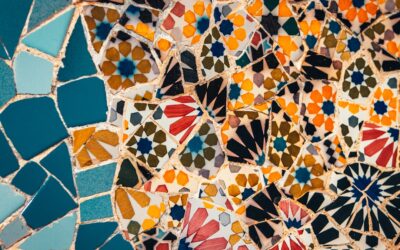
Bright pattern tile has come back hard in the last five years, driven by encaustic-look porcelain, hand-glazed ceramic, and Moroccan-inspired cement collections. The trick is picking colorful floor tile that still looks intentional in ten years — not regretful in eighteen months. Material science, pattern scale, and grout color all matter as much as the hue you fall in love with on the showroom rack.
Part of our Tile & Grout guide — explore the full guide →
- The Four Main Material Categories
- Why Porcelain Wins for Most Floor Applications
- When to Choose Cement (Encaustic) Tile
- Pattern Scale and Room Size
- Brand Spotlight: Bedrosians Cloe and Daltile Reveille
- DCOF Slip Rating and Where Pattern Tile Belongs
- Grout Strategy for Pattern Tile
- Installation Quality Matters More Here
The Four Main Material Categories
Colorful tile breaks down into four meaningful product families, each with different costs, durability, and care needs.
- Pattern porcelain: Inkjet-printed designs on through-body porcelain. Most durable and lowest maintenance. $4 to $9 per sq ft.
- Hand-glazed ceramic: Variations in glaze pooling and color depth give craft-look character. $5 to $12 per sq ft.
- Cement and encaustic tile: Pigment cast through the body of the tile, hand-pressed in Morocco, Mexico, or Portugal. Premium look, needs sealing. $8 to $25 per sq ft.
- Glass mosaic and accent tile: Used for small areas like rugs-within-floors or border accents. $10 to $40 per sq ft.
Why Porcelain Wins for Most Floor Applications
For floors that take real traffic, pattern porcelain is usually the smartest pick. The pattern is digitally printed and then fused under the same glaze that protects solid-color porcelain — meaning no fading, no sealing, and PEI 3 or 4 durability ratings that hold up to kids, dogs, and dragging chairs.
Brands like Daltile (Reveille and Memoir lines), Marazzi (D_Segni Blend), and Bedrosians (Cloe and Casablanca) print Spanish and Italian patterns onto 8×8 and 12×12 porcelain at $4.50 to $7.99 per sq ft. The visuals are nearly indistinguishable from genuine cement tile at a quarter of the maintenance burden.
When to Choose Cement (Encaustic) Tile
Real cement tile has a depth and softness no printed product matches. Bert & May, Granada Tile, and Cement Tile Shop produce authentic hand-pressed encaustic tile starting around $12 per sq ft and climbing past $25 for custom colorways. They feel slightly rough underfoot — the pigment is mineral, not glazed — and reward proper sealing.
Plan on penetrating-sealer treatment (Miracle Sealants 511 Impregnator or Aqua Mix Sealer’s Choice Gold) immediately after install and reseal every 12 to 18 months in wet areas. Use a pH-neutral cleaner exclusively; acidic cleaners etch the cement matrix and dull pigment within months.
Pattern Scale and Room Size
Pattern scale is the most common design mistake. A bold 12×12 hexagon that looks stunning in a showroom can overwhelm a 5×7 powder room and disappear in a 14×18 kitchen. Two rules of thumb help: in rooms under 50 sq ft, choose patterns with 4-6 inch repeats; in rooms over 200 sq ft, use 10-inch-plus repeats so the design reads from across the space.
For pattern continuity, order from a single dye lot. Cement and hand-glazed ceramic vary noticeably from production batch to batch — 8-12 percent variation is normal and intentional, but you want that variation distributed within one job, not split across two batches.
Brand Spotlight: Bedrosians Cloe and Daltile Reveille
Bedrosians’ Cloe line is the current go-to for hand-glazed ceramic in real ranges of blue, green, and terracotta. The 2.5×8 subway shape and 5×5 square format both work as floors in low-traffic areas (entryways, powder rooms, mudrooms). Pricing runs $5.49 to $8.49 per sq ft.
Daltile Reveille brings encaustic-look porcelain in 8×8 format at $4.79 to $6.29 per sq ft. Twenty-plus pattern variations are printed onto the same body, allowing for both single-pattern installs and mixed-pattern “rugs” within a larger plain field. For pure design value at scale, it is the strongest current player.
DCOF Slip Rating and Where Pattern Tile Belongs
Floor tile needs a DCOF (dynamic coefficient of friction) rating of 0.42 or higher per ANSI A137.1 standards. Many decorative pattern tiles — especially polished or high-gloss cement — fall below this. Check the spec sheet before committing to any floor application, particularly bathrooms, kitchens, and entryways where wet conditions create slip risk.
Matte and honed finishes typically rate higher than polished. If you love a polished pattern, use it on a feature wall or backsplash rather than the floor, and pair it with a matte coordinating tile for the walkable surface.
Grout Strategy for Pattern Tile
Grout color makes or breaks the look. Three approaches work well:
- Matching grout: Pick a grout color from one of the dominant tones in the pattern. Creates a seamless field where the pattern reads as continuous.
- Contrasting grout: Dark grout against a light pattern emphasizes individual tile geometry. Modern, graphic look.
- Neutral mid-tone: A warm gray or sand-colored grout disappears against most patterns. Safest choice for indecision.
For pattern tile, epoxy grout (Laticrete SpectraLOCK Pro, Mapei Kerapoxy CQ) is worth the upcharge. It will not stain, never needs sealing, and protects expensive pattern tiles for decades. Budget $0.75 to $1.25 per sq ft more than cement grout.
Installation Quality Matters More Here
Pattern tile is unforgiving of lippage and alignment errors. Hire a CTEF Certified Tile Installer with documented pattern-tile experience. Ask to see photos of completed pattern jobs — particularly Moroccan and encaustic installs where rotation alignment matters.
Expect to pay $1 to $2 per sq ft more than plain-tile install rates, plus the cost of crack-isolation membrane (Schluter Ditra, Laticrete Strata Mat) under any cement or hand-pressed tile. Done right, a pattern floor becomes the design centerpiece of a room — for decades, not seasons.
Prefer to explore on your own?
See how new flooring looks in your actual room in seconds — free, no signup.
Try the free Floor Studio →