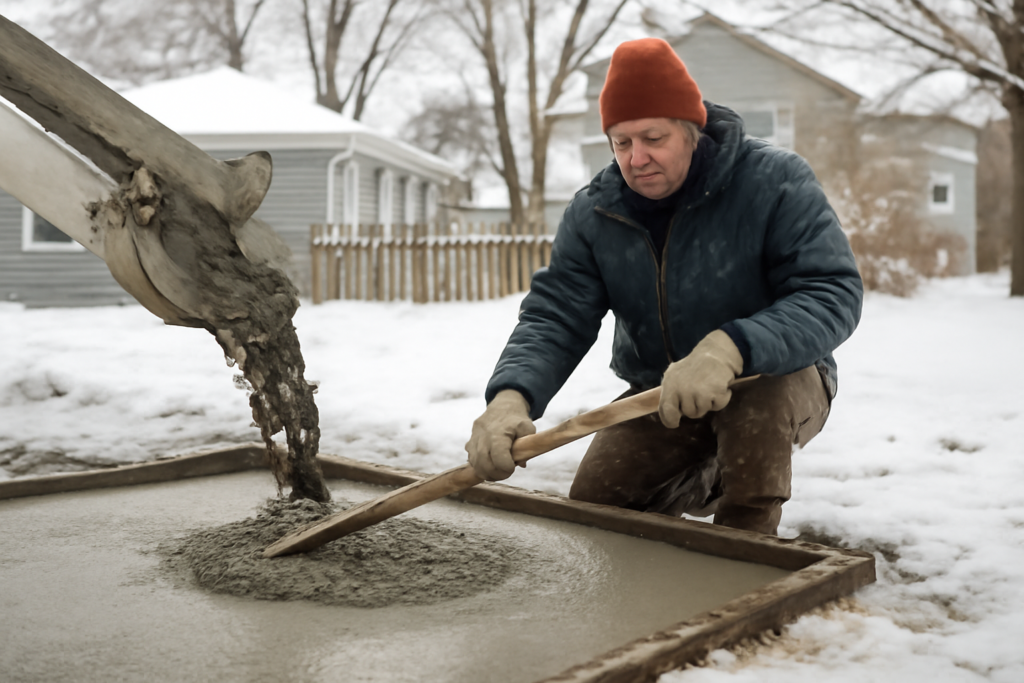
Concrete does not care that you are cold; it cares that it stays warm enough to cure. Pour a slab in concrete cold weather without the right precautions and the water inside can freeze before the mix gains strength, leaving you with a crumbling, weak surface that fails within a season. The chemistry of curing depends entirely on temperature, and once you understand that, working in the cold becomes a matter of planning rather than luck. Here is how to do it right.
Why Cold Weather Threatens Fresh Concrete
Concrete hardens through hydration, a chemical reaction between cement and water that generates its own heat and builds strength over days. That reaction slows dramatically as temperatures drop and nearly stalls below 40°F. The danger zone is freezing: if the water in fresh concrete turns to ice before the mix reaches about 500 psi, the expanding ice ruptures the internal structure permanently.
The industry defines cold-weather concreting as any stretch when the air temperature falls below 40°F for more than half of any 24-hour period. Once you cross that line, the standard timelines and methods all need adjustment.
The 40-Degree Rule and Planning the Pour
Aim to keep the concrete itself above 50°F for the first several days, the window when it gains most of its early strength. Check the extended forecast and avoid pouring if a hard freeze is expected within the first 24 to 48 hours, the most vulnerable period.
Timing the pour for late morning gives the mix the warmest part of the day to begin curing before the overnight drop. Never pour onto frozen ground; a frozen subgrade will thaw unevenly later, settle, and crack the slab. Thaw and protect the base first using insulated blankets or heated enclosures.
Adjusting the Mix
Your ready-mix supplier can tune the batch for cold conditions, and it is worth the conversation when you place the order.
- Accelerating admixtures: calcium chloride or non-chloride accelerators speed early strength gain. Use non-chloride near rebar to avoid corrosion.
- Hot water: the plant can heat the mixing water to raise the concrete’s delivery temperature.
- Higher cement content: a richer mix generates more hydration heat.
- Lower water-cement ratio: less free water means less to freeze and faster strength gain.
Air-entrained concrete is also standard in freeze-thaw climates because the microscopic air bubbles give expanding ice somewhere to go, dramatically improving the cured slab’s durability through future winters.
Protecting and Curing in the Cold
After finishing, the job is to trap the heat the concrete generates and keep it from freezing. Insulating concrete blankets are the workhorse here, laid directly over the slab to hold curing temperatures above 50°F even when air drops into the 20s. For larger or colder jobs, build a temporary enclosure with poly sheeting and run an indirect-fired heater inside.
Straw covered with plastic offers a cheaper insulation layer for flatwork, though blankets are more reliable. Whatever you use, leave the protection in place for at least 3 to 7 days, and longer if temperatures stay deep. Removing it too soon while the slab is still warm can thermal-shock and crack the surface, so let it cool gradually.
Common Cold-Weather Mistakes
The most expensive error is adding extra water to a stiff, cold mix to make it easier to work. That extra water weakens the concrete and gives ice more to expand. Instead, keep the mix as designed and use proper finishing tools.
Another frequent slip is troweling too early. Cold concrete bleeds water more slowly, so the surface stays wet longer; working it before the bleed water is gone traps moisture and causes scaling. Wait for the sheen to disappear before final finishing, even if it takes noticeably longer than a summer pour.
Ground Temperature and Subgrade Prep
Air temperature gets all the attention, but the ground you pour onto matters just as much. Concrete placed on frozen subgrade is a guaranteed failure, because the frozen layer thaws and settles unevenly weeks later, cracking the slab from below. Before any winter pour, the subgrade must be thawed and free of ice, frost, and snow.
On a cold but above-freezing day you can simply clear and inspect the base, but in deep cold you may need insulated blankets laid over the ground beforehand, or a ground-thawing heater for larger jobs. Pour as soon as the base is ready so it does not refreeze, and never place concrete on a surface with visible frost heave. Getting the subgrade right is half the battle in winter concreting.
Strength Testing Before You Build On It
In cold weather, the calendar lies about strength. A slab that would be ready to walk on after a day in summer may need several days in winter to reach the same point, because the slower hydration delays strength gain. Do not load, build on, or remove forms based on time alone.
For critical structural work, contractors place test cylinders cured alongside the slab and break them in a lab to confirm the concrete has hit its target PSI. For a homeowner driveway, a more practical rule is to wait longer than you think and keep the protection on; light foot traffic can usually wait 24 to 48 hours under blankets, but vehicle traffic should hold off a full week or more in cold conditions. Patience here prevents cracking the slab before it has earned its strength.
When to Wait for Spring
Sometimes the smart move is patience. If overnight lows will stay in the teens or below for the next week and you cannot reliably heat an enclosure, postponing avoids a costly failure. A driveway or footing poured wrong in January often has to be demolished and redone.
For homeowners hiring out the work, confirm the contractor has a written cold-weather protection plan before any winter pour. Done correctly, concrete cold weather placement produces a slab every bit as strong as a summer pour; done carelessly, it produces an expensive lesson you will be chipping out come spring.