Pour concrete on the wrong day and you can lose 30 percent of its compressive strength before it even has a chance to cure. The right temperature to pour concrete is between 50 degrees F and 60 degrees F at the time of placement, with five days of similar conditions following the pour. Real-world projects rarely line up that neatly with the weather, so understanding how to adjust mix design, scheduling, and protection at each end of the temperature range is what separates a 50-year slab from a cracked, dusty patio in five.
Why Temperature Matters So Much
Concrete strength comes from a chemical reaction called hydration, where water reacts with cement particles. Hydration speeds up in warm weather and slows down in cold. Both extremes cause problems.
Below 40 degrees F, hydration nearly stops. Below 32 degrees F, the water in fresh concrete freezes, expanding and disrupting the matrix permanently. Above 90 degrees F, hydration runs too fast — the concrete sets before you can finish it, water evaporates from the surface, and shrinkage cracks form within hours of the pour.
The Ideal Temperature Window
Most ready-mix suppliers and ACI (American Concrete Institute) guidelines agree on this range:
- 50 to 60 degrees F — ideal placement temperature, slow predictable cure
- 40 to 50 degrees F — acceptable with normal mix and minor protection
- 60 to 80 degrees F — workable but watch evaporation rate closely
- Above 80 degrees F — hot weather concreting protocols required
- Below 40 degrees F — cold weather concreting protocols required
The sweet spot for most homeowner projects is spring (April to May) or fall (September to October) in temperate climates. Summer pours work if scheduled for early morning. Winter pours are possible but require additives and protective coverings.
Pouring Concrete in Hot Weather
Hot weather is harder on concrete than cold in many ways because the damage happens fast and silently. Above 80 degrees F, concrete sets too quickly to finish properly, and rapid surface evaporation causes plastic shrinkage cracks before the slab is even hard enough to walk on.
To pour successfully in hot weather:
- Schedule for the coolest part of the day — start before 6 a.m. in mid-summer.
- Wet the subgrade and forms to prevent them from sucking moisture out of the mix.
- Add a retarder admixture to the mix at the plant. This buys you 30 to 60 extra minutes of working time.
- Use ice in the mix water to lower concrete temperature. The supplier handles this when you specify hot weather conditions.
- Mist the surface immediately after screeding, or apply an evaporation retarder spray like Conspec Aqua-Film.
- Cover the slab with wet burlap or curing blankets within 4 hours of placement.
Pouring Concrete in Cold Weather
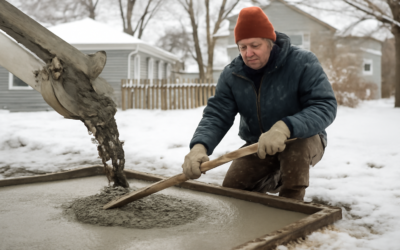
ACI 306 defines cold weather concreting as three consecutive days where the average daily temperature is below 40 degrees F or the air temperature stays under 50 degrees F for more than half of any 24 hour period. When that hits, you need additional steps to keep hydration going.
Successful cold weather pours rely on:
- Heated mix water — most plants offer hot water mixes when temperatures drop, increasing the concrete temperature 10 to 15 degrees F at delivery.
- Calcium chloride accelerator — added at the plant at 1 to 2 percent of cement weight, doubles the early strength gain.
- Higher cement content — a richer mix generates more heat from hydration. Specify a 4,000 PSI mix instead of 3,000 even for residential slabs.
- Insulating blankets — Polar curing blankets keep slab temperature above 50 degrees F for the first 72 hours.
- Heated enclosures — for foundation walls and large pours, build a tent with propane heaters.
Never pour on frozen ground. The earth will thaw under the concrete, settle, and crack the slab. Strip the topsoil, install a base of compacted gravel, and warm the subgrade with insulating blankets overnight before placing concrete.
How to Read the Forecast Before Pouring
Look at the 7 day forecast, not just the day of the pour. Concrete needs at least 5 days of curing above 50 degrees F to reach 70 percent of design strength. A warm pour day followed by a hard freeze can ruin a slab.
Key forecast checks:
- Daytime high and overnight low for the next 7 days
- Wind speed — winds above 10 mph dramatically increase evaporation
- Relative humidity — below 30 percent humidity, plan for surface protection
- Precipitation — rain in the first 8 hours after pouring damages the surface finish
- Direct sun exposure on the slab
Concrete Mix Adjustments by Temperature
Most ready-mix companies adjust their formulas automatically when you specify pour conditions. But it pays to know what is being added and why.
- Hot weather mix: retarder, fly ash replacement (15 to 25 percent of cement), lower water content
- Cold weather mix: Type III cement (high early strength), calcium chloride or non-chloride accelerator, hot water
- Wet weather mix: air entrainment for freeze-thaw resistance, water reducers to maintain workability without adding water
Curing After the Pour
Pouring is only half the battle. Concrete needs to stay moist and within an acceptable temperature range for at least 7 days to reach proper strength. Plain water curing, plastic sheeting, curing blankets, or chemical curing compounds all work — pick one and apply it within 4 hours of finishing.
For driveways and patios in moderate weather, a sprayed curing compound like Sealtight CS-309 from W.R. Meadows runs about $80 per 5 gallon pail and covers 1,000 sq ft. It seals in moisture and skips the need to drag a wet sheet around for a week.
Frequently Asked Questions
What is the coldest temperature you can pour concrete?
Concrete can be poured down to 20 degrees F with proper precautions — heated mix water, accelerators, and insulating blankets. Below 20 degrees F, professional contractors generally postpone unless heated enclosures are available.
What is the hottest temperature you can pour concrete?
Pours up to 100 degrees F are possible with retarders, ice in the mix, early morning scheduling, and aggressive surface protection. Above 100 degrees F, ACI guidelines recommend postponing.
How long does concrete take to cure in cold weather?
At 50 degrees F, concrete takes about 28 days to reach full design strength. At 40 degrees F, it can take 60 days. Below freezing without protection, hydration stops entirely until temperatures rise.
Can it rain after I pour concrete?
Light rain after the surface is hard (typically 8 to 12 hours) is harmless and even helpful for curing. Hard rain in the first 4 hours can wash out the surface and ruin the finish. Cover with plastic if rain threatens.