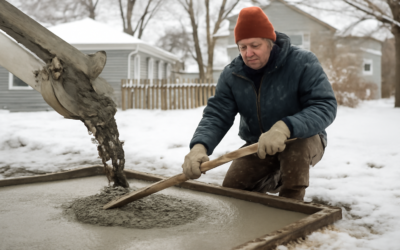
The American Concrete Institute defines cold weather concreting as any condition where the average daily temperature falls below 40°F for three consecutive days. Cross that line and the hydration reaction inside the slab slows dramatically, then stops entirely below 14°F. Pouring concrete in freezing weather is absolutely possible, contractors do it all winter long across the northern US and Canada, but it requires specific mix designs, heated water, and a managed curing environment for at least the first 72 hours. Skip any of those steps and the result is a slab that looks fine on day one and crumbles or cracks within a year.
Why Cold Concrete Fails
Concrete gains strength through hydration, a chemical reaction between Portland cement and water. The reaction is exothermic, meaning it generates its own heat, but it needs an internal temperature of at least 50°F to proceed at a usable rate. Below that, the reaction slows by half for every 18°F drop.
If the water inside the mix freezes before the concrete reaches 500 psi compressive strength (roughly 24 to 48 hours into cure under normal conditions), the expanding ice ruptures the cement matrix permanently. The slab might look uniform, but the internal structure is shattered at a microscopic level and the final strength will be 30 to 50 percent below specification.
The Temperature Thresholds That Matter
Three temperature numbers control every cold-weather pour decision. The air temperature at placement, the temperature of the concrete itself when delivered, and the lowest temperature the slab will experience during the first three days of cure.
- Air temp at pour: Minimum 25°F with active heating planned
- Concrete temp at delivery: Minimum 55°F for thin slabs, 50°F for mass pours
- Surface temp of subgrade: Above 32°F, no frost in soil
- Curing temperature: Maintain above 50°F for first 72 hours minimum
- Acceptable strength milestone: Reach 500 psi before allowing freezing
The ready-mix plant takes care of the delivery temperature by heating the mix water and sometimes the aggregate. Your job as the homeowner or contractor is to confirm the air and subgrade temperatures and to maintain the curing environment after placement.
Modify the Mix for the Season
Ready-mix plants offer winter mix designs that hydrate faster and tolerate the cold better. The standard adjustments include Type III high-early Portland cement, which gains strength roughly twice as fast as standard Type I, and chemical accelerators like calcium chloride at 1 to 2 percent of cement weight.
Non-chloride accelerators like Sika Plastocrete 161 FL or BASF Pozzolith NCA cost slightly more but are mandatory for any pour with embedded steel like rebar, post-tension cables, or anchor bolts. Calcium chloride accelerates corrosion of reinforcing steel and shortens slab life by decades when used in reinforced applications.
Air entrainment is also critical. A cold weather mix specifies 5 to 7 percent entrained air, which creates microscopic bubbles that give freezing water somewhere to expand. Standard summer mixes run lower air content and crack apart in freeze-thaw cycles.
Prep the Subgrade
The ground under the slab cannot be frozen at placement. A frozen subgrade thaws unevenly under the warm concrete, settles inconsistently, and cracks the slab from below within the first winter. Lay heavy frost blankets like Powerblanket or Eskimo Quilt over the pour area for 24 to 48 hours before placement to thaw the top 4 to 6 inches of soil.
For deep frost, propane heaters fired into a temporary enclosure for 12 to 24 hours bring the subgrade above freezing. Confirm with a soil thermometer probe pushed 4 inches into the dirt. Above 32°F is the minimum; above 40°F is better.
Pour and Finish Quickly
Cold weather pours leave less working time than summer pours, even though the math suggests the opposite. The accelerators and high-early cement compensate for the cold by speeding up the initial set. Plan to finish the slab in 60 to 90 minutes after placement instead of the 2 to 4 hours typical in 70°F weather.
Have all hands and tools staged before the truck arrives. Power trowels, edgers, jointing tools, and bull floats need to be at the slab. Once the concrete begins to set, you have a narrow window to bull float, hand float, and trowel before the surface gets too stiff.
Insulate Immediately After Finishing
The moment the final trowel pass is done, cover the slab with insulating blankets. Frost blankets rated R-3 to R-5 are the cheapest option at $1.50 to $3 per square foot to rent. Heavier curing blankets like ICS Insulated Concrete Blankets or PowerBlanket EB units provide R-12 protection and active heating for severe conditions.
Leave the blankets in place for a full 72 hours minimum, longer for thick slabs. Lift a corner once a day to check that the surface stays moist and warm. If you see frost forming under the blanket, add more insulation or supplemental heat from a propane salamander heater inside a temporary tarp enclosure.
Slow the Heat Transition Out
One of the most common failures happens not during the pour but during the removal of insulation. A slab that has been kept at 60°F under blankets for three days and then suddenly exposed to 15°F air experiences thermal shock and cracks. The temperature drop should not exceed 40°F in any 24-hour period.
Remove one layer of blanket at a time over two or three days when transitioning back to ambient temperature. For high-value pours like garage floors or driveways, leaving the blankets on for a full 7 days is cheap insurance against thermal shock cracking.
What to Expect From the Ready-Mix Plant
Most ready-mix suppliers add a cold-weather surcharge of $5 to $15 per cubic yard during the months when they need to heat the water and stage extra additives. Some require a minimum 4-yard order in winter to justify the truck trip. Confirm pricing and minimums when scheduling.
Tell the dispatcher you need a cold-weather mix with non-chloride accelerator and ask for the actual concrete temperature at the plant before the truck leaves. Most companies will deliver at 65 to 70°F to allow for cooling during transit. By the time it hits the chute on a 20°F day, expect 55 to 60°F at placement.
When to Postpone
Three conditions justify rescheduling. Air temperatures below 20°F at pour time without enclosure heating planned. Frozen subgrade that cannot be thawed within budget. And forecast temperatures below 14°F within the first 24 hours after placement.
A delay of a week or two costs you almost nothing. A failed slab costs $8 to $20 per square foot to demolish and replace. Knowing the rules for pouring concrete in freezing weather lets you make that decision with clear eyes.