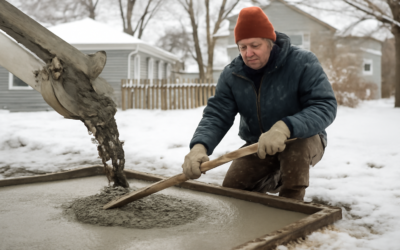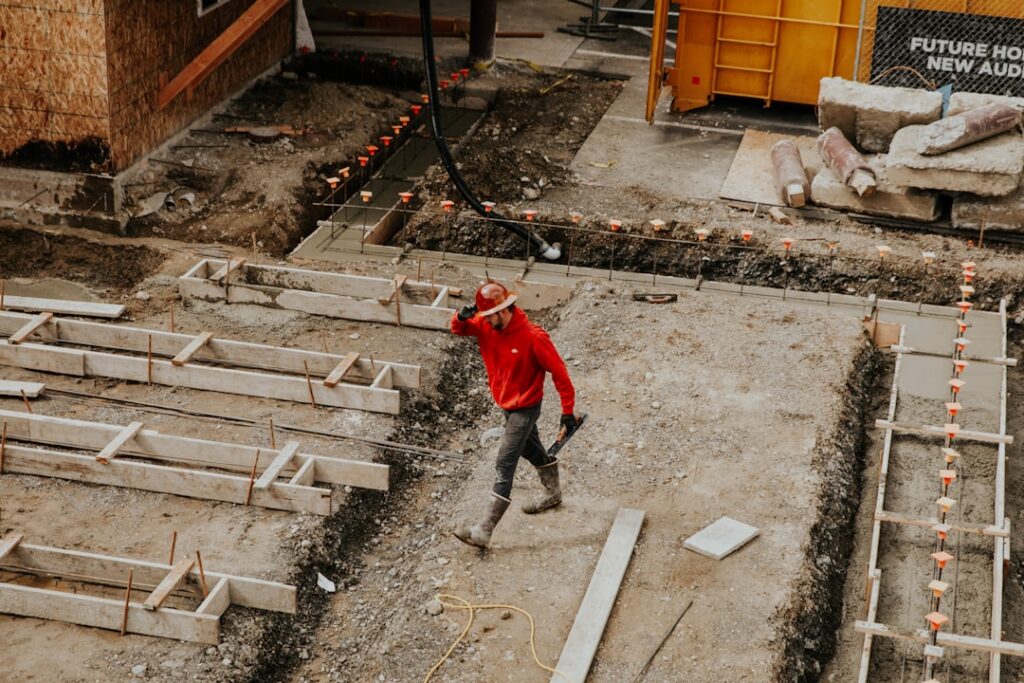
Commercial crews pour concrete at 20°F all winter across Minnesota and Alberta — and homeowners ruin slabs at 38°F every November. The difference is protocol, not luck. So can you pour concrete in the winter? Yes, provided you control three things: the temperature of the concrete going in, the temperature of what it touches, and the temperature it cures at for the first several days. Get any of the three wrong and hydration stalls or the water in the mix freezes, and frozen fresh concrete permanently loses up to 50% of its potential strength. Here is the cold-only playbook: thresholds, accelerators, hot-water batching, blankets and enclosures, and the one rule with no workaround — never pour on frozen ground.
- The Temperature Thresholds That Matter
- The Frozen-Subgrade Rule: No Exceptions
- Accelerators: Chemistry That Buys You Speed
- Hot Water and Heated Materials
- Blankets, Enclosures, and the Protection Period
- Strength Gain in the Cold: Adjust Your Calendar
- A Homeowner's Winter Pour Checklist
- The Bottom Line
The Temperature Thresholds That Matter
ACI 306 defines cold-weather concreting as three consecutive days averaging below 40°F. The numbers to build your plan around:
- 55-40°F ambient: Caution zone. Set times stretch dramatically — concrete that sets in 4 hours at 70°F can take 8-10 hours at 45°F. Plan for late finishing and overnight protection.
- Below 40°F: Formal cold-weather practice applies: heated mix, protection after placement, and a curing plan. Fresh concrete must be delivered at 55-65°F depending on section thickness.
- Below about 27°F concrete temperature: The pore water in fresh concrete freezes. Ice expands 9%, shredding the paste structure before it has strength to resist — this is the catastrophic failure mode.
- The 500 PSI milestone: Once concrete reaches roughly 500 PSI compressive strength, one freeze cycle no longer destroys it. In protected, accelerated winter concrete that arrives within 24-48 hours. The entire cold-weather game is escorting the pour to 500 PSI before it ever sees a hard freeze.
The Frozen-Subgrade Rule: No Exceptions
Never place concrete on frozen ground, frost-crusted base, or ice — this rule outranks every clever workaround. Two failures follow: the frozen subgrade thaws and settles in spring, cracking the slab from below; and the cold mass sucks heat out of the bottom of the pour, freezing the concrete where you cannot see it. Check by driving a rebar or screwdriver into the base — frost feels like hitting concrete. Thaw options: cover the base with insulated curing blankets for 2-3 days before the pour, rent hydronic ground-thaw units for larger areas (about $300-$500 per day, thaws 6-12 inches per day), or build a heated enclosure early. If the forecast gave you no time to thaw, you do not have a pour date yet.
Accelerators: Chemistry That Buys You Speed
Accelerating admixtures speed cement hydration so the concrete generates its own heat faster and hits 500 PSI sooner.
- Calcium chloride (Type C): The cheap, potent classic, dosed at 1-2% of cement weight. Cuts set time by a third to a half. The catch: chloride corrodes embedded steel, so it is prohibited in concrete with rebar you care about, post-tension cable, or embedded aluminum, and it darkens colored concrete blotchily.
- Non-chloride accelerators (NCA): Calcium nitrate/nitrite-based products (Master Builders Pozzolith NC534, Sika Rapid-1, Euclid Accelguard) — the standard spec for reinforced work, at a modest cost premium of $5-$15 per yard.
- Hot mixes by design: Ask the plant for a winter mix: Type III (high-early) cement or an extra 100 lb of cement per yard, 2% NCA, and reduced fly ash (pozzolans slow early strength in cold). A 4,000-PSI winter mix typically runs $10-$25 per yard over summer pricing.
For bagged-mix projects, Quikrete and Sakrete both sell high-early formulations, or you can add a liquid accelerator like Cement-All admix per label rates. In cold weather also skip the temptation of extra water — cold concrete bleeds longer and slower, and overwatered cold pours scale badly in their first winter.
Hot Water and Heated Materials
Ready-mix plants batch winter concrete with water heated to 140-180°F, which is the main lever for delivering 55-65°F concrete on a 20°F day; they will also steam or heat aggregate piles in serious cold. Order accordingly and tell the dispatcher your placement conditions — plants adjust water temperature to hit a specified delivery temperature. Mixing bagged concrete at home in cold weather, copy the method: mix with hot tap water (120-140°F — hotter risks flash set), store bags indoors overnight so you are not hydrating 25°F powder, and never mix on frozen ground. Small thermal mass is the DIY handicap: a wheelbarrow batch loses heat far faster than 10 yards in a drum, so small winter pours need protection even more than big ones.
Blankets, Enclosures, and the Protection Period
Placement is half the job; the first 3-7 days decide the outcome.
- Insulated curing blankets: The workhorse. Closed-cell foam blankets (R-values around 4-8) cost $80-$180 per 6×25 ft or rent cheaply; concrete’s own heat of hydration, trapped under blankets, routinely holds a slab 20-40°F above ambient. Double-layer the edges and corners — they freeze first. Straw under poly is the old-school fallback and still works at 6+ inches thick.
- Heated enclosures: For walls, footing-to-wall sequences, or severe cold, frame poly or tarps over the work and heat the space to 50-60°F. Critical detail: indirect-fired heaters or vented heat only. Unvented propane salamanders exhaust CO2, which reacts with fresh concrete surfaces to form a soft, chalky carbonated dusting layer — a classic winter defect.
- Protection duration: Keep concrete above 50°F for a minimum of 3 days (with accelerators) to 7 days (without) — longer for structural elements. Then avoid thermal shock: pulling blankets off a 70°F slab into a 5°F night can crack it; remove protection gradually so the surface cools no faster than about 40°F in 24 hours.
- No curing compounds trapped under blankets on day one if you plan to seal later — moisture management in winter is usually blankets alone; the slab is not losing water to 20°F dry air anyway.
Strength Gain in the Cold: Adjust Your Calendar
Cold concrete is slow concrete even when protected. At 50°F, concrete reaches its 28-day-equivalent strength in roughly 6-8 weeks; at 40°F, hydration crawls; below about 27°F concrete temperature it effectively stops. Practical consequences: strip forms later (walls at 2-3 days instead of 1), keep vehicle traffic off a winter driveway for 10-14 days instead of 7, and delay backfilling winter foundation walls until strength verifies. On inspected jobs, field-cured test cylinders or a maturity meter — sensors from Giatec or Command Center logging time-temperature history, about $60-$100 per sensor — replace guesswork. And schedule the first deicing salt exposure for next winter, not this one: concrete less than a year old scales readily under deicers, so use sand only on a new slab’s first season.
A Homeowner’s Winter Pour Checklist
- Confirm subgrade is thawed and dry enough to compact — probe with rebar the morning of the pour.
- Order a winter mix: specify delivery temperature (55-65°F), non-chloride accelerator, air entrainment for exterior work, and tell the plant your forms are outdoors.
- Stage insulated blankets (enough for full coverage plus doubled edges), poly sheeting, and lumber to weight the perimeter before the truck arrives.
- Pour as early in the day as possible; finish flat work promptly — cold concrete bleeds late, and waiting for bleed water in the dark at 25°F is how surfaces get sealed too soon.
- Cover within an hour of final finishing; log temperatures under the blankets daily if the job is structural.
- Uncover gradually after 3-7 days, keep loads off twice as long as summer schedules, and hold all deicers until year two.
Total winter premium for a typical driveway: roughly $200-$500 in mix upcharges and protection materials — about 5-8% of the job, and the cheapest strength insurance in concrete work.
The Bottom Line
Winter pouring is a solved problem: thawed subgrade, heated mix delivered at 55-65°F, a non-chloride accelerator, insulated blankets sealed at the edges for 3-7 days, and gradual cooldown. Respect the two absolutes — never on frozen ground, never let fresh concrete freeze before 500 PSI — and a January slab will match anything poured in June. Skip the protection to save $200 in blankets and accelerator, and you buy a slab that lost a third of its strength before its first sunrise.