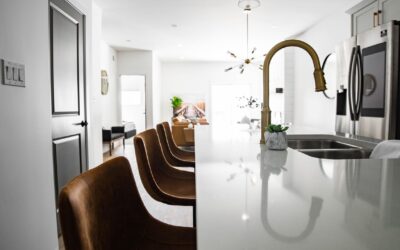
If you want a countertop that is simply white, with no veins, flecks or pattern, there are surprisingly few choices. Corian Glacier White is one of them: a plain, solid white in Corian’s solid surface lineup that has been specified for kitchens, baths, hospitals and labs for years. Its appeal is clean uniformity and the ability to repair scratches instead of living with them.
Part of our Countertops guide — explore the full guide →
Because it is a solid surface, the color runs all the way through the material. Light scratches can be sanded out, joints can be made nearly invisible, and sinks can be formed from the same material so there is no rim to trap grime. The trade-offs are lower heat resistance than stone and a softer surface than quartz.
- Corian Glacier White Specs and Traits
- How Glacier White Looks in a Room
- Where Glacier White Works Best
- Glacier White vs Other White Countertops
- Daily Care and Cleaning
- Repairs and Troubleshooting
- Design Pairings for a Plain White Top
- Edge Profiles and Backsplash Options
- Cost and Fabrication Notes
- When to Call a Pro
- Frequently Asked Questions
Here is what is confirmed about the color, how it compares with similar whites, where it works, and how to keep it looking bright.
Corian Glacier White Specs and Traits
The values in this table come from retailer sample listings and Corian sheet information. The exact thickness and finish options for this color vary by market, so check the current color chart with a fabricator.
| Spec | Value | What it means |
|---|---|---|
| Material | Acrylic solid surface | Nonporous, color-through, renewable surface |
| Color family | White, solid (no pattern) | Plain, uniform white |
| Common thickness | 1/2 in (12 mm) listed for this color | Standard countertop sheet, built up at edges |
| Corian sheet thicknesses | 6 mm, 12 mm and 19 mm standard | Thinner sheets suit wall cladding and backsplash panels |
| Finish | Matte on retail sample; honed options listed | Low sheen hides fine scratches better |
| Related color | Glacier Ice is a translucent version | Used where backlighting is wanted |
| Joints | Inconspicuous when fabricated properly | Long runs and L-shapes look continuous |
| Sinks | Integral sinks possible | No rim or caulk line between top and bowl |
How Glacier White Looks in a Room
Glacier White reads as a clear, clean white rather than a warm cream or a stark blue white, though it can lean slightly cool beside warm wood or under daylight bulbs. Because there are no particles or veins, it looks calm and modern. It also shows every crumb and drip, so it suits people who wipe surfaces often.
Under warm 2700K lighting it softens a little. Under cool 4000K to 5000K task lights it looks crisp. Check samples under your own lighting before deciding, especially if your cabinets are a warm white, since two different whites side by side can make one look dingy.
Search for corian white glacier and you will find the same color listed in reverse order; it is one product, not two.
Where Glacier White Works Best
Kitchen countertops and islands
A plain white top keeps busy cabinets, open shelving or patterned tile from feeling cluttered. Integral sinks make cleanup easy. Keep hot cookware off the surface and you will avoid most problems.
Bathroom vanities
One-piece vanity tops with integral bowls are among the best uses for this color. With no rim, there is no line of grime where the sink meets the counter, and the white suits nearly any tile.
Shower walls and backsplash panels
Thinner sheets can clad walls with few or no grout lines. That means less scrubbing and no grout sealing.
Commercial and healthcare spaces
Nonporous, repairable surfaces with inconspicuous joints are popular where hygiene matters, which is why plain whites like this appear in clinics, labs and food service.
Glacier White vs Other White Countertops
| Option | Look | Heat | Scratch repair |
|---|---|---|---|
| Solid surface white | Plain, matte, uniform | Use trivets; can scorch | Sand and refinish on site |
| White quartz | Polished, sometimes speckled | Use trivets; resin can discolor | Hard to repair invisibly |
| White quartzite | Natural stone with movement | Good | Pro stone repair |
| White laminate | Flat color, visible seams | Poor | Not repairable |
Note that Glacier White quartzite is a different, natural stone product sold under a similar name. If a fabricator mentions Glacier White, confirm whether they mean the solid surface color or a stone slab.
Daily Care and Cleaning
- Wipe daily with warm soapy water or a mild household cleaner and a soft cloth.
- Remove dried spills with an ammonia-based cleaner or a mild abrasive cleanser on a damp sponge, rubbing in small circles.
- Dry the surface to avoid a film of hard-water spots, which stand out on plain white.
- Use trivets and hot pads for pots, pans, slow cookers and air fryers.
- Use cutting boards. Knives leave marks in any solid surface.
- Refresh the finish every so often with a solid surface polishing kit or a fine abrasive pad matched to the finish level.
Avoid harsh chemicals such as paint removers, oven cleaners and strong solvents. If one contacts the surface, rinse with plenty of water right away.
Repairs and Troubleshooting
- Fine scratches: buff with a fine abrasive pad in circular motions across the whole area so the sheen stays even.
- Deeper scratches or scorch marks: a fabricator can sand them out and refinish because the color runs through.
- Stains from tea, coffee or food dye: a diluted bleach solution, used briefly and rinsed, often lifts them; follow care instructions from the manufacturer.
- Cracks near a sink or cooktop: often caused by heat or stress at a cutout. A professional can usually cut out and patch the area.
- Visible seam: a poorly made joint can be reground and refinished by a skilled fabricator.
Matte finishes are the most forgiving. High-gloss finishes on dark colors show scratches far more, which is one reason plain whites in matte are so common.
Design Pairings for a Plain White Top
Because Corian Glacier White has no pattern, the rest of the room carries the visual interest. That makes it a strong partner for materials that would clash with a busy stone.
- Wood cabinets: white oak, walnut and cherry all look richer next to a plain white top. The white keeps warm wood from feeling heavy.
- Painted cabinets: navy, forest green and charcoal cabinets create strong contrast. White-on-white works too, but match the undertones so the cabinets do not look yellow beside the counter.
- Patterned tile: encaustic-look floors, zellige-style backsplashes and bold mosaics stay the focus with a quiet top.
- Hardware and fixtures: matte black, brushed brass and polished nickel all read cleanly against white.
One caution: plain white shows the color difference between it and other white products. Bring a sample when you choose sinks, tubs and tile so you can see how the whites relate. A warm white tile behind a crisp white counter can look off unless you choose deliberately.
Edge Profiles and Backsplash Options
Solid surface fabricators can shape edges in ways stone shops cannot do as easily. A square or eased edge suits modern kitchens. A bullnose or ogee suits traditional spaces. A coved backsplash, where the counter curves up into the wall panel, removes the corner seam where crumbs and water usually collect, and it is a common choice in labs and hospitals for exactly that reason.
Thicker-looking edges are usually built up by bonding strips under the front edge of a 1/2 in sheet. Done well, the joint is hard to spot. Ask the fabricator to show you a sample edge before committing, because the build-up method affects how the underside of the edge looks.
Drop-in or undermount sinks of other materials can be used too, but the integral bowl is the feature most people choose solid surface for. Rounded inside corners and a coved transition into the bowl leave nothing for grime to settle into.
Cost and Fabrication Notes
Solid surface countertops usually land in a mid-range price band per square foot installed, often less than premium quartz and more than laminate. Integral sinks, thick built-up edges, backsplash coves and wall cladding all add to the total. Since solid surface must be fabricated and installed by trained shops for joints and sinks to look right, get quotes from fabricators who work with the material regularly.
When to Call a Pro
Light buffing is a DIY task. Call a certified fabricator for cracks, deep burns, seam repairs, new cutouts, or adding a sink. Plumbing changes for a new integral sink should follow local code: shut off the water and relieve pressure before disconnecting, and use a licensed plumber if you are not confident.
Frequently Asked Questions
Is Corian Glacier White a pure white?
It is a clean, plain white with no pattern. It can look slightly cool or slightly soft depending on your lighting.
Does Glacier White stain easily?
It is nonporous, so most spills wipe off. Strong dyes left sitting can mark it, but light stains usually come out with a mild cleanser.
Can I put hot pans on Corian?
No. Use trivets or hot pads, because high heat can scorch or crack solid surface.
What thickness is Glacier White?
Retail listings show 1/2 in (12 mm). Corian sheets also come in 6 mm and 19 mm, but check the current chart for this color.
Is Glacier White the same as Glacier White quartzite?
No. The quartzite is a natural stone. The Corian color is an acrylic solid surface.