Floor replacement is one of those projects where the contractor’s estimate often arrives at twice what you mentally budgeted. The cost to replace flooring in a typical US home in 2026 runs $3 to $22 per square foot installed, and the spread between low and high is driven less by the floor itself than by the demolition, prep, and trim work nobody mentions in the showroom. Knowing where the dollars actually go lets you negotiate smarter, choose materials that fit your real budget, and avoid the surprise charges that sink so many remodels.
The Per-Square-Foot Breakdown
- Sheet vinyl: $2 to $5 installed, the budget choice for rentals
- Laminate: $4 to $9 installed, mid-tier appearance and durability
- Luxury vinyl plank: $5 to $12 installed, the 2026 default
- Carpet: $4 to $11 installed including pad
- Engineered hardwood: $9 to $16 installed
- Solid hardwood: $10 to $22 installed
- Ceramic or porcelain tile: $9 to $18 installed
- Natural stone tile: $14 to $30 installed
Within each material, the spread comes from quality grade, regional labor rates, and project complexity. A 200 sq ft kitchen with detailed cuts around an island and refrigerator alcove costs more per foot to install than a 1,200 sq ft open basement.
What Demolition Adds
Tearing out the existing floor is rarely included in the headline material price. Standard demo runs $1 to $3 per sq ft on top of new flooring, and certain situations push it higher. Glue-down vinyl over concrete adds $1 to $2 because the adhesive scrape is brutal. Tile demo with broken-up mortar bed runs $2 to $4 because the work is loud, dusty, and slow.
Asbestos vinyl from pre-1985 homes is a separate category entirely. Testing alone runs $300 to $500. If positive, abatement requires licensed contractors and can hit $5 to $12 per sq ft just for removal before any new floor goes down.
Subfloor Prep Costs
Most quotes assume your subfloor is flat, dry, and structurally sound. When it is not, prep costs surface fast. Self-leveling concrete to fix dips runs $1.50 to $3.50 per sq ft. Replacing rotted plywood subfloor runs $2 to $4 per sq ft including disposal. Adding cement board for tile installation runs $2 to $3 per sq ft.
Always ask the contractor to walk the floor with you before signing. Anything they spot becomes a documented line item rather than a change order surprise mid-project.
Trim, Transitions, and the Hidden $800
Quarter-round and shoe molding to cover the expansion gap runs $1.50 to $3 per linear foot installed and painted. A typical 12×14 bedroom needs about 50 linear feet, or $75 to $150. Multiply across a whole house and trim alone hits $400 to $1,200.
Transition strips between rooms add another $25 to $75 each, and most homes need 5 to 12 of them. Stair nose pieces for finishing stair treads run $40 to $90 per piece and are mandatory if you are continuing the new floor up to a second level.
Real Project Examples
Three actual 2026 quotes for context:
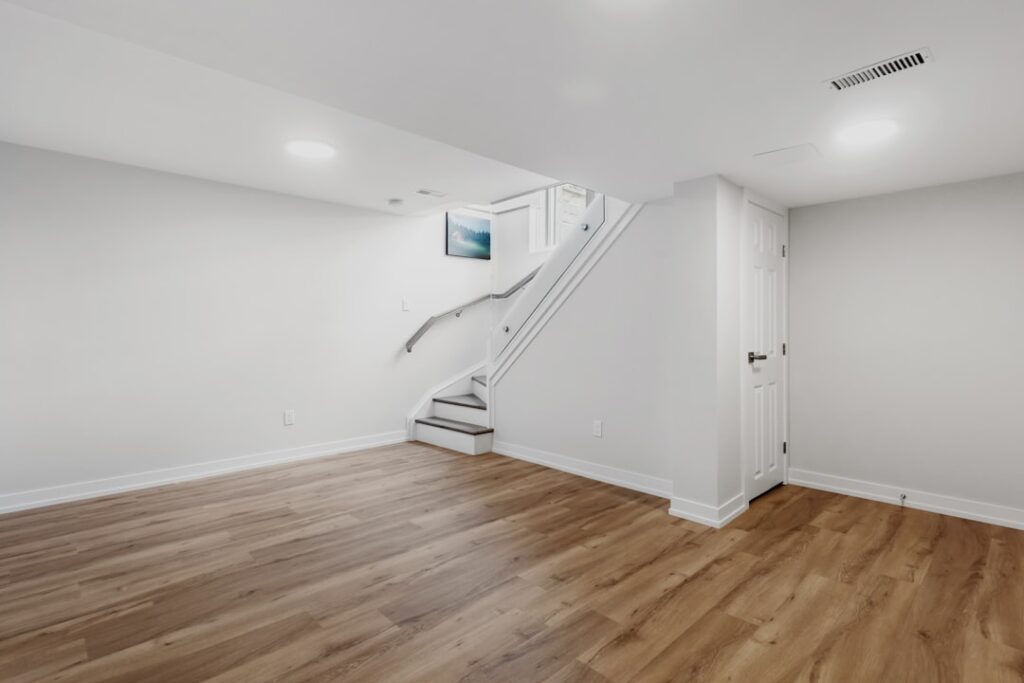
- 1,200 sq ft basement, mid-grade LVP: $7,800 turnkey including demo of old carpet
- 800 sq ft kitchen and dining area, porcelain tile: $11,400 with subfloor prep
- 2,200 sq ft full main floor, engineered oak hardwood: $24,500 including stairs
The basement job is the cheap one because demo was simple, the floor is open with few cuts, and laminate-style click LVP is fast to install. The hardwood job is expensive because solid wood requires careful subfloor moisture testing, slower install, and finished trim work everywhere.
Regional Labor Variation
Where you live changes the bottom line by 20 to 40 percent. Coastal California, the Boston metro, and the New York tri-state push labor toward the high end at $5 to $9 per sq ft for install. Texas, the Carolinas, the Midwest, and the Mountain West run $2.50 to $5 per sq ft. Material costs are roughly the same nationally; labor is where the regional gap shows up.
Within a metro, suburban contractors typically quote 15 to 25 percent below downtown crews. The drive-time savings are real, and the work quality is often identical.
Where to Cut Costs Without Regret
Smart corners to cut: skip showroom upcharges by buying the same SKU online or at a wholesale outlet, choose a 12 mil LVP wear layer instead of 22 mil if traffic is light, and accept stock cabinets-grade trim rather than custom milled. Each saves real money without affecting day-to-day living.
Bad corners to cut: do not skip subfloor prep, do not skip the moisture barrier on concrete, do not buy bargain-bin underlayment, and do not let a contractor talk you out of expansion gaps to save trim cost. Each of those produces a callback failure within 12 to 36 months.
Financing and Timing Considerations
Big-box stores offer 12 to 24 month no-interest financing on installed flooring purchases above $1,000 to $2,000. The trade-off is showroom pricing, which often runs 20 to 30 percent higher than independent installers. Run the math on total cost including interest before assuming financing wins.
Booking timing matters too. January and February are slow months for flooring contractors and you can often negotiate 10 to 15 percent off summer rates. Avoid July and August in southern markets where every contractor is buried in HVAC-driven remodels.
Final Budget Recommendation
For most US homeowners replacing flooring in 2026, budget $7 to $12 per sq ft installed turnkey for a quality mid-grade product with proper prep and trim. That gives you LVP, laminate, or carpet in nearly any room, with enough cushion to handle minor surprises. Hardwood and natural stone push you to $14 to $22, and you should have a 10 to 15 percent contingency on top of any quote you sign.
Prefer to explore on your own?
See how new flooring looks in your actual room in seconds — free, no signup.
Try the free Floor Studio →