
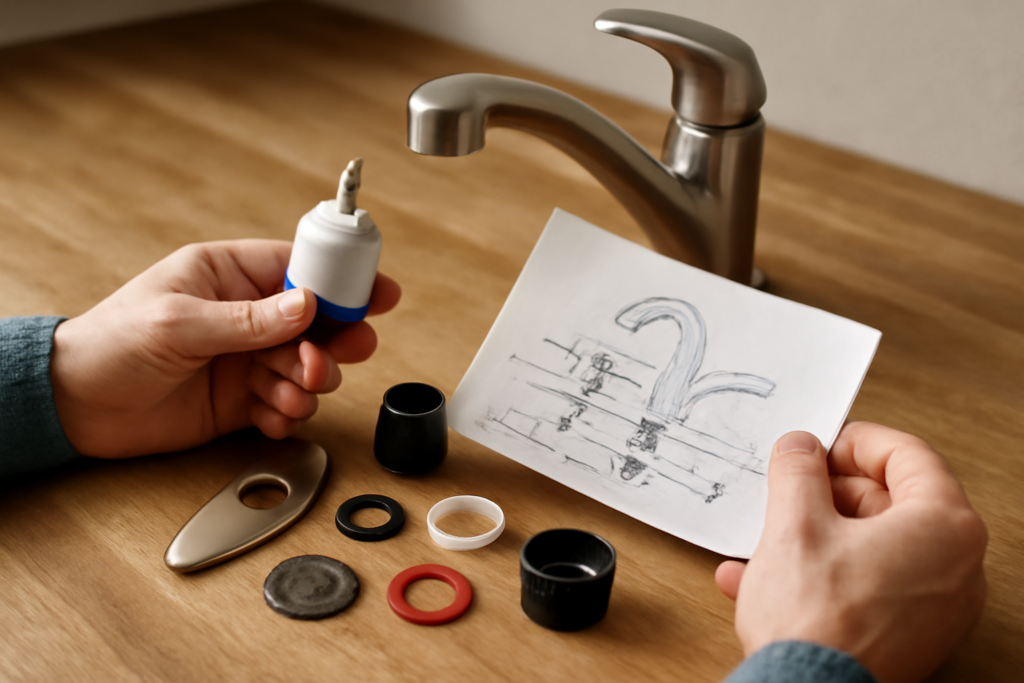
Delta backs its faucets with a lifetime limited warranty on parts for the original homeowner — which means the dripping kitchen faucet you are about to replace might be fixable for the cost of a phone call. The catch is identification: Delta faucet parts are ordered by RP number (Replacement Part number), and matching the right RP to your specific faucet is the entire game. Order blind and you will make three trips to the store; identify the model first and the fix is usually a $10-30 part and twenty minutes. Here is how Delta’s parts system works, the wear parts that cause 90 percent of problems, and the fastest path from “it drips” to the correct part in hand.
- Understanding Delta's RP Number System
- The Wear Parts That Actually Fail
- Cartridges and stem units
- Seats and springs
- O-rings and spout seals
- Aerators, hoses, and spray heads
- Matching Part to Faucet: A Reliable Workflow
- Finish Matching and Cosmetic Parts
- A Note on Shower Parts
- Where to Buy, and What Things Cost
- Beyond Delta
Understanding Delta’s RP Number System
Every serviceable Delta component carries an RP number — RP50587 is the well-known ball-faucet repair kit, RP19804 a common seat-and-spring set, RP1050 the classic ball assembly. These numbers are universal across retailers: the same RP number gets you the same part at Home Depot, on Amazon, or direct from deltafaucet.com. Delta also uses model numbers for complete faucets (a format like 9178-AR-DST for a popular kitchen pull-down, or a 3-4 digit series like 1400 for shower valves), and each model’s documentation includes an exploded parts diagram mapping every RP number in the faucet. Find the model, and every part identifies itself.
Where to find the model number: the original box or manual, a tag on the supply line or spray hose under the sink, laser etching on the faucet body (often behind the spout or under the handle escutcheon), or — for showers — sometimes inside the trim plate. No luck? Delta’s website has a visual identification tool, and their customer service line (1-800-345-3358) can identify most faucets from a photo and, for original owners, ship warranty parts free. That call is genuinely the best first move in the Delta ecosystem.
The Wear Parts That Actually Fail
Delta faucets are long-lived castings around a short list of consumable parts:
Cartridges and stem units
The valve cartridge controls flow and mix, and it is the usual suspect for drips, stiff handles, and temperature drift. Delta’s common families: the RP50587 kit era ball faucets, the RP19804-supported two-handle stem units, the single-handle RP70538/RP77737-class ceramic cartridges used in many modern kitchen models, and the shower-side RP19804 companions RP46074 (17 series) and the ubiquitous RP32104 (1300/1400 series). Cartridges run $15-40 retail. Identifying and swapping them is its own topic — our Delta faucet cartridge guide covers matching cartridge families and the replacement procedure step by step.
Seats and springs
Unique to Delta and Peerless designs: small rubber seats over conical springs sit beneath the ball or cartridge and do the actual sealing. They harden and groove with age, and they are the first thing to replace on any dripping older Delta — the RP4993 seat-and-spring pair costs about $5-8 and fixes more drips than any other single part. Buy two pairs and do both sides of a two-handle faucet while you are in there.
O-rings and spout seals
Water pooling at the base of a swivel spout means spout O-rings, not the cartridge. Kits like RP61 and model-specific O-ring sets run $4-10. Coat new rings with plumber’s silicone grease — never petroleum jelly, which swells rubber.
Aerators, hoses, and spray heads
Weak or spraying-sideways flow is usually a clogged aerator ($5-12; many Delta kitchen models use recessed “cache” aerators needing a plastic key). Pull-down kitchen faucets add two more consumables: the spray hose (RP50390 and successors, $20-35) and the spray head/wand ($30-60), plus the magnetic docking collar on MagnaTite models. Diverters and vacuum breakers round out the list on faucets with side sprayers.
Matching Part to Faucet: A Reliable Workflow
- Find the model number using the locations above; photograph the faucet from the side and underneath while you are there.
- Pull the parts diagram. Search “Delta [model] parts diagram” or use the model lookup at deltafaucet.com — the exploded view lists every RP number in the assembly.
- Match the symptom to the part: drip from spout = seats/springs or cartridge; leak at base = O-rings; leak under sink = supply or hose; low flow = aerator first.
- Verify before ordering. If you already have the faucet apart, take the old part to the store or match it against RP photos — cartridge families look similar but do not interchange.
- Call in the warranty. Original owner of the home when the faucet was installed? Delta ships most mechanical parts free for the faucet’s life. Keep receipts for new faucets in a house file for exactly this reason.
One trap worth flagging: Delta, Peerless (Delta’s value brand), and look-alike imports share styling but not parts. Confirm the brand stamp before assuming an RP number fits, and note that big-box “fits Delta” universal parts are hit-or-miss — the $3 saved is not worth a second teardown.
Finish Matching and Cosmetic Parts
Mechanical parts are finish-agnostic, but handles, spray heads, escutcheons, and trim must match your faucet’s finish code — and Delta encodes it in the model suffix. Common codes: no suffix or -CZ variants for chrome, -SS for Brilliance Stainless, -RB for Venetian Bronze, -BL for Matte Black, and -CZ for Champagne Bronze. Order cosmetic parts with the full model-plus-finish string, because “stainless” from one product generation can sit a shade off from another, and a mismatched spray head on a pull-down is visible every day. Discontinued finishes (Aged Pewter, Pearl Nickel) are the one area where even Delta’s parts network thins out — for those, check the model’s parts diagram for superseded RP numbers, which Delta lists when a newer part replaces an old one.
A Note on Shower Parts
Delta showers hide their identity behind the wall, but the trim tells you enough: nearly all single-handle Delta shower valves from the last several decades are either the 1300/1400 series (MultiChoice predecessor, RP32104 cartridge) or the 13/14 and 17 series MultiChoice universal valve — the 17 series adds separate volume control and uses RP46074 plus the RP19804 seats. Pull the handle and trim sleeve and the cartridge style is unmistakable. The universal MultiChoice body is Delta’s quiet masterstroke: the rough-in valve stays in the wall forever, and you can change the entire trim style, finish, and even series function without opening tile. Shut off water at the main before any shower cartridge work — shower valves rarely have local stops — and keep the RP19804 seats in the parts drawer; they fix as many shower drips as full cartridges do.
Where to Buy, and What Things Cost
Keep a small Delta kit in the house if you own several of their faucets: RP4993 seats and springs, silicone grease, and an O-ring assortment covers the majority of emergency drips for under $20 total.
Home Depot and Lowe’s stock the high-turnover items in the plumbing aisle: RP4993 seats and springs, common cartridges, aerators, and repair kits. Amazon and plumbing supply houses carry the deeper catalog of finish-specific handles, escutcheons, and older discontinued RPs. Delta direct is the source of truth for anything obscure and the only channel for warranty fulfillment. Ballpark costs: seats and springs $5-8, O-ring kits $4-10, cartridges $15-40, kitchen spray hoses $20-35, spray heads $30-60, and trim/handle kits $25-80. Compare that to $150-350 for a comparable new faucet plus installation, and repair wins economically almost every time the body and finish are still good.
Beyond Delta
The identification logic here — find the model, pull the exploded diagram, match symptom to component — applies across every major brand, just with different numbering systems (Moen’s 1200/1222/1225 cartridges, Kohler’s GP numbers). For the cross-brand fundamentals of how faucet internals work and fail, our general faucet parts guide covers the anatomy that every brand shares. Within the Delta world, though, the playbook is simple: model number, RP number, warranty call. In that order, the right part shows up the first time.


