Understanding door hardware parts turns a frustrating repair into a fifteen-minute fix, because once you can name each component you can order the exact replacement instead of buying a whole new set. Every door in your home relies on a handful of door hardware parts working together, from the hinges that swing it to the latch that keeps it shut. When something rattles, sticks, or fails to catch, the problem is usually one small worn piece. This guide walks through every part, what it does, and how to replace it.
Part of our Windows & Doors guide — explore the full guide →
- The Anatomy of a Door
- Hinges and Their Components
- The Latch Assembly
- Knobs, Levers, and Spindles
- Strike Plates and Boxes
- Deadbolt Components
- Door Closers and Stops
- Weatherstripping and Thresholds
- How to Identify a Replacement Part
- Handedness and Door Swing
- Mortise Versus Cylindrical Locks
- Basic Maintenance to Prevent Failures
The Anatomy of a Door
A standard interior or exterior door is a small system of interacting metal pieces. At the most basic level you have the hinges on one side, the handle or knob assembly in the middle, and the latch and strike plate that hold everything closed. Learning how these interact makes diagnosing problems much easier. When a door won’t stay shut, the trouble is nearly always the latch, strike plate, or a sagging hinge, not the door itself.
Hinges and Their Components
Hinges carry the full weight of the door and take constant stress. A typical residential butt hinge measures 3-1/2 inches for interior doors and 4 inches for heavier exterior doors. Each hinge has two leaves connected by a removable pin that runs through interlocking knuckles. If a door squeaks, a drop of oil on the pin usually cures it, and if it sags, the top hinge screws have often pulled loose from the frame.
- Leaves: The two flat plates that mount to the door and jamb.
- Pin: The removable rod that lets you lift the door off.
- Knuckles: The interlocking cylinders the pin passes through.
- Ball bearings: Found in heavier-duty hinges to reduce wear.
The Latch Assembly
The latch is the spring-loaded bolt that pokes out of the door edge and slips into the strike plate. It’s the part that clicks when you close a door. The angled or beveled latch, called a spring latch, retracts when you turn the knob and springs back automatically. A worn or misaligned latch is the number one reason doors won’t stay closed. Replacing just the latch mechanism costs $8 to $15 and takes minutes, since it slides out of the door edge after removing two screws on the faceplate.
Knobs, Levers, and Spindles
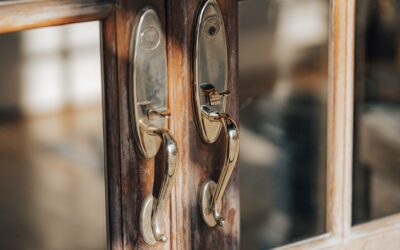
The handle you actually touch is only part of the assembly. Inside, a square metal rod called the spindle connects the two knobs or levers and transfers your turning motion to the latch. When a knob spins freely without retracting the latch, the spindle or the small set screw holding it has usually failed. Levers use the same principle but offer more leverage, which is why they’re required in commercial buildings and preferred for accessibility.
The rose or escutcheon is the decorative plate behind the knob that covers the bore hole and mounting screws. On modern locksets these often snap or screw over a mounting plate, giving a clean look without visible fasteners.
Strike Plates and Boxes
Mounted on the door frame, the strike plate is the metal plate with a hole that receives the latch or deadbolt. Behind it, a strike box reinforces the pocket in the jamb. Standard strike plates are held by two short screws, but for security you should replace those with three-inch screws that reach the wall stud. A high-security strike plate with four long screws can turn a flimsy frame into one that resists a hard kick, and it costs under $15.
Deadbolt Components
A deadbolt has its own set of parts distinct from the handle. The cylinder houses the keyway and pins that read your key. The bolt itself is a solid steel bar, ideally throwing at least one inch into the frame. On the interior side, a thumb-turn retracts the bolt without a key. If your key turns but the bolt won’t move, the tailpiece connecting the cylinder to the bolt mechanism is often the culprit. Deadbolt cylinders can frequently be rekeyed rather than replaced when you move into a new home.
Door Closers and Stops
Some doors, especially exterior and garage-to-house doors, use a door closer to pull them shut automatically. These hydraulic or spring units mount at the top of the door and have adjustment screws that control closing speed and latch force. Door stops, whether baseboard, hinge-pin, or wall-mounted, protect your walls from knob impact. A simple $5 hinge-pin stop prevents years of dented drywall behind an aggressively swung door.
Weatherstripping and Thresholds
Exterior door hardware parts include the seals that block drafts and water. Weatherstripping runs around the frame, and the threshold sits under the door, often with an adjustable sweep. Compression seals, V-strips, and door sweeps all wear out over time, and replacing them for $10 to $30 can noticeably cut drafts and lower energy bills. If you feel a breeze at the bottom of an exterior door, the sweep or threshold gasket has likely flattened.
How to Identify a Replacement Part
When something breaks, take the failed piece to the hardware store or photograph it next to a ruler. Note the backset (2-3/8 or 2-3/4 inches), the bore diameter (typically 2-1/8 inches), and the brand stamped on the metal. Many parts are universal, but proprietary systems like certain smart locks require brand-specific components. For older or discontinued hardware, a locksmith supply house or online specialty seller usually stocks parts the big-box stores don’t.
Handedness and Door Swing
One detail that trips up many homeowners is the “hand” of a door, which describes the direction it swings and which side the hinges are on. Stand outside the door, or on the side that swings away from you; if the hinges are on the right, it’s a right-hand door, and if on the left, a left-hand door. Levers and some locksets are handed, meaning the lever must point a specific way, though many modern levers are reversible on site. Getting the hand right matters when ordering handlesets, mortise locks, and certain commercial hardware, because a mismatch means the lever points up instead of down or the keyway sits upside down. Always confirm the hand before buying non-reversible hardware.
Mortise Versus Cylindrical Locks
Residential doors use one of two lock body styles, and knowing which you have guides replacement. Cylindrical (bored) locks are the common type, installed in the round bore holes described earlier, and they’re what you’ll find on nearly every modern home. Mortise locks, more common in older and higher-end homes, sit in a rectangular pocket cut into the door edge and combine the latch, deadbolt, and handle into one robust unit. Mortise hardware is stronger and more secure but far more expensive and harder to replace, often requiring exact-size components. If your door has a large rectangular metal plate on the edge rather than two round holes, you have a mortise lock and should shop accordingly.
Basic Maintenance to Prevent Failures
Most door hardware parts fail slowly and give warning signs. A little preventive care keeps them working for decades. Tighten any loose screws twice a year, lubricate latches and cylinders with a dry graphite or Teflon spray rather than oil, and clean grime from moving parts. Check that hinge screws are snug, since a single loose top screw is the most common cause of a rubbing or sagging door.
When lubricating, resist the temptation to reach for oil-based sprays, which feel effective at first but attract dust and eventually gum up the delicate pins inside a lock cylinder. A dry graphite powder or a Teflon-based lubricant slides into the mechanism without leaving a sticky residue, and a single application usually lasts a full year. For exterior hardware exposed to weather, a light coat of automotive paste wax on the finish helps repel water and slows corrosion at seams and fasteners. Keeping a small container of graphite and a screwdriver in a kitchen drawer means you can address a sticky lock or loose knob the moment you notice it, before a minor annoyance turns into a stuck door or a failed latch.
By learning the names and roles of these door hardware parts, you’ll diagnose problems faster, order the right replacement the first time, and save the cost of unnecessary full-set replacements. Most repairs need nothing more than a screwdriver, a few dollars in parts, and a few minutes of your time.