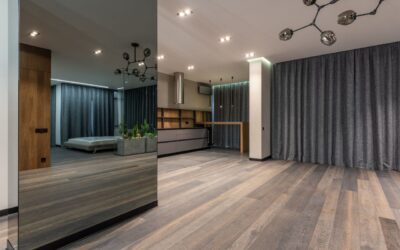
Engineered wooden flooring gives you real hardwood beauty with a construction built for modern homes. A genuine hardwood veneer bonded to a dimensionally stable core delivers the look and feel of solid wood while handling concrete subfloors, basements, radiant heating, and humidity fluctuations that solid timber cannot.
How Engineered Wooden Flooring Is Made
Every engineered plank consists of two main components:
Hardwood Veneer (Top Layer)
A real wood surface — oak, walnut, hickory, maple, or any other species — sliced from a solid timber log. Veneer thickness ranges from 0.6mm (budget products) to 6mm (premium). This is the layer you see and walk on. It’s real wood in every sense.
Core (Bottom Layers)
Multiple layers of plywood, HDF, or softwood arranged with grain running in alternating directions. This cross-grain construction resists the expansion and contraction that causes solid wood to gap, cup, and buckle with seasonal humidity changes.
Thickness Options
- 10mm total (thin veneer): Budget-friendly, cannot be refinished. Best for low-traffic rooms or temporary installations. Floating only.
- 12-14mm (mid-range): Most popular residential thickness. 2-3mm veneer allows 1-2 light sandings. Compatible with all installation methods.
- 15-18mm (premium): Thick veneer (3-4mm+) allows multiple refinishings. Feels substantial underfoot. Can be nailed down like solid hardwood.
- 20mm+ (ultra-premium): 5-6mm veneer approaches solid hardwood refinishing capacity. Maximum longevity.
Plank Width Options
- 3-4″ narrow: Traditional strip floor appearance. Classic, formal.
- 5-6″ standard: Most versatile. Works in any room and style.
- 7-9″ wide: Modern, open feel. Shows more grain per plank. Current trend.
- 10″+ extra-wide: Statement flooring. Premium price, requires quality core for stability.
Species Choices
- White Oak: Most popular. Neutral color, excellent hardness (1,360 Janka), takes stain well.
- Hickory: Hardest domestic species (1,820 Janka). Dramatic grain variation. Great for pets.
- Walnut: Rich dark brown. Softer (1,010 Janka). Best in low-traffic rooms.
- Maple: Light, clean appearance. Very hard (1,450 Janka). Contemporary look.
- Cherry: Warm tones that deepen with light exposure. Soft (950 Janka). Elegant.
Installation Methods
Click-Lock Floating
Planks snap together and rest on underlayment without adhesive. Fastest, most DIY-friendly method. Works over concrete, plywood, and existing flooring. Best for standard-width planks.
Glue-Down
Planks are adhered to the subfloor with flexible urethane adhesive. Creates the most solid feel with no hollow sound. Preferred over concrete and for wide planks. Better heat transfer for radiant floor systems.
Nail/Staple Down
Planks are fastened to plywood subfloors with a pneumatic nailer. Traditional hardwood installation feel. Requires 3/4″ plywood subfloor minimum. Best for planks 15mm+ thick.
Floating vs Glue-Down
- Floating: Faster, cheaper labor, DIY-friendly, easy to remove. May sound hollow. Movement possible in large open spaces.
- Glue-down: Solid feel, no hollow sound, excellent over radiant heat. More expensive labor, permanent. Better for wide planks and large rooms.
Care and Maintenance
- Sweep or vacuum with hard-floor attachment regularly
- Damp mop with manufacturer-approved cleaner (never excess water)
- Maintain 35-55% indoor humidity year-round
- Use felt pads under all furniture legs — replace annually
- Place mats at entrances to trap grit
- Avoid vinegar, steam mops, and all-purpose cleaners on wood
- Trim pet nails regularly
Cost
- Budget (thin veneer, narrow plank): $3 to $5/sq ft materials
- Mid-range (oak, standard width): $5 to $8/sq ft
- Premium (wide plank, thick veneer): $8 to $14/sq ft
- Installation: $2 to $5/sq ft depending on method
- Total installed: $5 to $19/sq ft
For a 1,000 sq ft project, expect $5,000 to $19,000 fully installed.
Is Engineered Wooden Flooring Worth It?
Yes — for most homeowners, engineered wood offers the best balance of real wood beauty and practical performance. You get genuine hardwood on the surface with the freedom to install over concrete, in basements, and over radiant heat. Unless you specifically need the maximum refinishing capacity of 3/4″ solid hardwood, engineered is the smarter choice.
Prefer to explore on your own?
See how new flooring looks in your actual room in seconds — free, no signup.
Try the free Floor Studio →