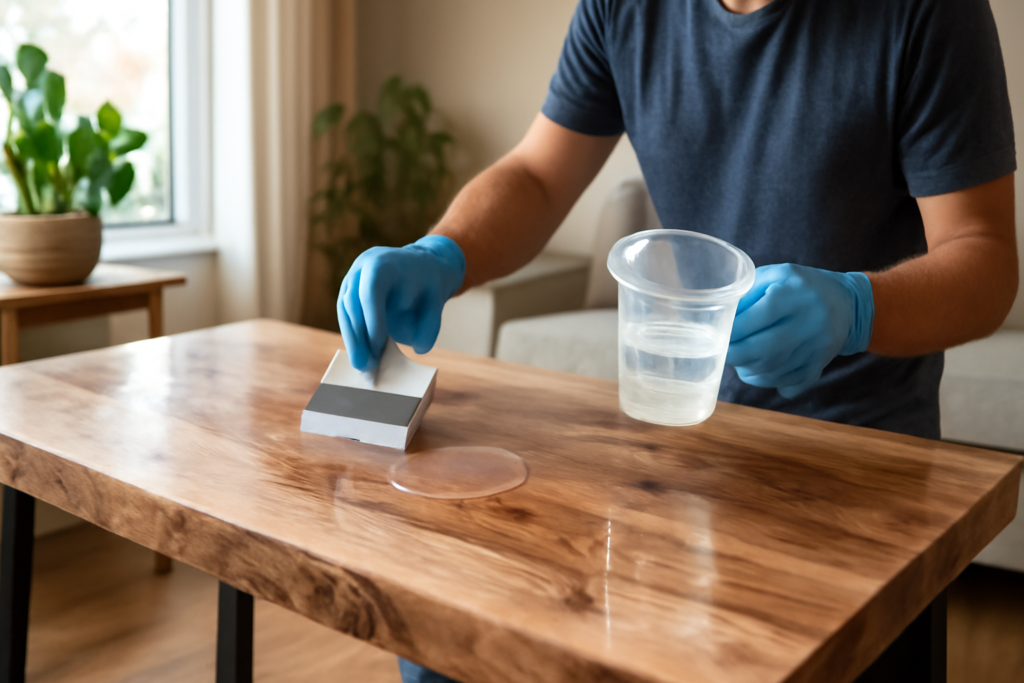
Epoxy glass refers to the thick, crystal-clear resin coating that cures into a glossy, glass-like surface over tables, countertops, bar tops, and artwork. When you see a river table with a glassy blue channel running through it, or a bar top that looks like it is covered in a sheet of liquid glass, you are looking at epoxy resin doing exactly what its nickname promises.
Part of our Epoxy, Concrete & Garage Floors guide — explore the full guide →
It is prized for its mirror-clear finish, depth, and durability, and it is well within reach for a determined DIYer. Here is what you need to know before you pour.
What “Epoxy Glass” Means
The term covers clear, two-part epoxy resin systems formulated to self-level into a smooth, transparent, high-gloss coating. Mixed from a resin and a hardener, it pours on as a liquid and cures into a hard, solid surface that magnifies whatever is underneath, which is why it makes wood grain, photos, and embedded objects look so vivid.
There are two broad categories. Coating epoxies are designed for thin layers, typically up to about 1/4 inch per pour, ideal for tabletops and bar tops. Deep-pour or casting epoxies are formulated for thick castings up to several inches, used for river tables and molds. Using the wrong type is the most common beginner mistake, since a coating epoxy poured too thick can overheat.
Common Projects and Uses
The applications keep expanding as the material gets more popular. Homeowners reach for clear epoxy to make:
- Glossy tabletops and desks
- Live-edge river tables with colored resin channels
- Bar tops and countertops with embedded coins, bottle caps, or photos
- Resin art, geodes, and decorative panels
- Cutting boards and serveware (with food-safe, fully cured resin)
- Sealed, ultra-durable finishes over existing wood surfaces
The glass-like clarity is the draw, but the toughness is the bonus. A cured epoxy surface resists water, heat (to a point), and daily wear far better than most varnishes.
How to Apply It
Application looks intimidating but follows a reliable rhythm. Preparation and timing matter most:
- Prep the surface. Sand it, clean off all dust, and seal porous wood with a thin “flood coat” or seal coat to prevent bubbles from off-gassing.
- Build a dam. Tape or form edges so the resin does not run off; release-taped edges peel away cleanly later.
- Measure precisely. Epoxy cures by exact ratio, usually 1:1 or 2:1 by volume; guessing leads to sticky, never-curing spots.
- Mix slowly and thoroughly. Stir for the full time the maker specifies, scraping the sides and bottom, to avoid streaks.
- Pour and spread. Pour in a steady ribbon and let it self-level, nudging it to the edges with a spreader.
- Pop bubbles. Pass a heat gun or torch lightly over the surface to release trapped air, keeping the flame moving so you do not scorch it.
Curing and Finishing
Curing is a waiting game, and rushing ruins results. Most coating epoxies are tack-free within 12 to 24 hours, safe to handle in about 24 to 48 hours, and fully cured to maximum hardness in roughly 7 days. Deep pours cure more slowly. Keep the room warm and stable, ideally around 70 to 75°F, since cold slows curing and invites cloudiness, while excess heat can cause bubbles.
If you want to add layers, pour the next coat within the recoat window so the layers bond chemically; miss it and you will need to sand for a mechanical bond. For a flawless finish, you can sand cured epoxy with progressively finer grits and polish it back to a high gloss, or even apply a final fresh flood coat.
Cost and What to Expect
Budget depends on coverage and depth. Clear coating epoxy generally runs in the range of a moderate per-kit price, with deep-pour casting resin costing more per volume because of how much you use. A small tabletop might take a single kit, while a large river table can consume several gallons. Factor in extras like pigments, a torch, mixing cups, gloves, and protective sheeting for your workspace.
DIY saves significant labor cost, but a complex, flawless bar top or river table is also a legitimate job for a professional resin artist if you want guaranteed results on an expensive slab.
Safety Best Practices
Liquid epoxy is a chemical product, so handle it accordingly. Work in a well-ventilated space, since fumes can irritate the lungs, and consider a respirator rated for organic vapors during large pours. Wear nitrile gloves and protective clothing, because uncured resin and hardener can irritate and sensitize skin with repeated contact. Protect your eyes and avoid touching your face while working.
Use the torch or heat gun carefully near flammable materials, and never leave it unattended. For any surface that will contact food, confirm the product is rated food-safe and let it reach full cure first. Above all, follow the manufacturer’s exact mixing ratio, working time, and ventilation guidance, which override any general tips.
Avoiding Common Problems
Most epoxy failures trace back to a short list of mistakes. Inaccurate measuring is the worst offender; epoxy cures by an exact ratio, and an off blend leaves soft, sticky areas that never harden. Measure by the method the maker specifies, usually volume, and do not eyeball it. Under-mixing leaves cloudy streaks, so stir thoroughly and scrape the sides and bottom of the cup.
Bubbles come from pouring over unsealed porous wood or from working too cold; seal the surface first and keep the room warm. Dust and lint settle into wet resin and ruin the glassy finish, so work in a clean, draft-free space and tent the piece while it cures. Pouring a coating epoxy too thick is another classic error, since it can overheat, yellow, or crack; respect the maximum per-coat depth and build up in layers within the recoat window if you need more thickness.
Is Epoxy Glass Right for Your Project?
If you want a deep, glossy, glass-like finish that highlights wood, color, or embedded keepsakes, epoxy resin delivers a look few other materials can match. Choose a coating epoxy for thin tabletop and bar finishes and a deep-pour resin for castings, measure carefully, control your temperature, and respect the cure time. Get those fundamentals right and your finished epoxy glass surface will look professionally poured and hold up to years of everyday use.