Water is the quiet enemy of every house, and poor exterior drainage is behind most wet basements, cracked foundations, and soggy yards. The good news is that managing where rainwater goes is largely about a handful of straightforward systems working together: the slope of your soil, your gutters and downspouts, and sometimes a buried drain. Get those right and you prevent damage that costs tens of thousands of dollars to repair.
This guide walks through how water moves around your home, the main drainage solutions, and when a problem is bigger than a weekend project.
Why Drainage Matters So Much
Every inch of rain on a 2,000-square-foot roof produces roughly 1,250 gallons of water. That water has to go somewhere. When it pools against your foundation, hydrostatic pressure pushes it through tiny cracks and porous concrete, leading to leaks, efflorescence, mold, and over time, structural movement. Standing water in the yard also kills lawns, breeds mosquitoes, and makes a property unusable after every storm. Drainage is not a luxury upgrade. It is foundational maintenance.
Start With Grading
The single most important drainage feature costs almost nothing: the slope of the ground around your house. Soil should fall away from the foundation at a grade of roughly 6 inches over the first 10 feet, which is about a 5 percent slope. Negative grade, where the ground tilts back toward the house, funnels water straight to your basement.
Check your grade by laying a level on a long board and measuring the drop. If the ground slopes the wrong way, you can often fix it by adding and tamping soil to build a positive slope. Use clay-rich fill rather than loose topsoil near the foundation, since it sheds water better, and keep the soil at least 6 inches below siding and wood.
Gutters and Downspouts: The First Line of Defense
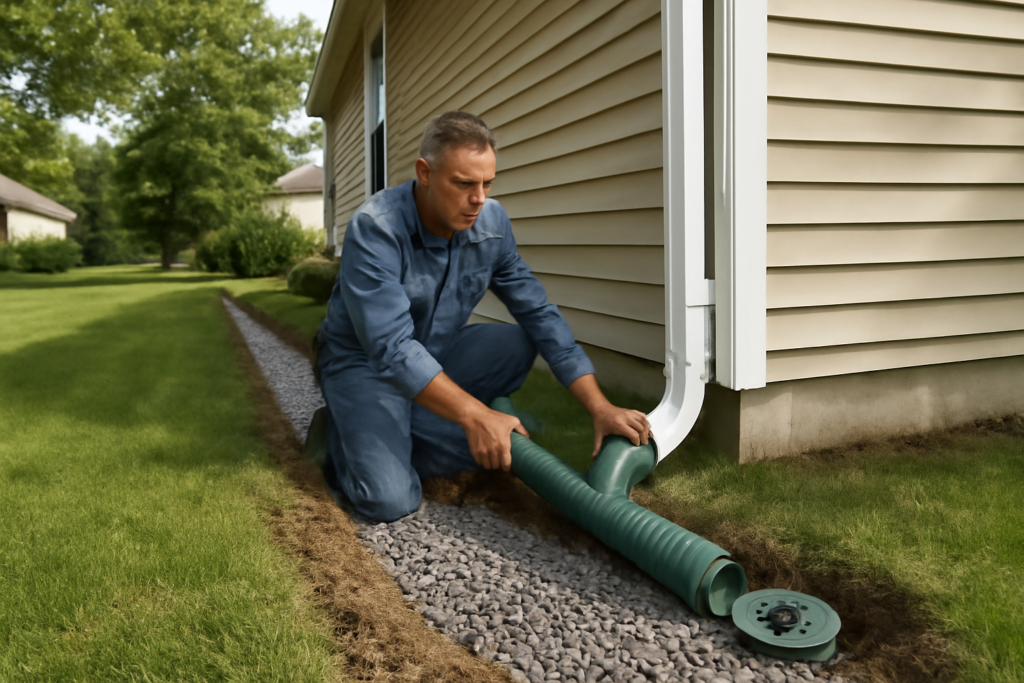
Gutters catch roof runoff, and downspouts carry it down, but the job is not finished there. The classic mistake is letting a downspout dump water right at the foundation. Every downspout should discharge at least 4 to 6 feet from the house, farther on flat lots.
- Extensions: Simple add-on extenders or roll-out splash sleeves move water past the foundation cheaply.
- Buried drain lines: Solid PVC pipe connected to the downspout can carry water underground to a daylight outlet or a dry well well away from the house.
- Splash blocks: A basic concrete or plastic block redirects flow and prevents soil erosion at the outlet.
Clean gutters at least twice a year. A clogged gutter overflows directly onto the soil at the foundation, undoing everything else you have done.
French Drains
When grading and gutters are not enough, a French drain is the workhorse solution. It is a trench filled with gravel that contains a perforated pipe, wrapped in landscape fabric to keep silt out. Water seeps into the gravel, enters the pipe, and flows by gravity to a lower outlet.
French drains solve two problems. An exterior footing drain, installed alongside the foundation, intercepts groundwater before it reaches the basement wall. A yard French drain captures surface water in a chronically wet area and routes it away. The keys to success are continuous downhill slope, at least 1 percent, a clean gravel bed, and a clear place for the water to exit. A drain that empties into a low spot just moves the puddle.
Other Useful Drainage Tools
Depending on your lot, a few additional features may help.
- Dry wells: A buried gravel-filled pit or perforated tank that lets collected water percolate slowly into the soil, useful where there is no daylight outlet.
- Channel or trench drains: Surface grates set in driveways or patios that catch sheet flow before it reaches the garage or house.
- Swales: Shallow, gently sloped landscaped channels that guide water across a yard naturally.
- Rain gardens: Planted depressions that absorb and filter runoff while looking intentional.
Reading the Warning Signs
Drainage problems announce themselves if you know what to look for. Catching them early turns an inexpensive fix into a project, instead of letting it become a flooded basement and a foundation repair.
- Pooling water that lingers more than a day after rain signals poor grading or compacted soil.
- Water stains, efflorescence, or a musty smell in the basement point to moisture pushing through the foundation.
- Erosion channels or exposed soil near downspouts mean water is concentrating where it should not.
- Cracks in the foundation that widen over time can indicate hydrostatic pressure from saturated soil.
- Soggy, mossy patches in the lawn reveal low spots that need a swale or French drain.
Seasonal Drainage Maintenance
Even a well-designed system needs upkeep to keep working. Clean your gutters in spring and fall so they do not overflow at the foundation, and check that downspout extensions are still in place after lawn mowing or snow removal. Walk the yard after a heavy storm and note where water collects, since new low spots develop as soil settles. In freezing climates, make sure discharge points and drain outlets are not blocked by ice, which can back water up against the house. A 20-minute inspection a couple of times a year preserves all the work you put into the system.
When to Call a Professional
Plenty of drainage work is DIY-friendly, including extending downspouts, regrading small areas, and installing a shallow yard French drain. Call a professional when the problem is at the foundation itself. Water already entering the basement, deep footing drains, interior drain tile with a sump pump, or any sign of foundation cracking and movement calls for a waterproofing contractor or structural engineer. Major regrading near retaining walls, utilities, or property lines also warrants a pro, both for the equipment and for code and easement issues.
The Bottom Line
Effective exterior drainage is layered: correct grading sends water away from the house, clean gutters and extended downspouts handle the roof, and French drains or dry wells manage what is left. Start with the cheapest fixes first, since grading and downspout extensions solve most problems, and escalate only if water keeps finding your foundation. A few hundred dollars and a couple of weekends spent now can save you from a flooded basement and a five-figure repair later.