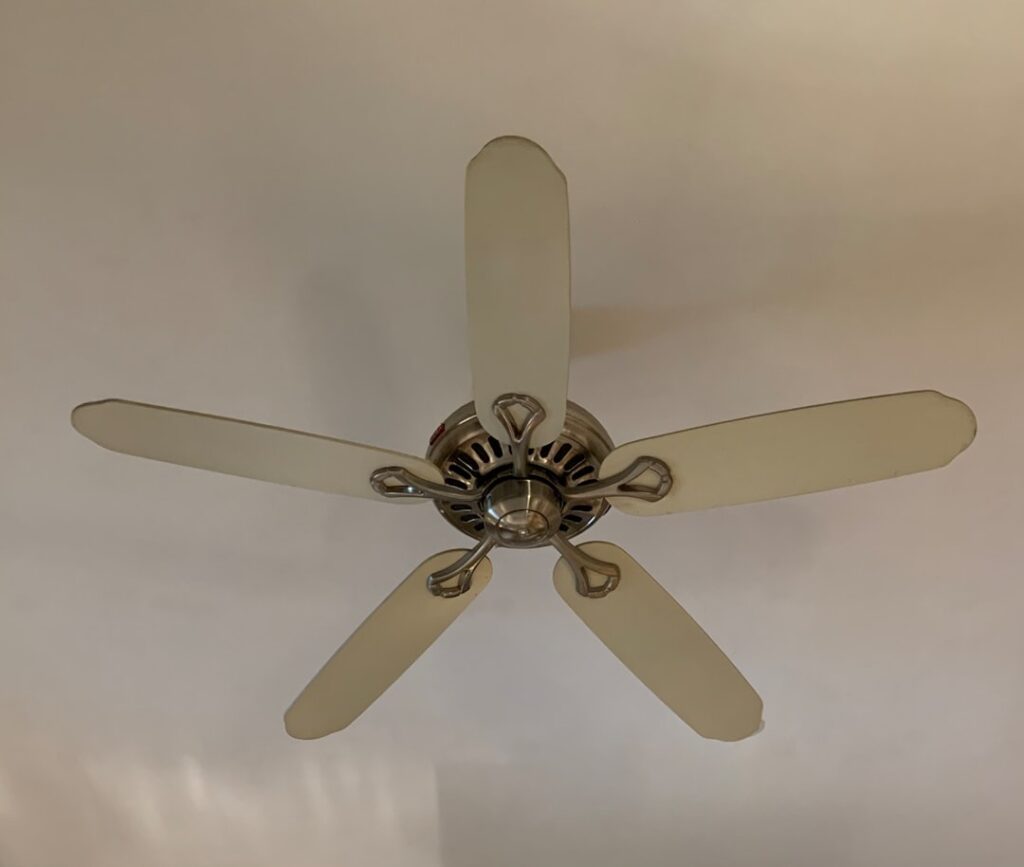
Hang a standard 52-inch fan in a 20-by-24-foot great room and you get a gentle breeze directly under the blades and dead air everywhere else — the most common fan-buying mistake in big-room America. An extra large ceiling fan, meaning anything from 60 inches up to residential monsters of 84, 96, and even 100 inches, solves the problem the way industry does: move a huge column of air slowly, and let it wash across the entire room. Oversized fans have exploded in popularity alongside open-plan builds and vaulted ceilings, and the category now runs from $250 workhorses to $1,500 architectural statements. Here is how to size one correctly, what the specs actually mean, and where the big-fan money goes.
When a Standard Fan Stops Being Enough
Fan sizing follows room area, and the traditional charts top out fast: a 52-inch fan is matched to rooms of roughly 175 to 350 square feet. Beyond that, you either add multiple fans or go big. The case for one big fan is both aesthetic and physical. A large-diameter fan spinning slowly moves more air, more quietly, and more evenly than a small fan spinning hard — the same principle behind commercial HVLS (“high volume, low speed”) fans in warehouses. Slow blade-tip speeds mean less motor noise and none of the choppy, papers-blowing turbulence of a small fan on high. And in a room with a 12- to 20-foot ceiling, a 52-inch fan simply looks lost; scale matters visually as much as functionally.
Practical sizing bands: 300 to 450 square feet, choose 60 to 66 inches; 450 to 600 square feet, 70 to 84 inches; larger great rooms, barn-style spaces, and covered patios beyond 600 square feet justify 96 inches and up, or multiple large fans. In long rectangular rooms, two 60-inch fans often beat one 84 — air needs to reach the corners, and a single fan’s wash weakens past roughly 1.5 times its diameter from center.
Reading the Specs: CFM Is the Number That Matters
Diameter sells fans; CFM moves air. Cubic feet per minute at high speed is the honest performance figure, published on every Energy Star-style fan label. Ordinary 52-inch fans deliver 4,000 to 6,000 CFM. A quality 60- to 72-inch fan should post 6,000 to 10,000 CFM, and serious 84-plus-inch residential fans reach 10,000 to 13,000-plus. Alongside CFM, check efficiency (CFM per watt): DC motors dominate the large-fan category for good reason, delivering 60 to 75 percent lower energy use than AC motors, whisper-quiet operation, and six or more speeds — expect 30 to 40 watts at high speed from a good DC 72-incher, versus 90-plus for an old AC motor.
Blade count matters less than marketing implies. Two- and three-blade designs (Big Ass Fans’ Haiku, Minka-Aire Xtreme) and eight-blade windmill styles can post similar CFM; airfoil shape and motor torque do the work. What does matter on big fans: a rated damp or wet listing for patios and sunrooms, reversible rotation for winter destratification (running reverse on low pushes ceiling heat back down — worth real money in a room with 18-foot ceilings), and a remote or wall control included, since pull chains do not exist at this scale.
Mounting Height and Downrod Math
Code and safety fix the floor: blades must hang at least 7 feet above the floor, and 8 to 9 feet is the performance sweet spot. The ceiling fixes the rest. On a 9- or 10-foot flat ceiling, most extra large fans mount on their standard short downrod. Vaulted and cathedral ceilings are where the category shines — and where buyers under-spec the downrod. The goal is to bring the fan down into the living zone: for a 14-foot peak, plan on a 24- to 36-inch downrod; for 18 feet, 60 inches or more. A giant fan hugging a 18-foot ceiling stirs the attic-adjacent air and leaves the humans becalmed.
Sloped ceilings need attention twice: confirm the fan’s ball-mount handles your pitch (most handle up to about 30 degrees; steeper slopes need an angled-mount adapter), and confirm blade-tip clearance from the descending slope — an 84-inch fan sweeps a 7-foot circle, and the uphill blade tip is the one that finds the ceiling. Keep tips at least 18 inches from any wall or slope, more for airflow quality.
Installation: Respect the Weight
This is where extra large fans differ most from their 52-inch cousins. Big fans weigh 30 to 60-plus pounds and generate real dynamic loads, and a standard plastic ceiling box will not do. You need a metal fan-rated box marked “Acceptable for Fan Support” — and for fans above 70 pounds installed weight, code requires independent support engineered for the load. On new construction, block between joists; on retrofit, use a fan-rated brace bar spanning the joists ($15 to $30) or mount directly to a joist or beam. Verify your specific fan’s requirement, because several 84- to 96-inch models specify structural mounting regardless.
Wiring is conventional (120V single circuit, with DC fans handling speed control at the fan via remote), but the physical hang is a genuine two-person job: assembling a 96-inch fan on a ladder at 16 feet is not a Saturday-morning solo project. Electrician pricing for large-fan installation runs $200 to $500 on accessible ceilings and $400 to $800-plus where scaffolding or lift work enters the picture. Budget it — a fan this size failing at the mount is not a risk worth improvising around.
What to Expect at Each Price Tier
- $250 to $450: Strong value picks — Minka-Aire Xtreme H2O (65-inch, wet-rated, DC, ~10,000 CFM), Hunter Trak XL, Harbor Breeze and Fanimation’s larger studio lines. Solid motors, basic finishes, remote included.
- $450 to $900: The design tier — Fanimation Odyn (84-inch, ~13,500 CFM), Minka-Aire Slipstream XXL, Modern Forms’ smart DC fans with app and voice control, Craftmade windmill styles. Better finishes, LED light kits, damp/wet options across the range.
- $900 to $1,600-plus: Architectural and near-HVLS territory — Big Ass Fans Haiku L and i6 (up to 84 inches, sensor-driven automation), MacroAir-style residential offerings, and 96- to 100-inch statement fans. You are paying for airfoil engineering, silence, and controls as much as size.
Smart features are worth a hard look in this category specifically: occupancy- and temperature-responsive speed (Haiku’s ecosystem, or any fan on a smart wall control) pairs beautifully with the thermostat setback strategy — a big fan’s breeze lets most people raise summer thermostat settings 3 to 4°F with no comfort loss, and at 30 watts the fan is vastly cheaper than the compressor it relieves.
The Bottom Line
Buy the extra large ceiling fan by the numbers and it is one of the highest-comfort-per-dollar upgrades a big room can get: match diameter to square footage, judge performance by CFM and CFM-per-watt, drop it to 8 or 9 feet with the right downrod, and mount it to structure, not to hope. Skip the category only if your ceiling cannot yield 7 feet of clearance or your room is under about 300 square feet, where a quality 52- to 56-inch fan remains the right tool. For everyone with a great room that never quite feels comfortable, the fix has been spinning slowly over warehouse floors for twenty years — it just took the furniture industry a while to make it beautiful.
Living With a Big Fan: Balance, Wobble, and Upkeep
Expect a short settling-in period. A slight wobble on first startup is common at this scale and almost always traceable to three fixable causes: a downrod set screw not fully seated, blades torqued unevenly during assembly, or minor blade-weight variance corrected with the clip-and-stick balancing kit included in nearly every box. Work through those in order before calling support — a properly mounted large fan should run visually still at every speed. Ongoing maintenance is modest but real: dust the blades quarterly (a long-handle microfiber wand reaches most installations; anything higher justifies the twice-yearly ladder trip), check the canopy and blade-iron screws for torque once a year, and listen for new clicks, which are usually a loose light-kit lens rather than the motor. DC motors are sealed and permanently lubricated, so there is nothing to oil on a modern unit. Come October, flip to reverse at low speed and let the fan quietly repay its purchase price pushing warm air off the ceiling — then flip it back in May. A fan this size is closer to a small appliance than a light fixture, and ten minutes of seasonal attention keeps a good one running balanced and silent for fifteen to twenty years.