
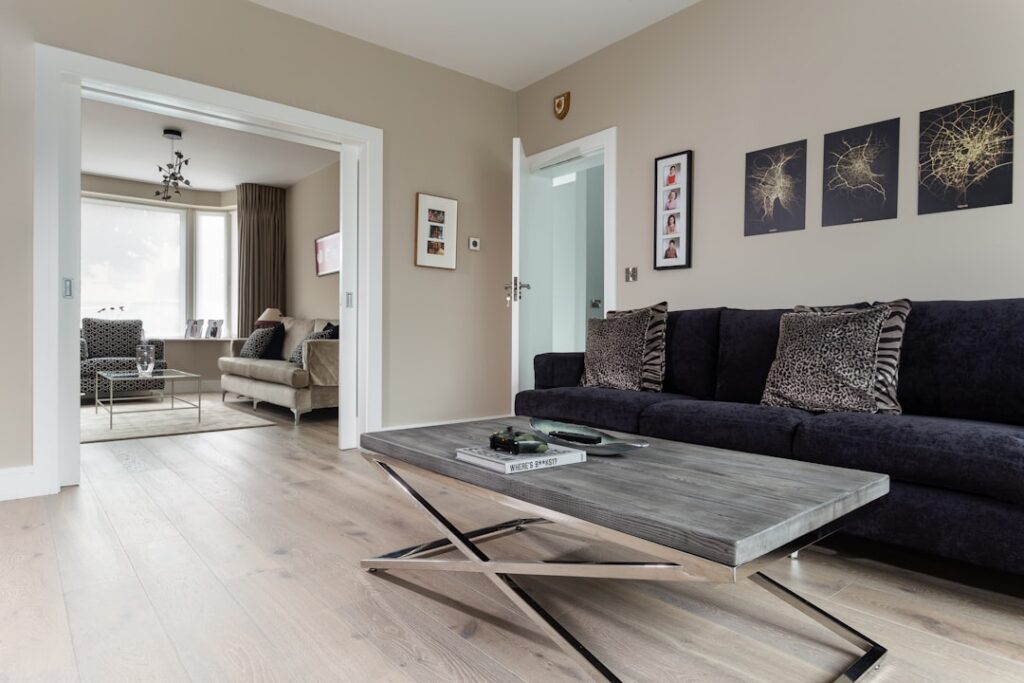
Walk into any big-box flooring aisle and you’ll see 40 different boxes of floating laminate flooring, all promising the same thing. They don’t all perform the same. Some lock tight for 20 years. Others gap within a season because the subfloor was never leveled. The difference between a great install and a disappointing one often comes down to three things: core density, click mechanism, and whether you followed the acclimation rules.
- How Floating Laminate Actually Works
- The Real Pros
- The Honest Cons
- Choosing the Right AC Rating
- Click System Differences
- Subfloor and Acclimation
- Installation Tips That Save Hours
- Top Products Worth Your Money
- Underlayment Matters More Than You Think
- Warranty Fine Print to Read
- When Laminate Isn’t the Right Call
How Floating Laminate Actually Works
A floating floor is not glued or nailed to the subfloor. Planks click together at the edges and rest on a foam or cork underlayment, held in place by their own weight and the perimeter baseboard. This lets the whole floor expand and contract with humidity as a single sheet, which is why the 1/4 inch gap at every wall matters so much.
Laminate itself is a four-layer sandwich: a melamine wear layer, a decorative photo layer, an HDF core, and a moisture-resistant backing. The HDF core is where most quality differences hide.
The Real Pros
- Cost: $1.50 to $4.50 per sq ft for material, roughly half the price of engineered hardwood
- DIY-friendly: An average homeowner can install 400 sq ft in a weekend
- Scratch resistance: AC4 and AC5 rated boards shrug off dog claws and dropped pans
- Visual upgrade: Modern embossed textures look surprisingly close to real oak or hickory
- Works over most subfloors: Plywood, OSB, existing vinyl, even cured concrete
The Honest Cons
Water is still laminate’s biggest enemy. Even waterproof-rated boards will swell if water sits in the seams for more than 24 hours. Sound is the other weak spot. Without a quality 3mm underlayment, footsteps echo. Pergo Gold and QuietWalk Plus both solve this for about $0.40 per sq ft extra.
Laminate also can’t be refinished. Once the wear layer is compromised, that plank is done. And while modern visuals are good, close inspection still reveals the repeat pattern, usually every 8 to 12 boards.
Choosing the Right AC Rating
The Abrasion Class rating tells you where the floor belongs.
- AC3: Light residential traffic, guest rooms only
- AC4: General residential, most homes
- AC5: Heavy residential or light commercial, kitchens and entryways
- AC6: Commercial, overkill in a house but a nice buffer if you have big dogs
For a busy family home, AC4 is the sweet spot on price and durability.
Click System Differences
Not all locking profiles are equal. Unilin’s Uniclic and Valinge’s 5G drop-lock are the two dominant systems. 5G is faster because you drop the plank in rather than angling, which matters in tight bedrooms. Cheap off-brand click mechanisms often have thinner tongues that snap during install. If you feel the plank flex while engaging, send it back.
Subfloor and Acclimation
Your subfloor must be flat within 3/16 inch over 10 feet. Use a long straightedge and self-leveler where needed. Concrete slabs require a 6-mil vapor barrier under the underlayment. Always acclimate boxes in the room for 48 hours at normal living temperature, 65 to 75 degrees F, at 35 to 65 percent humidity. Skipping this causes 80 percent of floating laminate flooring failures I see on callbacks.
Installation Tips That Save Hours
Start along the longest wall, with the tongue facing the room. Stagger end joints at least 12 inches so the seams don’t line up. Use a tapping block, never a hammer directly on the plank, and rent a pull bar for the last row against the wall. For rooms over 40 feet long or wider than 30 feet, plan a T-molding transition. Without it, seasonal expansion will buckle the floor.
Top Products Worth Your Money
Pergo Outlast+ runs about $3.29 per sq ft at Home Depot and carries a lifetime residential warranty with true waterproof performance. Mohawk RevWood Plus sits around $3.99 and has the best edge detail in the mid-price tier. For budget builds, Tarkett Aquaflor at $1.89 per sq ft is the best value I’ve installed under $2.
Underlayment Matters More Than You Think
Skipping underlayment or grabbing the cheapest 2mm foam is the biggest install regret I hear about after the fact. A dedicated 3mm cork-rubber hybrid cuts impact noise by 20 to 25 decibels, which is the difference between a footstep sounding like a footstep and sounding like a hollow drum. For second-floor bedrooms, this upgrade matters enormously. QuietWalk Plus ($0.40 per sq ft) also includes a moisture barrier, which replaces a separate 6-mil poly step on concrete slabs. Manufacturers sometimes void warranties when pre-attached pad laminate is installed over additional underlayment, so check the spec sheet first.
Warranty Fine Print to Read
Most laminate warranties sound impressive until you read the exclusions. Lifetime residential coverage typically excludes water damage over 24 hours, installation errors, subfloor issues, and any scenario without a documented acclimation period. Pergo and Mohawk both require owner documentation and a clean moisture test to honor claims. Keep the receipts, the lot numbers from the box, and photos of the subfloor and underlayment layer. Without that paperwork, most warranty claims get denied at the first phone call.
When Laminate Isn’t the Right Call
Full bathrooms with tubs and showers should get luxury vinyl plank instead, even with waterproof laminate. Basements with chronic moisture need SPC rigid core. And if you plan to sell in under three years in a high-end market, solid hardwood will recoup more of its cost at closing. For everything else, quality floating laminate flooring delivers one of the best dollar-per-year performance numbers in residential flooring, a 15 to 20 year service life on a product that costs a fraction of the alternatives.
Prefer to explore on your own?
See how new flooring looks in your actual room in seconds — free, no signup.
Try the free Floor Studio →

