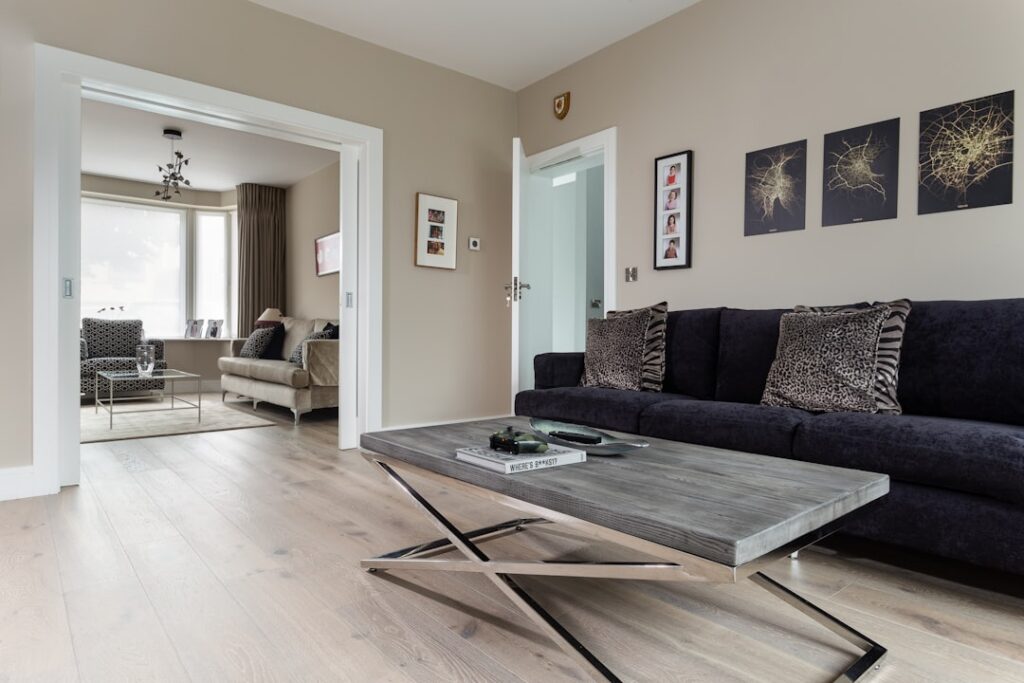
Real maple boards run $7 to $12 a square foot installed and dent if you drop a soup can. Maple laminate flooring delivers the same pale, butter-toned look for under $3 a square foot and laughs off the things that destroy real wood — pet claws, dragged chairs, splashed coffee. The trade-off is texture realism and resale appeal, but for the right rooms the math is hard to argue with. Here is what to know before you order pallets.
Why Maple Translates Well to Laminate
Maple has a tight, almost photographic grain that printers can replicate convincingly. Compared to species like hickory or rustic oak — where deep knots and dramatic color swings give cheap laminate away — maple’s subtle pattern hides the repeating image cycle that haunts low-end product. Even a 12mm board with a 4-pattern repeat can look authentic on a 200-square-foot floor.
The species also keeps its color in finished form, so manufacturers do not have to fight yellowing or oxidation in the print layer the way they do with cherry or pine.
What Maple Laminate Is Made Of
Standard construction is four layers fused under heat and pressure:
- Wear layer: aluminum oxide-coated melamine, the surface you walk on
- Decor layer: high-resolution photo of maple grain
- Core: high-density fiberboard (HDF) at 8-12mm thick
- Backer: melamine balancing layer to resist cupping
The HDF core is the durability story. Anything under 8mm flexes underfoot and telegraphs subfloor imperfections. Splurge for 10mm or 12mm if you can — the underfoot feel is noticeably more solid.
Understanding AC Ratings
Abrasion Class (AC) ratings tell you how much abuse the wear layer can take:
- AC3: moderate residential — bedrooms, dining rooms
- AC4: heavy residential and light commercial — kitchens, hallways
- AC5: heavy commercial — retail, offices
For most homes, AC4 is the sweet spot. Brands like Pergo Outlast+, Mohawk RevWood, and Quick-Step Studio routinely hit AC4 on their maple lines for $2.50-$4.00 per square foot.
Pros of Choosing Maple Laminate
- Costs 60-75 percent less than real maple installed
- Scratch resistance far exceeds solid hardwood — pets and kids welcome
- Click-lock systems install over almost any flat substrate, no glue or nails
- Most products are now water-resistant or fully waterproof for 24-72 hours
- Light tones brighten rooms and pair with both modern and traditional decor
- DIY-friendly — a competent homeowner can do 500 sq ft over a weekend
Cons Worth Knowing
- Cannot be sanded or refinished — wear-through means replacement
- Hollow underfoot sound without a quality cork or dense foam underlayment
- Adds little to home resale value compared to real hardwood
- Edges can swell if water pools at seams for hours
- Limited width options — most maple laminate runs 5-7 inches wide
- Some buyers can spot the repeating pattern in long sightlines
What to Pay
Recent retail pricing tiers:
- Budget (8mm AC3): $1.20-$2.00 per sq ft, fine for guest bedrooms
- Mid (10mm AC4): $2.00-$3.50 per sq ft, the volume sweet spot
- Premium (12mm AC4 with attached underlayment): $3.50-$5.50 per sq ft
- Installation: $2.00-$4.00 per sq ft if you hire out
Total installed for a 1,000-square-foot main level usually runs $4,500-$8,500. Compare that to real maple at $11,000-$18,000 and the appeal is obvious.
How to Spot Quality at the Store
Pull a sample plank from each carton you are considering. Run your finger across the surface — premium boards have an embossed-in-register (EIR) texture that follows the printed grain. Cheap boards feel uniformly smooth or have a generic ticking texture that does not align with the visual.
Bend the corner of a sample. The HDF core should feel dense and refuse to flex. Lightly tap two boards together; the click should be sharp and tight, not loose or rattly. Check the warranty — anything under 25 years residential is suspect.
Underlayment Matters More Than You Think
Many maple laminates ship with attached IXPE foam, which is convenient but acoustically thin. For upstairs rooms or condos, add a 3mm cork sheet underneath. It quiets footfall by 18-22 decibels and softens the underfoot feel dramatically. Expect to pay $0.40-$0.80 per square foot for cork.
For concrete slabs, use an underlayment with a built-in 6-mil moisture barrier or lay 6-mil polyethylene sheeting first. Slab moisture is the number one killer of laminate floors over basements.
Installation Quick Notes
Acclimate cartons in the install room for 48 hours. Leave a 3/8-inch expansion gap around all walls, fixed cabinets, pipes, and doorways. Stagger end joints by at least 12 inches and offset starting rows by a third of a plank length for natural pattern variation.
Use a tapping block and pull bar — never strike planks directly. Cut with a fine-tooth jigsaw blade or a flooring saw to avoid chipping the wear layer. For doorways, undercut jambs and slide planks underneath rather than scribing around them.
Cleaning and Long-Term Care
Sweep or vacuum (hard-floor setting only — beater bars scratch the wear layer) two to three times a week. Damp-mop weekly with a microfiber pad and a laminate-safe cleaner like Bona Pro Series Hard-Surface Cleaner. Skip vinegar, ammonia, and oil soaps — they dull the finish.
Wipe spills within an hour. Place felt pads under every chair leg and use breathable rugs in entries. Trim pet nails monthly. Done right, maple laminate looks fresh for 15-20 years.
Bottom Line
Maple laminate flooring is a smart pick when you want bright, clean wood looks at a budget price and you value scratch resistance over authenticity. For rental properties, kids’ rooms, basements, and busy family homes it is hard to beat. Buy AC4 or better, splurge on quality underlayment, and you will not look at the floor again for a decade.
Prefer to explore on your own?
See how new flooring looks in your actual room in seconds — free, no signup.
Try the free Floor Studio →