If you have ever stood on a basketball court, you have walked on solid maple, but pulling that look into a modern American home means dealing with maple’s notoriously twitchy reaction to humidity. That is exactly the problem maple engineered flooring solves: a real maple wear layer fused to a dimensionally stable plywood or HDF core, giving you the bright, contemporary look without the cupping headaches that haunt solid maple over a slab. After installing this in two finished basements last year, I am convinced it is the smart maple choice for most homeowners.
How Engineered Construction Works
An engineered plank stacks layers like a sandwich. The top is genuine maple, anywhere from 0.6 mm on budget products to 6 mm on premium European-made planks. Below sits a cross-laminated plywood core (the gold standard) or an HDF core (cheaper but more dent-prone). The bottom is a balancing veneer, often pine or eucalyptus, that prevents cupping by counteracting top-layer expansion forces.
This sandwich changes the math on humidity. While solid maple moves about 0.0026 inches per inch per percent moisture content change, an engineered plank with a 4 mm wear layer moves roughly one-quarter as much. That is the difference between visible spring gaps and a floor that stays flat year-round.
Pros That Make Maple Engineered Flooring Worth It
The advantages stack up quickly for the right homeowner. First, dimensional stability lets you install it below grade, over concrete, or in radiant-heated rooms where solid maple cannot go. Second, you can float, glue, or nail-down the same product, depending on your subfloor. Third, the maple wear layer keeps the bright, modern look that makes the species so popular for contemporary kitchens.
- Works below grade and over concrete with a vapor barrier
- Compatible with radiant heat systems up to 81°F
- Wider plank widths (5 to 7.5 inches) without cupping risk
- Pre-finished with aluminum oxide UV-cured topcoat for 25-year wear
- Janka rating of 1450 in sugar maple matches the solid version
The Downsides of Maple
Maple’s tight, closed grain is beautiful but brutal to stain. The wood resists penetration and tends to blotch, which is why most factory products skip stain entirely or use specialty conditioners. If you want a rich walnut look, maple is the wrong species; pick walnut or stained white oak instead.
Maple also shows scratches more visibly than oak because the smooth surface lacks oak’s grain pattern to camouflage damage. A 12 mil aluminum oxide finish helps, but a high-traffic mudroom with a Labrador will still show some surface wear by year five.
Maple Engineered vs. Solid Maple
Cost is comparable, with engineered running $4 to $9 per square foot and solid maple landing $5 to $11. Where engineered wins is install flexibility and humidity tolerance. Where solid still wins is refinishing capacity; a solid maple plank can be sanded 5 to 7 times over its life, while a 2 mm wear layer engineered plank tops out at one careful refinish.
For homeowners planning to live in the house under 15 years, the refinishing argument barely matters. For those buying their forever home, the 6 mm wear layer engineered products from manufacturers like Mirage and Lauzon close the gap to within one or two refinishes of solid.
Finish and Color Choices
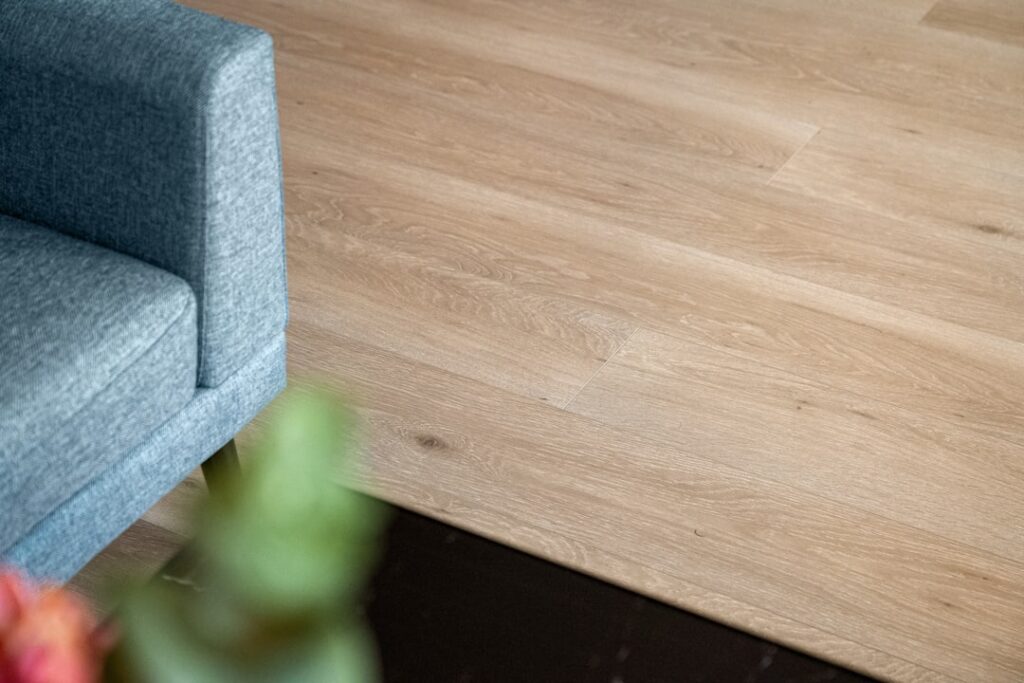
Natural maple is the bestseller for a reason; the pale cream color reads bright and modern. Wire-brushed maple adds tactile interest. Smoked maple delivers a warmer caramel without conventional staining. For homeowners wanting something darker, look at reactive-stained options where the manufacturer chemically alters the wood rather than applying a surface stain.
- Natural matte: bright, contemporary, hides dust well
- Wire-brushed satin: textured, hides foot traffic, modern
- Smoked or fumed: caramel tone without blotchy stain risk
- Hand-scraped: distressed look that masks dings over time
Installation Methods and Costs
Floating installation with a click-lock profile is the most DIY-friendly method. Expect about $1.50 to $2.50 per square foot in labor savings if you handle this yourself. Glue-down over concrete runs $2 to $3 per square foot in labor. Nail-down over plywood is the traditional method and runs $2.50 to $4 per square foot.
Total installed cost for maple engineered flooring typically lands between $7 and $14 per square foot, including underlayment, transitions, and trim. Premium European products with 6 mm wear layers can push to $18 installed.
Maintenance Tips
Daily care matters more with maple because of how clearly it shows scratches. Use felt pads under every chair leg, replace them annually, and never drag furniture. Vacuum or microfiber-dust two to three times per week. Clean spills immediately with a barely damp microfiber and a hardwood-specific pH-neutral cleaner.
Skip vinegar, ammonia, oil soaps, and steam mops entirely. Plan a deep clean every 60 to 90 days using Bona Pro Series Hardwood Cleaner or equivalent, and reapply a maintenance polish like Bona Hardwood Floor Refresher every 12 to 18 months to extend the factory finish.
Best Brands and Where to Buy
Three Canadian manufacturers dominate the premium maple market. Mirage out of Quebec produces some of the most consistently graded sugar maple available, with 4 mm wear layers on premium lines. Lauzon offers similar quality with proprietary air-purifying finishes. Preverco rounds out the trio with a strong custom-color program for designers.
For mid-tier value, Bruce Hardwood (now part of AHF Products) and Mohawk RevWood Premier offer maple engineered options in the $4 to $6 per square foot range at major retailers. Floor & Decor stocks several private-label maple SKUs at the lowest prices, but the wear layers are often only 1 to 2 mm.
Who Should Buy It
Maple engineered flooring is the right call for homeowners who love the bright, modern maple look but live with concrete subfloors, radiant heat, basement installations, or humidity swings outside the 35 to 55 percent ideal band. Skip it if you want a deeply stained dark floor (pick oak), or if your refinishing horizon stretches past 30 years and budget allows true solid construction.
Prefer to explore on your own?
See how new flooring looks in your actual room in seconds — free, no signup.
Try the free Floor Studio →