Choosing the right flooring glue is just as important as choosing the flooring itself. The wrong adhesive can cause planks to lift, tiles to crack, and entire installations to fail prematurely. Yet most homeowners and even some contractors treat adhesive selection as an afterthought, grabbing whatever is cheapest or most convenient at the hardware store.
This guide covers every major type of flooring glue available in 2026, explains which adhesives work best with specific flooring materials, and walks you through proper application techniques. Whether you are installing hardwood flooring, vinyl flooring, tile flooring, or carpet flooring, understanding adhesives will help ensure a durable, long-lasting result.
Why Flooring Glue Matters
Flooring adhesive does more than stick material to the subfloor. A quality adhesive creates a permanent bond that resists moisture, temperature changes, foot traffic, and the natural expansion and contraction of flooring materials over time. Poor adhesive choices lead to hollow spots, squeaking, edge curling, and eventually complete bond failure requiring costly repairs.
The right adhesive also acts as a moisture barrier in some applications, prevents sound transmission between floors, and accommodates the slight movements that all flooring materials experience as humidity and temperature fluctuate. In short, flooring glue is the invisible foundation that determines how long your floor lasts and how well it performs.
Types of Flooring Glue
The adhesive market offers dozens of products, but they fall into several major categories. Understanding these categories is the first step toward selecting the right product for your project.
Urethane Adhesives
Urethane (polyurethane) adhesives are the premium choice for hardwood and engineered wood flooring installations. They cure by reacting with ambient moisture in the air and subfloor, forming an extremely strong, flexible bond that accommodates wood’s natural expansion and contraction.
Urethane adhesives also function as moisture barriers, protecting wood flooring from subfloor moisture vapor. This dual function makes them particularly valuable when installing wood over concrete slabs, where moisture is a constant concern. Premium urethane adhesives cost $40 to $80 per gallon and cover approximately 40 to 60 square feet per gallon depending on trowel size.
Best for: Solid hardwood, engineered wood, bamboo flooring over concrete or plywood subfloors.
Acrylic Adhesives
Acrylic-based adhesives are water-based, low-odor, and easy to clean up before they cure. They provide a strong bond suitable for many flooring types and are popular for residential installations where ventilation may be limited. Most acrylic adhesives are ready to use straight from the container with no mixing required.
Acrylic adhesives are less flexible than urethane options, so they are not ideal for wide-plank hardwood installations where significant wood movement is expected. However, they work excellently for LVP flooring, sheet vinyl, and engineered wood with narrower planks. Pricing ranges from $20 to $50 per gallon.
Best for: LVP, sheet vinyl, engineered wood (narrow planks), VCT (vinyl composition tile).
Pressure-Sensitive Adhesives (PSA)
Pressure-sensitive adhesives remain permanently tacky after application rather than curing to a rigid bond. This allows flooring to be repositioned and even removed without destroying the subfloor — a major advantage for commercial spaces that frequently change carpet tiles or luxury vinyl tiles.
PSA adhesives are applied with a roller or trowel and allowed to dry until tacky before the flooring is placed. They provide a secure hold while still allowing individual tiles or planks to be lifted for maintenance or replacement. This releasable bond is why virtually every commercial carpet flooring tile installation uses pressure-sensitive adhesive.
Best for: Carpet tiles, modular luxury vinyl tiles, temporary installations.
Epoxy Adhesives
Epoxy adhesives are two-part systems (resin and hardener) that create the strongest bonds in the flooring industry. They are waterproof, chemical-resistant, and incredibly durable. Epoxy flooring systems use these adhesives both as bonding agents and as the floor surface itself.
In tile installation, epoxy adhesives and grouts are used in demanding environments like commercial kitchens, food processing plants, and laboratories where chemical resistance and waterproofing are critical. Epoxy adhesives cost more ($50 to $100+ per gallon) and require precise mixing ratios, but they deliver unmatched performance in harsh conditions.
Best for: Heavy-duty tile installations, commercial kitchens, industrial environments, bonding to challenging substrates.
Thin-Set Mortar
Thin-set mortar is the standard adhesive for ceramic and porcelain tile flooring installations. It is a cement-based product mixed with water (modified thin-set includes polymer additives for improved flexibility and bond strength). Thin-set creates a rigid, durable bond that supports heavy tile and natural stone flooring.
Modified thin-set is the go-to choice for most residential and commercial tile work. Unmodified thin-set is used in specific applications, such as tile over uncoupling membranes where the membrane manufacturer specifies it. Thin-set mortar costs $15 to $40 per 50-pound bag and covers 60 to 100 square feet depending on tile size and trowel notch depth.
Best for: Ceramic tile, porcelain tile, natural stone tile, mosaic tile.
Mastic Adhesive
Mastic is a premixed, ready-to-use adhesive for wall tile installations. It is convenient — open the bucket and start troweling — but it has significant limitations. Mastic is not waterproof, not suitable for floor tile (it lacks the compressive strength), and should never be used in wet areas like showers or tub surrounds.
Use mastic only for dry-area wall tile, such as kitchen backsplashes above the countertop line. For everything else, thin-set mortar is the proper choice.
Best for: Dry-area wall tile only (backsplashes, decorative accent walls).
Multipurpose Flooring Adhesives
Several manufacturers offer multipurpose adhesives designed to work with a range of flooring materials — vinyl, rubber, carpet, and cork. These products are convenient for contractors who install multiple flooring types and want to minimize the number of adhesive products on their truck.
While multipurpose adhesives are genuinely versatile, they may not perform as well as specialized adhesives in demanding applications. For high-end hardwood or critical commercial installations, use the adhesive specifically engineered for that material.
Matching Flooring Glue to Flooring Type
Here is a quick-reference guide for selecting the right adhesive based on your flooring material.
Hardwood Flooring
Use urethane adhesive for glue-down solid hardwood and engineered hardwood installations. The flexibility and moisture-barrier properties of urethane are essential for accommodating wood movement and protecting against subfloor moisture.
Engineered Wood Flooring
Urethane or acrylic adhesives both work for engineered wood flooring. Use urethane when installing over concrete or when maximum moisture protection is needed. Acrylic is acceptable over dry plywood subfloors with narrow planks.
Vinyl Plank and LVP
Acrylic or pressure-sensitive adhesive, depending on whether you want a permanent or removable bond. Many LVP flooring products are designed as floating floors and require no adhesive at all.
Sheet Vinyl
Full-spread acrylic adhesive for permanent installations. Perimeter-bond adhesive (applied only along edges and seams) for residential applications where future removal may be desired.
Ceramic and Porcelain Tile
Modified thin-set mortar for floors and wet areas. Mastic only for dry wall applications. Large-format tiles may require medium-bed mortar for full coverage.
Natural Stone Tile
White modified thin-set mortar for light-colored stones (gray thin-set can telegraph through translucent stones like white marble). Epoxy adhesive for demanding commercial environments.
Carpet
Carpet tiles use pressure-sensitive adhesive. Broadloom carpet is stretched over tack strips at the perimeter (no adhesive on the carpet itself) or direct-glued with multipurpose carpet adhesive in commercial settings.
Rubber Flooring
Contact adhesive or urethane adhesive for rubber flooring tiles and rolls. Some rubber manufacturers specify proprietary adhesives — always check the warranty requirements.
How to Apply Flooring Glue Properly
Even the best adhesive fails if applied incorrectly. Follow these steps for a professional-quality bond.
Surface Preparation
The subfloor must be clean, dry, flat, and structurally sound. Remove all dust, debris, paint, curing compounds, and old adhesive residue. Concrete subfloors should be profiled (lightly sanded or ground) to promote adhesive bonding. Test concrete moisture levels — most adhesives have maximum moisture emission limits (typically 3 to 8 pounds per 1,000 square feet per 24 hours).
Trowel Selection
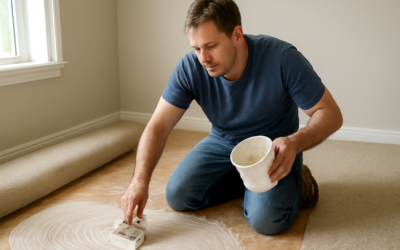
The trowel notch size and shape control how much adhesive is applied. Using the wrong trowel is one of the most common installation mistakes. Too little adhesive creates weak bonds and hollow spots. Too much adhesive oozes up between planks or tiles and creates a mess.
Every adhesive manufacturer specifies the correct trowel size on the product label. Follow their recommendation precisely. Common sizes include 1/16-by-1/16-inch square notch for vinyl, 1/4-by-1/4-inch square notch for tile, and 1/4-by-3/8-inch U-notch for hardwood.
Spread Rate and Open Time
Spread adhesive only as much as you can cover with flooring within the product’s open time — the window during which the adhesive remains workable. Open times range from 15 minutes for some thin-set mortars to 60 minutes for urethane adhesives. Working beyond the open time results in a skinned-over surface that will not bond properly.
In hot or dry conditions, open times shorten significantly. Adjust your working area accordingly, spreading smaller sections at a time. In cool conditions, adhesives may take longer to develop tack, requiring patience before placing flooring.
Flash Time
Some adhesives, particularly those used with vinyl and LVP, require a flash time — a waiting period after spreading during which solvents or water partially evaporate before the flooring is placed. Flash time transforms the adhesive from a wet spread to a tacky state that bonds on contact. Skipping flash time can cause bubbling, poor adhesion, and flooring failure.
Rolling
After placing flooring into wet adhesive, roll the entire surface with a weighted floor roller (75 to 100 pounds for most applications) to ensure full contact between the flooring and the adhesive ridges. Rolling is especially critical for vinyl, LVP, and engineered wood installations. Without rolling, adhesive ridges may not fully compress, leaving voids that become weak spots.
Common Flooring Glue Mistakes to Avoid
These errors cause the majority of adhesive-related flooring failures. Avoid them and your installation will last.
Using the wrong adhesive: Never use mastic where thin-set is required, or general-purpose adhesive where the manufacturer specifies urethane. Always check the flooring manufacturer’s installation guide for approved adhesives.
Ignoring moisture: Adhesive bonds fail when excess moisture is present. Always test concrete subfloors for moisture and install a moisture barrier or use a moisture-mitigating adhesive when levels exceed the product’s limits.
Skipping surface preparation: Dusty, dirty, or uneven subfloors prevent proper bonding. Take the time to clean and prepare the surface before spreading any adhesive.
Wrong trowel size: As discussed above, trowel selection directly affects adhesive coverage. Follow the manufacturer’s specifications without exception.
Working past open time: If the adhesive has skinned over before you place the flooring, scrape it off and re-apply. Forcing flooring into dried adhesive creates a weak bond that will eventually fail.
Forgetting to roll: Rolling compresses the adhesive ridges into full contact with the flooring back. Skipping this step is a leading cause of vinyl and LVP delamination.
Removing Old Flooring Glue
Renovation projects often require removing old adhesive before installing new flooring. The removal method depends on the adhesive type and subfloor material.
For water-based adhesive residue on concrete, a floor scraper and warm water usually suffice. For stubborn residue, an adhesive remover solution softens the old glue for easier scraping. Solvent-based adhesives may require chemical strippers — ensure adequate ventilation and follow all safety precautions.
For large areas, renting a floor grinder or shot blaster is the most efficient approach. These machines mechanically remove old adhesive and simultaneously profile the concrete surface for new adhesive application.
Important warning: Adhesives installed before the 1980s may contain asbestos. If you suspect asbestos-containing adhesive (often black cutback adhesive), have it tested before disturbing it. Asbestos removal requires licensed professionals and must comply with local regulations.
Eco-Friendly Flooring Adhesive Options
Environmental awareness is driving demand for greener flooring adhesives. Look for products with these certifications and characteristics.
FloorScore certification: Indicates the adhesive meets strict indoor air quality standards for volatile organic compound (VOC) emissions.
GREENGUARD Gold certification: Even stricter than FloorScore, certifying very low chemical emissions suitable for schools and healthcare facilities.
Zero-VOC or low-VOC formulations: Water-based acrylic and some urethane adhesives now achieve zero or near-zero VOC content without sacrificing performance.
Bio-based content: Some manufacturers incorporate plant-based ingredients (soy, natural rubber) to reduce petroleum dependence.
Green adhesives typically cost 10 to 20 percent more than conventional alternatives but contribute to healthier indoor air quality — a worthwhile trade-off for most homeowners, especially those with children or sensitivities.
Frequently Asked Questions
How long does flooring glue take to dry?
Drying times vary by product type. Acrylic adhesives typically reach initial set in 12 to 24 hours. Urethane adhesives cure fully in 24 to 48 hours. Thin-set mortar sets in 24 hours for light traffic and reaches full cure in 28 days. Always check the product label for specific times and keep foot traffic off freshly installed floors during the curing period.
Can I install floating floors instead of using glue?
Yes, many laminate flooring, LVP flooring, and engineered wood flooring products are designed as floating installations using click-lock connections. No adhesive is needed except possibly a small bead at the tongue-and-groove joints for added security. Floating floors are faster to install and easier to remove than glued floors.
What happens if I use too much flooring glue?
Excess adhesive squeezes up between planks or tiles, creating unsightly ridges and a messy finish. It can also prevent flooring from seating properly, causing height differences and an uneven surface. Always use the manufacturer-recommended trowel size to control the adhesive spread rate.
Can flooring glue be used on heated subfloors?
Some adhesives are rated for radiant heat systems, but not all. Check the product specifications carefully. Urethane adhesives generally handle radiant heat well, while some acrylic and pressure-sensitive adhesives may soften at elevated temperatures. The flooring manufacturer may also have adhesive requirements for radiant heat installations.
Final Thoughts
Flooring glue may not be glamorous, but it is the critical link between your beautiful new floor and the subfloor beneath it. Choose the right adhesive for your specific flooring material and subfloor conditions, follow the manufacturer’s application instructions precisely, and invest in proper surface preparation. These steps ensure your flooring installation performs flawlessly for years to come. When in doubt, consult both the flooring manufacturer and the adhesive manufacturer for compatibility guidance — a few minutes of research prevents years of regret.
Prefer to explore on your own?
See how new flooring looks in your actual room in seconds — free, no signup.
Try the free Floor Studio →