A free standing patio umbrella solves a problem that table-mounted umbrellas cannot: it shades a lounge chair, a sandbox, or a corner of the deck without needing a table to hold it up. Because the support comes from a weighted base or an offset arm rather than a hole in a tabletop, you can place shade exactly where you want it and move it as the sun shifts. Choosing the right one comes down to style, size, base weight, and fabric, and this guide covers each.
Part of our Decks & Outdoor guide — explore the full guide →
Cantilever vs. Market Style
Free standing umbrellas come in two main forms, and the difference shapes how and where you can use them.
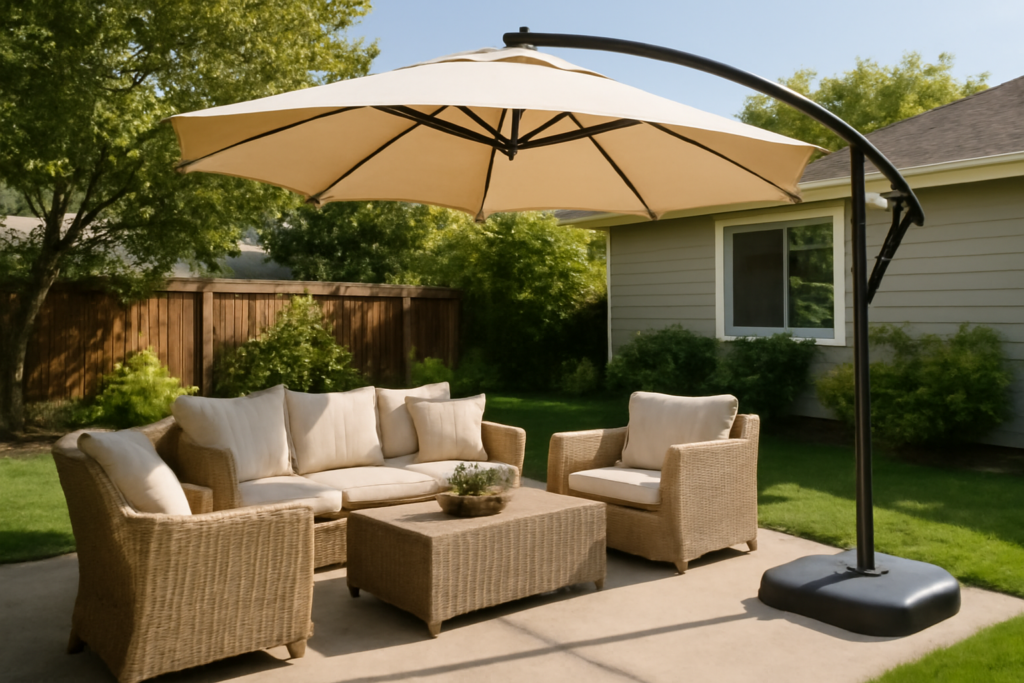
- Cantilever (offset) umbrellas: The pole sits off to the side and an arm suspends the canopy overhead, leaving the space below completely open. This is ideal for shading furniture, hot tubs, or play areas without a pole in the middle. Many rotate 360 degrees to follow the sun.
- Market-style umbrellas with a stand: A traditional center-pole umbrella set into a heavy freestanding base. They are more affordable and simpler, but the center pole takes up floor space.
Cantilever models cost more and need a heavier base, but the unobstructed shade they provide is hard to beat for a seating area.
Getting the Size Right
Umbrellas are measured by canopy diameter or width, and bigger is not always better if your space is tight. As a rule of thumb, a canopy should extend about 2 feet beyond the area you want shaded on each side, since the sun moves across the sky.
- 6 to 7.5 feet: Good for a couple of chairs or a small bistro setup.
- 9 feet: The most popular size, shading a standard patio table or a pair of loungers.
- 10 to 11 feet and larger: For big seating groups or generous lounge zones; usually cantilever designs.
Square and rectangular canopies cover seating arrangements more efficiently than round ones, while round canopies suit round tables and conversational layouts.
Do Not Skimp on the Base
The base is what keeps a freestanding umbrella from becoming a sail in a gust, so it deserves serious attention. Underweighting is the most common mistake and the leading cause of tipped, broken umbrellas.
For a market-style stand, aim for roughly 50 pounds for a 9-foot canopy and more for larger sizes. Cantilever umbrellas need far heavier bases, often 150 pounds or more, frequently achieved with fillable plastic plates loaded with sand or water plus added paver weights or cross-bar designs that hold patio stones. When in doubt, go heavier than the minimum, and always close the umbrella when you leave or when wind picks up.
Choose a Fabric That Lasts
The canopy fabric determines how long the umbrella looks good and how well it blocks the sun. Solution-dyed acrylic, the kind used in premium awning fabrics, resists fading and mildew far better than cheaper polyester. Polyester is fine for occasional or budget use but will fade after a season or two of intense sun.
Look for a high UV-protection rating if sun safety is a priority, and consider a vented canopy, which has an opening at the top that lets wind pass through and reduces the chance of the umbrella catching air and flipping.
Useful Features to Look For
A few conveniences separate a good umbrella from a frustrating one.
- Tilt and crank: A crank lift makes opening easy, and a tilt function angles the canopy as the sun drops.
- Rotation: Cantilever models that spin let you follow the sun without moving the base.
- Sturdy ribs: Fiberglass ribs flex in wind without snapping; aluminum poles resist rust.
- Integrated lighting: Some canopies include solar LED lights along the ribs for evening use.
Frame and Pole Materials
The skeleton of the umbrella determines how long it lasts and how it handles weather. Aluminum poles are lightweight, rust-resistant, and the most common choice, ideal for most patios. Steel is stronger and heavier, better for very large canopies but prone to rust if the finish chips. Wood poles, often eucalyptus or teak, bring a natural look but require more upkeep and can weather over time.
Ribs matter just as much as the pole. Fiberglass ribs flex in the wind and spring back instead of snapping, which makes them the most wind-tolerant option. Aluminum and steel ribs are sturdy but can bend or break under strong gusts. If your area gets breezy afternoons, prioritize fiberglass ribs and a vented canopy together, since that combination survives wind far better than a rigid, unvented umbrella.
Matching the Umbrella to Your Climate
Your local weather should steer your choice as much as your decor. In sunny, dry regions, prioritize a fade-resistant solution-dyed acrylic canopy and a high UV rating to protect against relentless sun. In windy coastal or open areas, lean toward a heavy base, fiberglass ribs, and a vented top, and close the umbrella whenever it is unattended. In rainy climates, look for a water-resistant canopy and be diligent about drying it before storage to prevent mildew. Choosing with your climate in mind means the umbrella performs reliably instead of becoming a casualty of the first big storm.
Care and Storage
A little maintenance extends the life of any patio umbrella considerably. Hose off the canopy and spot-clean with mild soap and water as needed, letting it dry fully before closing to prevent mildew. Always close the umbrella in wind and overnight. For winter or long periods of disuse, store it indoors or use a fitted cover, and bring fillable bases inside if they could freeze and crack.
The Bottom Line
A free standing patio umbrella gives you flexible, table-free shade anywhere on your patio or deck. Decide between a cantilever model for unobstructed coverage and a market style for value, size the canopy about 2 feet larger than your seating area on each side, and above all match it to a base heavy enough to keep it grounded. Pair the right size and base with a quality acrylic canopy, and you will have dependable shade that lasts for years.