A GE counter depth refrigerator sits nearly flush with your countertops and cabinets instead of jutting a foot into the room like a standard fridge. That built-in look is why they’ve exploded in popularity — but there are real trade-offs in capacity, price, and layout that nobody explains in the showroom. Here’s what actually matters across GE’s lineup.
GE spans three tiers here: the base GE brand, the mid-tier GE Profile, and the premium Cafe series. All three offer counter-depth models, and the differences go well beyond the badge on the door. I’ll walk through dimensions first, because that’s the whole point of buying counter-depth.
- What “Counter Depth” Actually Means
- GE, Profile, and Cafe: Which Line Fits You
- Layouts: French Door, Side-by-Side, and Four-Door
- Features Worth Paying For
- Measuring Your Space Before You Buy
- Reliability and Service
- Organizing the Interior for Real Life
- Energy Use and Running Costs
- Finishes and Fingerprint Resistance
- The Bottom Line
What “Counter Depth” Actually Means
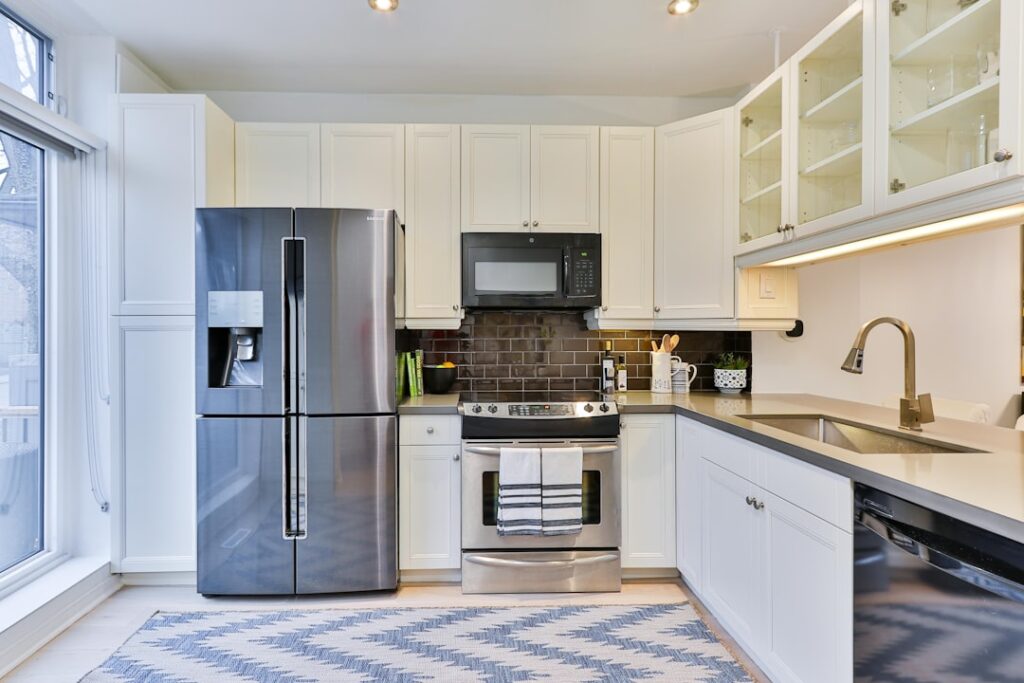
A standard refrigerator runs 33 to 36 inches deep including the doors and handles. A counter-depth model shrinks that to roughly 28 to 31 inches so the body aligns with a typical 24-inch base cabinet, with only the doors and handles projecting past the counter’s edge. The result is a sleek, integrated look without the cost of a true built-in.
The catch: you give up interior volume. A standard French-door GE holds 25–27 cubic feet. The counter-depth equivalent drops to 22–24 cubic feet, and some slimmer models land near 18.6 cubic feet. You’re trading about 3–5 cubic feet — roughly a couple of grocery bags of storage — for that flush profile. For most households it’s a fair trade; for a family of six who buys in bulk, think hard.
GE, Profile, and Cafe: Which Line Fits You
The base GE counter-depth models cover the essentials — French-door or side-by-side layouts, decent LED lighting, and basic humidity-controlled crispers — usually $1,600 to $2,200. They’re the value pick if you want the look without splurging on gadgets.
The GE Profile tier, typically $2,200 to $3,200, adds the features people actually notice: an internal water dispenser or the Autofill pitcher, hands-free autofill dispensers, showcase LED lighting, and better temperature management. This is the sweet spot for most buyers.
The Cafe series, $3,000 to $4,500, is where design takes over — customizable hardware in brushed bronze, brushed black, or brushed stainless, matte white and matte black finishes, and premium touches like the Keurig K-Cup brewing system built into the dispenser on some models. If your kitchen is a design statement, Cafe delivers.
Layouts: French Door, Side-by-Side, and Four-Door
French-door layouts dominate the counter-depth market for good reason — the wide, shallow shelves fit party platters and pizza boxes, and the freezer drawer keeps frozen goods at waist level. GE’s four-door models add a convertible middle drawer that switches between fridge and freezer temperatures, handy for overflow or a beverage zone.
Side-by-side counter-depth GE units suit narrow kitchens where door swing is tight, since each door needs less clearance. But the tall, skinny freezer struggles to fit wide items like sheet pans and frozen turkeys. Choose the layout around what you store, not just the aesthetic.
Features Worth Paying For
Not every feature earns its price. These consistently prove their worth in the field:
- Autofill dispenser — fills any container with a measured amount of filtered water, no button-holding. Genuinely useful daily.
- Turbo Cool / Turbo Freeze — rapidly drops temperature after you’ve loaded warm groceries or left the door open. Protects food and speeds recovery.
- Dual evaporators — separate cooling systems for fridge and freezer keep humidity and odors from crossing over. Your lettuce lasts longer and your ice doesn’t taste like last night’s leftovers.
- WiFi Connect — remote temperature control and filter alerts. Nice-to-have, not essential.
Skip the built-in Keurig unless you’ll genuinely use it — it adds cost and one more thing to break.
Measuring Your Space Before You Buy
A GE counter depth refrigerator only looks built-in if it’s installed with the right clearances. Standard counter-depth width is 35.75 inches, so a 36-inch opening is typical — but leave 1/8 inch on each side plus room at the back for the water line and airflow. Height runs 68 to 70 inches; measure your upper-cabinet clearance.
Critically, account for door swing. French doors need clearance to open past 90 degrees so the interior drawers can pull out fully — a wall or island too close will block them. Measure the handle-to-wall distance and check the spec sheet’s “door open” depth, which can push past 48 inches. Plan a 1/2-inch air gap on top and sides for ventilation, and confirm you have a water supply line and a grounded outlet within reach.
Reliability and Service
GE refrigerators land in the reliable-to-average band. The most common service issues are ice maker faults and, occasionally, control-board or evaporator-fan problems around the 5-to-8-year mark — normal for the category. GE’s parts availability is a genuine advantage: components are widely stocked and reasonably priced, and most metro areas have factory-authorized service. Register the unit and keep the model number handy for filter orders.
The standard warranty is one year on parts and labor, with a longer sealed-system warranty on some Profile and Cafe models. Extended coverage is optional; given GE’s parts availability, many owners skip it and pay out of pocket for the occasional repair.
Organizing the Interior for Real Life
Because a GE counter depth refrigerator gives up a few cubic feet, how you organize it matters more than in a cavernous standard unit. GE’s better models help here with adjustable spill-proof glass shelves that slide back to make room for a tall pitcher, gallon-size door bins that keep milk and juice off the main shelves, and two humidity-controlled crisper drawers — one set high for leafy greens, one low for fruit.
The freezer drawer is where counter-depth pinches hardest, so use it deliberately. GE’s split-basket and sliding-tray systems keep frozen goods from becoming a solid brick at the bottom. Store flat items like pizzas and sheet-pan meals upright like files rather than stacked, and you’ll reclaim usable space. Owners who think through their storage before buying rarely miss the volume they traded away.
Energy Use and Running Costs
Most GE counter-depth models carry an ENERGY STAR rating, drawing roughly 600 to 750 kWh a year — about $75 to $100 in electricity depending on your utility rate. That’s competitive with standard-depth units despite the fridge working slightly harder in a shallower cabinet. The inverter compressors on Profile and Cafe models run quieter and modulate their speed, trimming energy use versus older single-speed compressors.
Ongoing costs beyond electricity are modest: a water filter every six months at $40 to $50, and the occasional out-of-warranty repair. Over a 12-to-15-year lifespan, the running costs are predictable and reasonable — the bigger financial variable is the upfront tier you choose, not what it costs to keep the fridge humming.
Finishes and Fingerprint Resistance
Finish is a daily-life decision, not just an aesthetic one. GE’s standard stainless steel looks classic but shows fingerprints and smudges, which is a real annoyance in a busy family kitchen. The fix is fingerprint-resistant stainless, offered across most Profile and Cafe models — it wears a micro-textured coating that hides prints and wipes clean with a dry cloth. For most households, paying up for the fingerprint-resistant finish is worth it purely for the reduced cleaning.
The Cafe line pushes finishes furthest, with matte white, matte black, and stainless options paired with swappable hardware in brushed brass, bronze, black, or stainless — you can restyle the fridge later just by changing the handles. Black stainless and slate finishes bridge the gap for kitchens moving away from bright stainless. Pick the finish alongside your cabinet and hardware palette so the fridge reads as part of the design rather than a mismatched appliance.
The Bottom Line
A GE counter depth refrigerator is the right call if you want that clean, integrated kitchen look without the five-figure price of a true built-in like a Sub-Zero. Decide your budget tier first — base GE for value, Profile for the best mix of features and price, Cafe for design — then confirm the cubic footage works for your household and the door swing fits your layout. Measure twice, size the capacity to how you really shop, and you’ll get a fridge that looks like it was designed into the kitchen from day one.