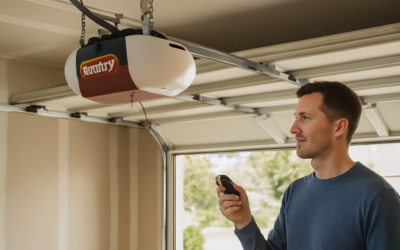
Screw-drive openers have a reputation for being loud, but the Genie Pro Max garage door opener has quietly outsold flashier belt-drive units for a simple reason: it lifts heavy doors reliably with fewer moving parts and less maintenance. Homeowners with insulated steel or solid wood doors often discover that the smoother, more powerful chain and belt units struggle where this screw-drive workhorse keeps pulling. Understanding what the Pro Max does well, and where it falls short, helps you decide whether it belongs in your garage.
Part of our Garage Doors guide — explore the full guide →
This guide walks through the model’s horsepower and drive system, its programming and safety features, and the troubleshooting steps that resolve the issues owners run into most. Whether you are shopping for a replacement or trying to revive a unit that has stopped responding, the details below will save you a service call.
What Sets the Pro Max Apart
The Pro Max is built around a screw-drive mechanism rather than a chain or belt. A long threaded steel rod rotates, and a trolley threaded onto that rod travels up and down to move the door. This design delivers strong, steady lifting force with roughly a third fewer moving parts than a chain drive, which translates to less to wear out, break, or knock loose over the opener’s life.
Screw drives also excel at heavy lifting. Because the force applies directly along the rod, the Pro Max handles insulated and solid doors that make lighter units strain. The tradeoff historically was noise, but modern versions run on a lubricated rail and a plastic-lined trolley that keep operation reasonably quiet, far quieter than the metal-on-metal clatter people remember from older screw drives.
Horsepower and Lifting Capacity
The Pro Max is commonly rated around three-quarter horsepower or its DC-motor equivalent, which is more capacity than most residential doors require. That headroom matters because an opener working near its limit wears out faster and struggles in cold weather when door springs stiffen. With the Pro Max, a standard 16-foot double door or a heavy single wood door has power to spare.
If your door is unusually tall, wider than 18 feet, or made of thick solid wood, the extra lifting force is exactly what you want. For a light aluminum single door, the Pro Max is arguably overbuilt, and a smaller unit would suffice, but the reserve power never hurts and extends the opener’s working life.
Key Features Worth Knowing
Beyond raw lifting power, the Pro Max includes the convenience and safety features buyers expect from a mid-range opener. Understanding what is included helps you use the unit fully rather than leaving half its capability untouched.
- Intellicode rolling-code security: the access code changes with every use to block code-grabbing devices
- Safe-T-Beam infrared sensors: a pair of photo-eyes that reverse the door if anything crosses the opening
- Manual release cord: disconnects the trolley so you can operate the door by hand during a power outage
- Adjustable travel limits and force settings: let you fine-tune how far and how hard the door moves
- Compatibility with Genie remotes, keypads, and Aladdin Connect Wi-Fi: for smartphone control on equipped versions
The Safe-T-Beam system deserves special attention because it is federally required and the most common source of operating faults. Two small units mount near the floor on either side of the door, and their alignment is critical to normal function.
Programming Remotes and Keypads
Pairing a remote to the Pro Max is straightforward once you locate the learn button, usually on the back or side of the motor head near the antenna wire. Press and release the learn button; an LED will illuminate for about 30 seconds. During that window, press the button on your remote once, then a second time after the opener light blinks, confirming the code was accepted.
Keypads follow a similar sequence. Enter your chosen PIN on the keypad, press the learn button on the motor, then press the keypad button to link them. If the door does not respond afterward, the most common cause is that the learn window timed out before you finished, so simply repeat the process a bit faster. Rolling-code security means each new device must be trained directly at the motor rather than copied from an existing remote.
Troubleshooting Common Problems
Most Pro Max complaints trace back to a handful of easily fixed issues. Before assuming the motor has failed, work through these in order.
Door Reverses Before Closing
This nearly always means the Safe-T-Beam sensors are misaligned or blocked. Check that both sensor lights glow steadily; a blinking or off light indicates the beam is broken. Wipe the lenses, confirm nothing sits in the doorway, and gently adjust the sensor brackets until both show a solid light. Loose brackets that drift out of alignment are the number one nuisance with this opener.
Motor Runs But Door Does Not Move
The trolley has likely disconnected from the screw rod, usually because someone pulled the manual release cord. Reconnect by pulling the cord toward the door and running the opener until the trolley re-engages with a click. If the carriage is stripped, that plastic part is a $20 to $40 replacement.
Remote Works Intermittently
Weak remote batteries are the usual cause, followed by radio interference from LED shop lights or a nearby smart device. Swap the battery first, and if the range is still poor, check that the antenna wire dangling from the motor head is fully extended and undamaged.
Maintenance to Keep It Quiet
A screw-drive opener needs different care than a chain drive. The single most important task is lubricating the screw rod, and using the correct product matters. Apply a lithium-based or silicone grease made for screw-drive rails, never a spray oil like WD-40, which strips lubricant and attracts grit. Once or twice a year, wipe old grease off the rod and apply a fresh thin coat along its full length.
Also test the door balance annually. Pull the manual release with the door closed and lift it halfway by hand; a properly balanced door stays put. If it slams down or springs up, the door springs need adjustment, and running the opener against an unbalanced door shortens the motor’s life. Spring work is best left to a professional because the tension involved is genuinely dangerous.
Smart Features and Aladdin Connect
Many Pro Max versions are compatible with Genie’s Aladdin Connect system, which brings smartphone control to an otherwise conventional opener. With the add-on module and the free app, you can open or close the door from anywhere, receive alerts when it operates, and check whether you left it open after pulling out of the driveway. For households where someone always wonders whether the door is down, this feature alone justifies the small upgrade cost.
Aladdin Connect also integrates with major smart-home platforms, allowing voice commands and automation routines such as closing the door automatically at a set time each night. If your Pro Max did not ship with the module built in, the retrofit kit is typically $40 to $60 and installs in about fifteen minutes by connecting to the opener’s terminals and your home Wi-Fi. It is one of the more useful and affordable ways to modernize an existing opener without replacing the whole unit.
Keep in mind that smart features depend on a reliable Wi-Fi signal reaching the garage, which is often the weakest-covered room in the house. If the app frequently reports the door as offline, the fix is usually a Wi-Fi extender near the garage rather than a fault in the opener. A strong, stable connection is what makes the remote-control and alert features dependable rather than frustrating.
Is the Pro Max Right for You?
The Genie Pro Max garage door opener is the pragmatic choice for homeowners with heavy doors who value durability and low maintenance over whisper-quiet operation. It is not the quietest opener on the market; a belt drive still wins that contest by a small margin. But for reliable lifting power, fewer parts to fail, and a proven track record, the Pro Max remains a strong value in the $200 to $300 range.
If your garage sits below a bedroom and silence is the top priority, weigh a belt-drive alternative. For nearly everyone else, especially those with insulated or solid doors, the Pro Max delivers dependable performance that will keep the door moving smoothly for well over a decade with only annual lubrication and the occasional sensor adjustment.