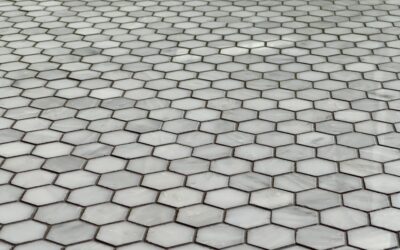
The hexagon never really left American interiors. It first appeared on bathroom floors in the 1900s, took a backseat to subway and 4-by-4 squares for decades, and roared back in the 2010s as designers rediscovered its visual energy. Buying h tile in 2026 means navigating a wider product catalog than ever: 1-inch mosaic to 13-inch large-format planks, in porcelain, ceramic, marble, glass, cement, and even wood-look. Picking the right product for the right room comes down to size, material, install pattern, and grout strategy.
Part of our Tile & Grout guide — explore the full guide →
- Sizes That Are Actually Available
- Material Differences
- Install Pattern Choices
- Substrate and Setting
- Grout: The Defining Choice
- Where Hexagon Tile Excels
- Where Hexagon Falls Flat
- Slip Resistance for Wet Areas
- Cost Breakdown for a 40 Sq Ft Powder Room
- Brand Lines to Shortlist
- Installation Time Reality
- The Bottom Line
Sizes That Are Actually Available
- 1-inch hex mosaic on 12-by-12-inch mesh: shower floors, decorative borders. $8 to $14 per sq ft.
- 2-inch hex mosaic: powder room floors, mudrooms. $7 to $13 per sq ft.
- 3-inch and 4-inch hex: general residential floors and walls. $5 to $10 per sq ft.
- 6-inch hex: contemporary look, large-format hex feel. $6 to $14 per sq ft.
- 8-inch hex: statement floors and accent walls. $8 to $18 per sq ft.
- 13-inch hex (Marrakech, Casablanca pattern): hospitality-grade statement floors. $10 to $25 per sq ft.
Material Differences
Porcelain leads the hex category. Daltile, Marazzi, Florim, and MS International all run extensive hexagon lines in PEI 4-5 porcelain at $4 to $12 per sq ft. The body color of porcelain runs through the tile, so chips are nearly invisible. Ceramic hexagons are cheaper ($3 to $7 per sq ft) but show a different-colored clay body if chipped, limiting them to walls and light-traffic areas.
Marble and stone hexagons read luxurious but require sealing every 18 to 24 months with a penetrating sealer like Miracle 511 or Stonetech Bulletproof. Glass hexagons (Bedrosians, Walker Zanger) deliver light-reflective sparkle but should stay on walls and backsplashes.
Install Pattern Choices
The hex shape itself dictates the basic grid, but layout decisions still matter. Standard grid offset (each row shifted by half a hex width) creates a flowing organic pattern. Color-blocking with a different shade hex used at room transitions or as a faux rug under a vanity creates strong design moments. Black-and-white hex in a 2:1 ratio gives the classic Victorian bathroom feel that has been a designer favorite for 20-plus years.
Substrate and Setting
For floor installs, the subfloor needs deflection no worse than L/360 (TCNA Handbook standard). On wood-framed floors, that means 3/4-inch tongue-and-groove plywood plus 1/4-inch cement board or Schluter Ditra. On concrete, a clean leveled slab tested per ASTM F2170 with RH under 80 percent.
Use polymer-modified thinset rated ANSI A118.4 for porcelain and natural stone. The hex shape requires careful trowel work; spread thinset in one direction with a 1/4-by-1/4-inch square-notch trowel, then flatten the ridges before setting tile to prevent voids beneath the small honeycomb spaces.
Grout: The Defining Choice
Hexagons have approximately 30 to 50 percent more grout joint per sq ft than a square pattern of the same tile size. Grout color becomes a major design choice. Three approaches:
- Grout matched to tile: monolithic look, hexagons read as a continuous surface. Common in modern designs.
- Contrasting grout (white tile, dark grout, or vice versa): emphasizes the geometry. Bold and busy.
- Neutral grout (light grey, warm grey): forgives staining over time and works with any future redecorating.
Spend the extra for epoxy or urethane grout in any hexagon installation. Mapei Kerapoxy IEG CQ, Laticrete SpectraLOCK Pro Premium, or TEC Power Grout all run $1 to $3 per sq ft material and save endless cleaning time.
Where Hexagon Tile Excels
Powder rooms and small bathrooms benefit dramatically from hexagon’s pattern energy, where the visual interest compensates for the room’s lack of size. Entryways, mudrooms, and laundry rooms get hard-wearing, easy-to-clean floors with character. Kitchen backsplashes in hex glass or porcelain bring movement to vertical surfaces. Shower walls in stacked or staggered hex feel current without overwhelming.
Where Hexagon Falls Flat
Large open floor plans can swallow the visual texture, leaving the floor reading busy without focus. Long narrow hallways amplify the eye’s tendency to follow the joint pattern, which can feel disorienting. And in any room with significant cut tiles needed at perimeters, hex generates more waste (10 to 15 percent vs 5 to 8 percent for square tile), driving material cost up.
Slip Resistance for Wet Areas
The grout-line density that makes large-grid hexagons busy on the eye becomes a major advantage in showers. Even slick-glazed porcelain hex tile delivers excellent foot grip thanks to all those grout grooves. Spec a DCOF of 0.42 or higher (ANSI A137.1 minimum), and for shower floors specifically, push for 0.50 or higher with a matte or textured finish.
Cost Breakdown for a 40 Sq Ft Powder Room
- Mid-range porcelain 2-inch hex: $8 per sq ft = $320
- Schluter Ditra membrane: $1.70 per sq ft = $68
- Polymer-modified thinset: $35 for 1 bag
- Epoxy grout, 1 unit: $80
- Edge trim (Schluter Jolly profile): $40
- Pro install at $9 per sq ft labor: $360
Total: about $900 for a finished powder room floor that will outlast the rest of the bathroom finishes.
Brand Lines to Shortlist
Daltile Octagon and Dot in classic 2-inch hex at $7.49 per sq ft. Marazzi Soho hex porcelain in 12 colors at $5.99 per sq ft. Bedrosians Cloe ceramic 6-inch hex for a hand-made artisan look at $9 per sq ft. Walker Zanger Studio Moderne hex marble at $24 per sq ft for luxury baths. Floor & Decor’s house brand hex porcelain at $3.49 per sq ft is a value benchmark.
Installation Time Reality
Plan on the install taking 25 to 40 percent longer than a comparable square-tile job. The hex perimeter cuts require careful templating, and the grout work demands extra effort to keep every joint clean. If your installer quotes the same labor rate as for a square-tile job, push back; they will either rush the work or run over their bid.
The Bottom Line
H tile delivers more design impact per sq ft than any other tile geometry. Choose porcelain for floors and bathrooms, ceramic or glass for walls and backsplashes, and natural stone for premium statement work. Pair with epoxy grout, factor in 10 to 15 percent waste, and pay for skilled installation. The result is a floor or wall that anchors the room for decades.
Prefer to explore on your own?
See how new flooring looks in your actual room in seconds — free, no signup.
Try the free Floor Studio →