
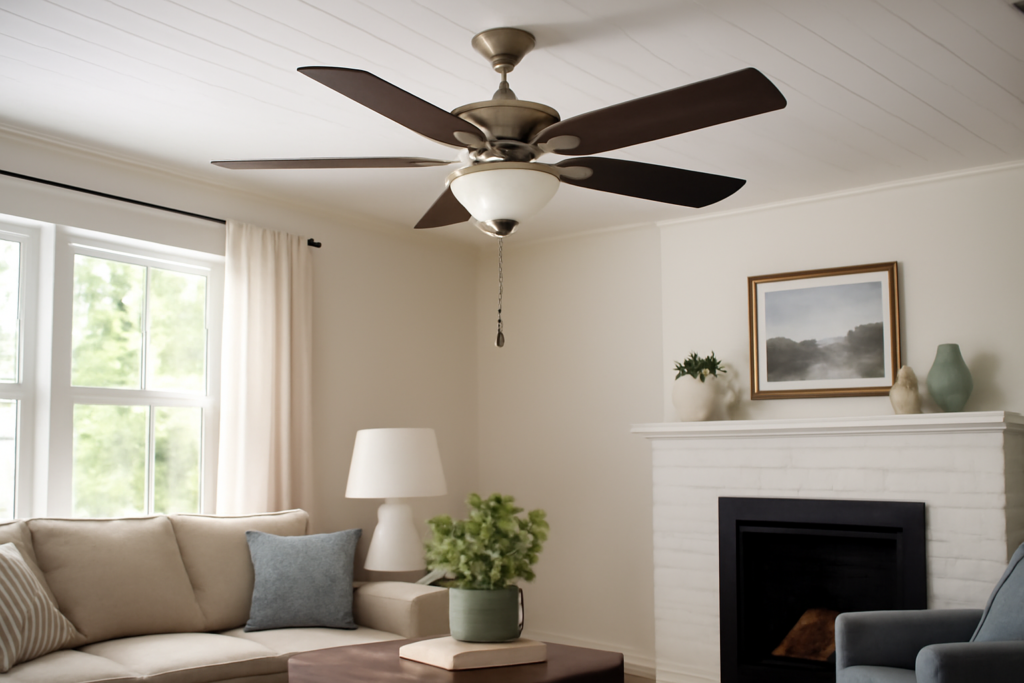
Walk into any Lowe’s and the fan aisle is wall-to-wall Harbor Breeze — yet the company “Harbor Breeze” does not exist. A Harbor Breeze ceiling fan is Lowe’s house brand, manufactured primarily by Litex Industries of Grand Prairie, Texas, and it occupies the same slot Hampton Bay fills at Home Depot: budget-to-midrange fans, $50 to $250, sold in volume with hit-or-miss consistency between models. Some Harbor Breeze fans are genuinely excellent value; a few are the reason the brand has a mixed reputation online. After installing and servicing plenty of both kinds, here is the honest picture — the models worth buying, the known weak points, and the parts situation when something fails.
Who Actually Makes Harbor Breeze
Litex Industries holds the license and builds most of the line, with some models historically sourced from other OEMs. That matters for two practical reasons. Warranty and parts run through Lowe’s and Litex customer service (a real phone operation in Texas, which is more than some house brands offer), and quality varies by model rather than by brand — the same aisle holds a $59 builder special and a $220 DC-motor fan that compares respectably with $350 name brands. Judge the model, not the label. Motors carry a limited lifetime warranty on most models, with parts like remotes and light kits covered for one year.
The Models Worth Buying
Harbor Breeze Mazon 44″
The brand’s cult favorite. A flush-mount, three-blade modern fan with an 18-watt LED and remote, usually $120 to $150. It moves around 4,500 CFM — strong for a 44-inch flush mount — and its low-profile look suits 8-foot ceilings where most stylish fans will not fit. Complaint file: the remote is mandatory (no pull chains), so keep a spare battery.
Harbor Breeze Armitage 52″
The $60-ish builder workhorse — five reversible blades, pull chains, optional light kit, roughly 4,400 CFM. Nothing about it is fancy and nothing about it breaks; it is the fan to buy four of for a rental property.
Harbor Breeze Saratoga / Hydra (60″+)
The large-room entries, typically $150 to $230, moving 5,000 to 6,800 CFM for great rooms up to 400 square feet. The Hydra’s DC motor version runs near-silent and sips about 30 watts on high — the closest the brand gets to premium performance.
Harbor Breeze Coastal Creek 52″
Wet-rated outdoor model around $130 for porches and covered patios, with sealed motor housing and ABS blades that shrug off humidity that would delaminate indoor blades in a season.
Performance and Efficiency: The Numbers
Across the lineup, AC-motor Harbor Breeze fans deliver 60 to 100 CFM per watt — average for the class — while the DC models push past 200 CFM per watt. Compare that with premium DC fans from Big Ass Fans or Modern Forms at 250 to 350 CFM per watt and you see the gap money buys. For a bedroom used eight hours a night, the difference is a few dollars a year; the premium brands are really selling motor longevity, quieter windings, and better remotes. Airflow honesty is decent: the CFM printed on the Energy Guide label comes from standardized testing, so cross-shop by CFM rather than blade count — a three-blade Mazon out-blows plenty of five-blade traditional fans.
Known Weak Points
Patterns repeat across service calls, and Harbor Breeze has four classics. Remote receivers fail more than anything else — the little module tucked in the canopy dies or loses pairing, and the fix is a $20 to $35 replacement receiver or a universal kit rather than a new fan. Pull-chain switches strip on the cheaper models; a $8 three-speed switch and ten minutes solves it. LED light kits on some integrated models are non-replaceable in theory — in practice Litex sells replacement LED panels for most, but confirm part availability before buying any fan with a sealed light disc. And wobble complaints usually trace to the stamped-steel blade irons flexing on the $50 to $70 tier; the balancing kit in the box genuinely works if anyone uses it.
A note on the reverse function: most models reverse via a motor-housing slide switch, the remote models via a held button. If winter destratification matters to you — and it should in any vaulted room — verify the model you are holding actually has reverse, then see our guide to ceiling fan direction for winter for the setup that trims heating bills.
Parts, Remotes, and Manuals
The brand’s quiet strength is parts availability. Litex runs harborbreezeoutlet-style parts channels, Lowe’s stocks universal remotes (the Harbor Breeze 3-speed universal kit, about $30, revives almost any dead-remote fan), and blade arms, glass shades, capacitors, and receivers are orderable by model number. Find the model and item number on the sticker atop the motor housing — photograph it during installation, because reading it off an installed fan means a ladder and a flashlight. Manuals for discontinued models live on Litex’s support site; the fan’s Lowe’s item number is the fastest search key.
Sizing a Harbor Breeze to the Room
The lineup spans 42 to 72 inches, and the standard chart applies: 42 to 44 inches for rooms under 175 square feet, 52 inches for 175 to 350, and 60-plus for great rooms beyond that. Ceiling height picks the mount — flush-mount models like the Mazon for 8-foot ceilings, standard downrod for 9, and add roughly 6 inches of rod per foot of ceiling above that so blades settle 8 to 9 feet off the floor. Two Harbor Breeze-specific wrinkles: several budget models are sold as “dual mount” but lose an inch or two of blade-to-ceiling clearance in flush configuration, which costs airflow, and the light-kit-included models run about 2 pounds heavier than the spec sheet suggests once glass is installed — relevant only if your ceiling box rating is marginal, in which case replace the box anyway.
Room use matters as much as size. Bedrooms reward the quieter DC models even at a $60 premium since AC motor hum shows up at 2 a.m., while garages and workshops are exactly where the $60 Armitage class belongs — nobody cares about hum over a table saw.
Installation Notes From the Field
Harbor Breeze fans install like any UL-listed fan, with two brand-specific tips. First, the included downrods are short (3 to 4 inches); ceilings over 9 feet want a longer rod ($12 to $18) to bring blades to the optimal 8 to 9 feet above the floor. Second, always land the fan on a fan-rated box — the 35-pound rating matters, and the original light fixture’s pancake box does not qualify. Budget 45 to 90 minutes per fan for a straightforward swap, and put the remote receiver’s dip-switch setting somewhere you will find it when a neighbor’s remote starts controlling your bedroom fan, which is a real and comical Harbor Breeze service call.
Harbor Breeze vs. Hampton Bay and Hunter
Cross-shopping questions come up constantly, so the short comparisons: against Hampton Bay (Home Depot’s house brand, built largely by King of Fans), it is effectively a coin flip — equivalent tiers, equivalent quirks, so buy whichever store’s model fits the room and keep the receipt. Against entry-level Hunter and Hampton’s upper tier, the $50 to $80 premium buys quieter motor windings, better balancing from the factory, and a dealer parts network that outlives the store SKU. The honest rule: under $150, house brands are unbeatable value; over $250, the national brands start winning on refinement; between those numbers, judge the individual model’s CFM, motor type, and reviews rather than the badge.
Verdict: Good Value, Chosen Carefully
A Harbor Breeze ceiling fan is the right buy when the budget is under $250 and the model is one of the proven performers — Mazon for modern low ceilings, Armitage for cheap reliability, Hydra or Saratoga for big rooms, Coastal Creek outdoors. The brand earns its mixed reviews at the very bottom of the line, where $50 buys $50 of fan. Check the CFM label, confirm the reverse switch and parts availability, save the model sticker photo, and the fan will move air uneventfully for a decade — which is all anyone should ask of a ceiling fan.


