Color is the decision homeowners agonize over longest, and with good reason — hardie board siding colors are baked on at the factory and meant to last 15-plus years, so you’re choosing something closer to permanent than paint. James Hardie’s ColorPlus Technology palette runs about 25-30 statement and core colors at any given time, plus regional Dream Collection options that push the choice list past 700. This guide organizes hardie board siding colors by family, flags the perennial best-sellers, and covers the warranty and pairing logic that should drive the pick.
Hardie Board Siding Colors: How ColorPlus Differs From Painted Hardie
ColorPlus is a factory finish: multiple coats of acrylic color baked onto the fiber cement in a controlled plant, bonded deeper than any field-applied paint can manage. The practical differences:
- Fade warranty: 15 years on paint and labor, with fade covered to a maximum of 5 Delta-E units — a measurable, contractual fade limit. Field-painted primed Hardie carries only the paint manufacturer’s warranty, typically covering far less.
- Consistency: Every board matches; no lap marks, no weather-window compromises during painting.
- Cost: ColorPlus adds roughly $0.75-$1.50 per sq ft over primed board, but skipping the $3,500-$7,000 initial paint job usually nets out ahead.
- Touch-up: Nicks get the matching touch-up kit supplied with the job — applied with the little bottle, never sprayed.
Primed-for-paint Hardie still makes sense when you need a color outside the palette or an HOA-mandated custom shade; otherwise ColorPlus is the better buy.
The Palette by Color Family
Whites and Creams
- Arctic White: The brightest true white in the line and the backbone of the modern-farmhouse boom. Pairs with black windows and Iron Gray accents.
- Cobble Stone: A warm cream-tan; reads softer than Arctic White on wooded lots.
- Sailcloth: Between the two — a soft warm white that flatters brick foundations.
Grays
- Iron Gray: Year after year the single most-installed dark Hardie color in the country. A deep charcoal-blue-gray that anchors white trim beautifully.
- Aged Pewter: Mid-tone greenish gray, the “goes with everything” pick.
- Gray Slate and Light Mist: Cooler mid and pale grays for coastal and contemporary schemes.
- Night Gray: Softer than Iron Gray by a step; good when Iron Gray feels too heavy on a large elevation.
Blues
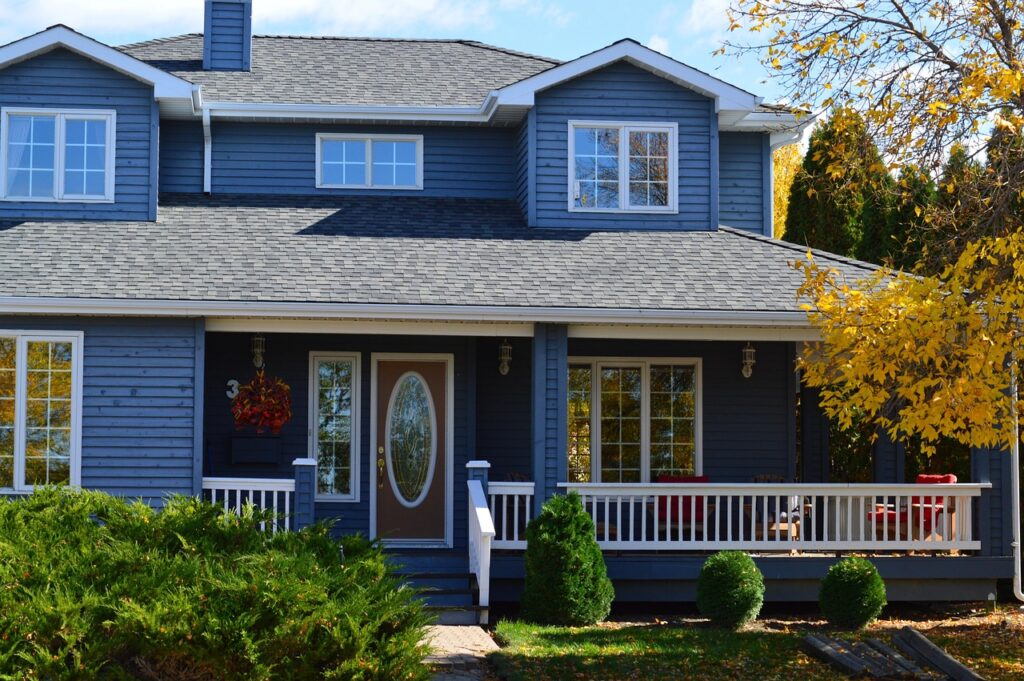
- Deep Ocean: A saturated navy that has surged with the dark-house trend; stunning with Arctic White trim and cedar accents.
- Evening Blue: Brighter, more traditional coastal blue.
- Boothbay Blue: The famous gray-blue — probably the most photographed Hardie color online; calm, dusty, and forgiving in all light.
- Light Blue tones (Gentle Breeze region-dependent): Pale options for cottage looks.
Greens
- Mountain Sage: Gray-green, the current darling for craftsman and cottage exteriors.
- Parkside Pine: Deep forest green for the moody end of the trend.
Beiges, Browns, and Earth Tones
- Khaki Brown, Monterey Taupe, Timber Bark: The traditional-suburb workhorses; Timber Bark is the richest of the three and hides dust well.
- Navajo Beige and Autumn Tan: Light, HOA-friendly neutrals.
Reds and Statement Darks
- Countrylane Red: Barn red for farmhouses and accent gables.
- Midnight Soot / Rich Espresso (Statement/Dream depending on region): The near-black options driving contemporary builds.
Availability note: Hardie splits the palette into a nationally stocked Statement Collection and a made-to-order Dream Collection that varies by region — roughly 20-plus stocked colors and 700 orderable ones. Dream Collection orders add 3-6 weeks lead time, so confirm early.
The Most Popular Combinations Right Now
- Arctic White body + Iron Gray board-and-batten gables + black windows — the modern farmhouse standard.
- Iron Gray body + Arctic White trim + cedar-look shingle accents in Khaki Brown or a stained-wood porch ceiling.
- Boothbay Blue body + Sailcloth trim — coastal without being nautical-costume.
- Aged Pewter body + Arctic White trim + Deep Ocean front door — the safest “still interesting” resale scheme I recommend.
- Mountain Sage body + Cobble Stone trim + copper or bronze fixtures for craftsman bungalows.
Choosing for Light, Climate, and Fade
Sun changes everything. Dark colors read 2-3 shades lighter in full southern sun and absorb more heat — surface temps on Iron Gray can run 30-40°F above ambient on a July afternoon, which fiber cement handles fine (a genuine advantage over dark vinyl, which can distort). Fade behaves predictably: saturated reds and deep blues shift the most over 15 years, grays and earth tones the least; the ColorPlus warranty’s 5 Delta-E cap applies either way. Practical tests before committing:
- Order actual board samples, not printed chips — texture changes color perception.
- Tape samples to north AND south elevations and look at 9 a.m., noon, and dusk over several days.
- Check the color against your fixed elements: roof shingles, brick, stone, and concrete undertones veto more schemes than taste does.
- Drive the neighborhood; a Deep Ocean house between two Deep Ocean houses loses its punch.
Trim, Soffit, and Accent Coordination
HardieTrim and HardieSoffit come in the core ColorPlus colors, so the classic play is body in one color and trim in Arctic White. Two upgrades worth the modest cost: color-matched touch-up kits for every color on the job (insist the crew leaves them), and ColorPlus-matched caulk from the approved list — mismatched bright-white caulk lines around windows are the most common finish complaint I see on dark Hardie jobs. For mixed-cladding designs, Hardie’s shingle panels in a second color on gables run about $1-$2 per sq ft over lap and transform the elevation.
Matching Colors to House Styles
Certain pairings keep proving themselves across hundreds of installs, and they track architectural style more than trend:
- Modern farmhouse: Arctic White body, black windows, Iron Gray or a near-black accent gable. Add a cedar-tone porch ceiling to keep it from going sterile.
- Craftsman bungalow: Mountain Sage, Aged Pewter, or Timber Bark body with Cobble Stone trim; two-color schemes with a third door color suit the style’s layered woodwork heritage.
- Colonial and traditional: Sailcloth or Navajo Beige body, Arctic White trim, black or deep green shutters. Restraint reads correct on symmetrical facades.
- Coastal and cottage: Boothbay Blue, Light Mist, or Evening Blue with bright white trim; shingle-panel gables in the same color family add texture without a second hue.
- Contemporary: Iron Gray, Deep Ocean, or a Dream Collection near-black, run in mixed profiles — smooth lap plus vertical panel — with minimal trim in the body color for the monolithic look.
- Ranch and mid-century: Aged Pewter or Monterey Taupe with a saturated door (Countrylane Red, teal, or mustard) honors the era’s earth-plus-pop formula.
HOA and resale angle: light neutrals and mid-grays clear architectural review boards fastest and appraise most predictably, while the deep trend colors add curb distinction at a small resale risk in conservative markets. When in doubt, put the bold color on the door and shutters — a $60 quart repaints a door; nobody repaints a Deep Ocean house on a whim.
Cost and Repaint Horizon
Installed ColorPlus lap siding typically runs $10-$16 per sq ft depending on market and complexity, versus $9-$14 for primed-plus-field-paint. When the finish finally dulls — realistically 18-25 years in — fiber cement repaints beautifully with 100 percent acrylic exterior paint at $2.50-$5.00 per sq ft, and unlike wood it won’t be fighting peeling substrate. Pick from the gray, white, or earth families if resale within a decade matters; pick Deep Ocean, Mountain Sage, or a near-black if you’re staying put and want the house that photographs best on the street. Either way, order the real boards and stare at them in your own light for a week — the chip in the showroom has fooled better eyes than ours.
A closing word on the two questions homeowners ask most. Can you repaint ColorPlus if you tire of the color? Yes — clean, scuff-sand lightly, and apply two coats of 100 percent acrylic; the factory finish is an excellent paint substrate, though repainting before year 15 forfeits the remaining finish warranty, so live with a color at least that long if you can. And do dark colors cost more? Usually — Dream Collection and dark Statement shades add roughly 5-15 percent to material, partly for the enhanced fade package. Budget for it rather than substituting a bargain dark from another product line; fade resistance is precisely the technology you’re paying that premium to get, and a south wall will audit the decision every summer for two decades. Take the samples, take your time, and pick the color you’ll still be glad to pull into the driveway toward in year fifteen — with ColorPlus, that’s exactly how long the decision is designed to last.