
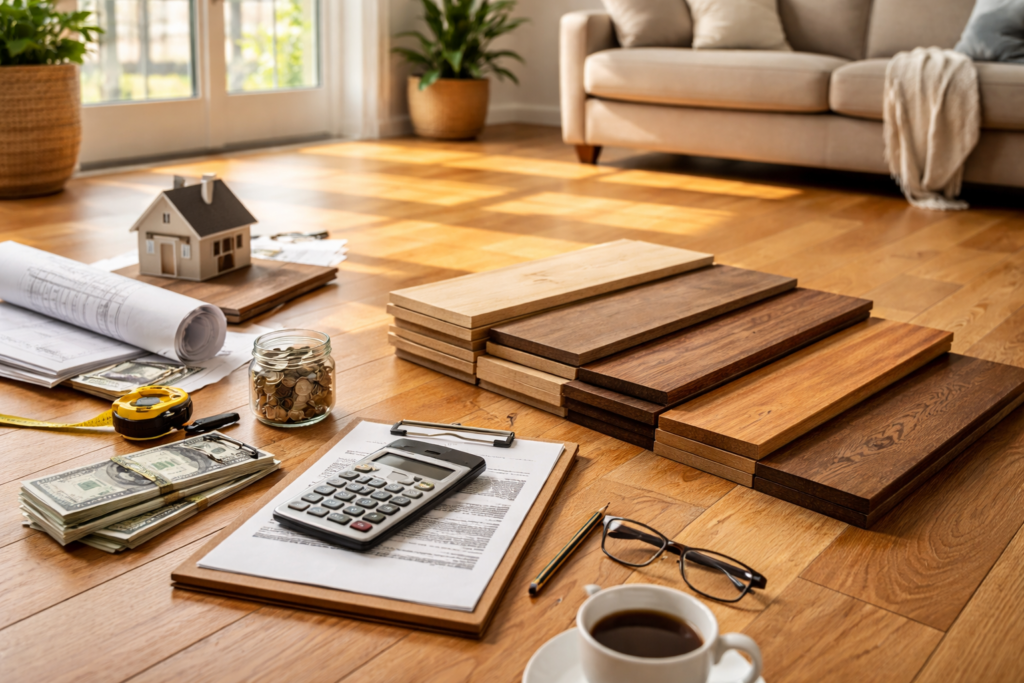
Quotes for the same hardwood project can swing by $8,000 from one contractor to the next, and most homeowners have no idea why. Understanding hardwood floor pricing means looking past the per-square-foot retail tag and accounting for species, grade, finish type, installation method, and demolition. A $4 per sq ft engineered floor can balloon to $14 installed once you add subfloor prep and trim. Knowing where the dollars go gives you the leverage to negotiate confidently and to spot a too-good-to-be-true bid before signing.
- The Three Big Cost Variables
- Price Per Square Foot by Species in 2026
- Solid vs Engineered Cost Differences
- Installation Labor Costs
- Subfloor Prep Adds Up Fast
- Finishing and Stain Costs
- Regional Pricing Differences
- Total Project Cost for a 1,500 Sq Ft Install
- Where to Save Without Sacrificing Quality
The Three Big Cost Variables
Three factors drive 80 percent of the price difference between hardwood quotes. Lock these in early to compare bids apples to apples:
- Material grade: Select grade has minimal knots and color variation. Character grade includes more visual movement at a lower price.
- Plank width and length: Wider, longer planks command 20 to 50 percent premiums.
- Finish location: Site-finished floors cost more in labor but offer custom stain matches. Prefinished saves labor but limits color choices.
Price Per Square Foot by Species in 2026
Material-only retail pricing varies by species and grade. Expect these numbers at distributors like LL Flooring, Hosking Hardwood, and most regional dealers:
- Red oak: $3.50 to $6 per sq ft. The American baseline. Predictable grain, easy to refinish.
- White oak: $5 to $9 per sq ft. Current designer favorite. Slightly harder, more rot-resistant, accepts modern stains better.
- Hickory: $4 to $8 per sq ft. The toughest domestic species at 1,820 Janka. Dramatic color variation.
- Maple: $4 to $7 per sq ft. Light, clean look; harder to stain evenly.
- Walnut: $8 to $15 per sq ft. Premium dark wood, softer than oak, scratches faster.
- Exotic species (Brazilian cherry, tigerwood): $7 to $14 per sq ft. Bold tones, supply tightening.
Solid vs Engineered Cost Differences
Solid hardwood is 3/4-inch thick across the board, refinishable 4 to 6 times, and limited to nail-down installation over wood subfloor. Engineered hardwood uses a hardwood veneer of 2 to 6 mm over a plywood core, can be glued or floated, and is required for concrete slab installs.
Pricing-wise, engineered with a thick wear layer often matches or exceeds solid pricing because of the manufacturing cost. The decision is more about install conditions than budget. Anyone working over a basement or on a concrete slab should default to engineered.
Installation Labor Costs
Labor adds $3 to $8 per sq ft to the material cost depending on complexity. Standard nail-down install in a clean rectangular room runs $3 to $5 per sq ft. Add 50 percent for diagonal patterns. Double it for herringbone or chevron because of the increased cut count.
Glue-down on concrete runs $5 to $7 per sq ft because the adhesive itself costs $1 to $2 per sq ft. Stair installs price separately at $100 to $200 per tread plus riser materials.
Subfloor Prep Adds Up Fast
The prep budget is the wildcard. Plywood subfloors with squeaks or unevenness above 1/8 inch over 6 feet need either sistered joists or self-leveling compound. Plan $1 to $3 per sq ft for prep on most homes built before 2000.
Concrete slabs require moisture testing before any wood install. ASTM F2170 in-situ relative humidity probes cost $40 to $60 each, and you’ll need one per 1,000 sq ft. Vapor barrier underlayment or epoxy moisture mitigation adds $2 to $5 per sq ft if the slab reads above 75 percent RH.
Finishing and Stain Costs
Site-finished floors give you complete control over the stain color. Cost runs $1.50 to $3 per sq ft for sanding plus $1 to $3 per sq ft for staining and three coats of polyurethane. Bona, Loba, and Pallmann are the dominant finish brands; water-based products dry faster but cost more.
Prefinished hardwood skips all the on-site work. You’re paying for factory-applied aluminum oxide coatings that are 5 to 10 times harder than site-applied poly. The trade-off is visible micro-bevels at each plank edge and a limited color palette.
Regional Pricing Differences
Geographic spread is wider than most homeowners expect. Houston, Atlanta, and Phoenix run 10 to 15 percent below national averages because of abundant installers. Boston, NYC, San Francisco, and Seattle run 20 to 35 percent above due to permitting, parking, and union labor.
Rural areas can also surprise on the high end. Limited contractor availability sometimes pushes labor rates above urban norms, especially for jobs under 800 sq ft where small jobs don’t justify a long drive at standard rates.
Total Project Cost for a 1,500 Sq Ft Install
Here’s what a real-world budget looks like for 1,500 sq ft of mid-grade white oak in a typical suburban home:
Materials run $9,000 to $12,000 at $6 to $8 per sq ft. Demo of old flooring adds $1,500 to $3,000. Subfloor prep accounts for $750 to $2,500. Installation labor totals $5,250 to $9,000. Stain and finish on a site-finished job add another $3,000 to $6,000. Trim, transitions, and quarter-round wrap up another $500 to $1,500. Total: $20,000 to $34,000 for a high-quality finished installation.
Where to Save Without Sacrificing Quality
Three smart trims preserve the look without gutting the budget. Use character-grade material in main living areas; the extra knots actually read more authentic in farmhouse and transitional designs. Pick a 5-inch plank width instead of 7-inch; the visual difference is minor, but cost drops 15 to 25 percent. Finally, skip exotic species for premium domestic oak. White oak with the right stain delivers most of the look of imported wood at half the price.
The biggest mistake is buying cheap underlayment to save $200 on a $25,000 project. Quality 3-in-1 underlayment from QuietWalk or Roberts protects the floor for decades and dampens noise across all rooms. The penny-wise short cut here is genuinely pound-foolish.
Prefer to explore on your own?
See how new flooring looks in your actual room in seconds — free, no signup.
Try the free Floor Studio →

