

Steam cleaners promise a chemical-free, deep-cleaning solution for your floors — and on tile, vinyl, and laminate, they deliver. But on hardwood? Steam cleaning is one of the fastest ways to ruin an expensive floor. The combination of heat and moisture attacks the very things that keep hardwood looking good and structurally sound: the finish, the wood fibers, and the adhesive holding everything together.
Before you plug in a steam mop on your hardwood floors, read this guide. We’ll explain exactly what goes wrong, when (if ever) steam might be acceptable, and what to use instead for genuinely clean hardwood.
How Steam Cleaners Work
Steam cleaners heat water to 200-250°F (93-121°C), converting it to pressurized steam that’s released through a mop head or cleaning pad. The high temperature kills bacteria and loosens stuck-on grime, and the moisture dissolves dirt so it can be absorbed by the mop pad.
This process works beautifully on non-porous, water-impervious surfaces like ceramic tile, sealed concrete, and sheet vinyl. The problem is that hardwood is neither non-porous nor water-impervious — and the very features that make steam effective (extreme heat and moisture) are the two things hardwood flooring handles worst.


Why Steam Cleaners Damage Hardwood Floors
Moisture Penetration
Wood is hygroscopic — it absorbs and releases moisture constantly. Even well-sealed polyurethane-finished hardwood has microscopic gaps at board edges, end joints, and any areas where the finish has worn thin. Steam forces hot water vapor into these gaps far more aggressively than a damp mop would.
Once moisture gets under the finish or between boards, it causes:
- Cupping — Board edges rise higher than the center, creating a concave profile. This happens when the bottom of the board absorbs more moisture than the top.
- Crowning — The opposite of cupping. The center of the board rises above the edges, typically after cupping is addressed but the underlying moisture issue persists.
- Swelling — Boards expand as they absorb moisture, pressing against each other and creating buckling or peaked joints.
- Dark staining — Water reacts with tannins in wood (especially oak) to create dark, iron-like stains that penetrate well below the surface.
- Mold growth — Moisture trapped under the finish or between the subfloor and hardwood promotes mold and mildew growth that’s invisible until it causes serious problems.
Finish Deterioration
The high heat of steam accelerates the breakdown of polyurethane and other floor finishes:
- Clouding and whitening — Heat forces moisture into the finish layer, creating a cloudy, milky appearance called blushing. This is often the first visible sign of steam damage.
- Peeling and flaking — Repeated steam exposure weakens the bond between the finish and the wood, causing the finish to lift, peel, and flake off in patches.
- Dulling — Heat breaks down the molecular structure of the finish, turning glossy floors matte and matte floors chalky.
- Cracking — The thermal shock of sudden high heat followed by cooling causes micro-cracking in the finish coat.
Adhesive Failure (Engineered Hardwood)
Engineered hardwood consists of a real wood veneer layer bonded to a plywood or HDF core. Steam heat can soften and weaken the adhesive between these layers, leading to:
- Delamination — the veneer separating from the core
- Warping of the plywood substrate
- Bubbling at the surface
- Edge lifting
Engineered hardwood is particularly vulnerable because the veneer layer is thin (typically 1-4mm), so moisture doesn’t have far to travel before reaching the adhesive layer.
Manufacturer Warranty Voidance
This is the practical consequence that many homeowners discover too late. Virtually every major hardwood flooring manufacturer explicitly excludes steam cleaning from their warranty coverage:
- Bruce Hardwood — Warranty states “Do not use steam mops, wet mops, or excessive water”
- Shaw Hardwood — “Do not use a steam cleaner on your hardwood floor”
- Mohawk Hardwood — “Never use a steam mop on your hardwood floor”
- Mannington — “Do not use steam mops/cleaners”
- Bona (finish manufacturer) — “Steam mops should not be used on any wood flooring”
If you steam clean your hardwood and later file a warranty claim for finish failure, cupping, or delamination, the manufacturer can — and frequently does — deny the claim based on improper cleaning methods.
When Low-Moisture Steam Might Be Acceptable
Is there ever a situation where steam on hardwood is OK? Technically, some very specific conditions reduce the risk to manageable levels — but it’s never truly safe:
Potentially Lower-Risk Conditions
- The floor has a completely intact, recently applied polyurethane finish with no gaps, cracks, or worn areas
- You use the absolute lowest steam setting available
- You keep the mop moving constantly — never pause in one spot
- You use only quick, light passes rather than slow, saturating ones
- You dry the floor immediately behind the steam mop with a microfiber cloth
- You do this infrequently (not as a regular cleaning method)
Conditions Where Steam Is Never Acceptable
- Engineered hardwood of any type
- Wax-finished or oil-finished hardwood
- Any floor with visible wear in the finish
- Floors with gaps between boards
- Floors over radiant heating systems
- New hardwood installations (finish needs time to fully cure)
- Any floor still under manufacturer warranty you want to preserve
The honest assessment: even under the “best” conditions, you’re taking a risk with no real upside. Steam doesn’t clean hardwood better than proper damp mopping — it just does it faster while potentially causing damage.
Safe Alternatives: How to Deep Clean Hardwood
You don’t need steam to get genuinely clean hardwood floors. These methods are safe, effective, and won’t void your warranty.
Daily Cleaning: Dry Methods
- Microfiber dust mop — The single best daily cleaning tool for hardwood. Microfiber picks up dust, pet hair, and fine grit without scratching. Bona Microfiber Floor Mop and O-Cedar ProMist are popular options.
- Vacuum with hard floor setting — Use a vacuum with the brush roll turned off or a dedicated hard floor attachment. This prevents the spinning bristles from scratching the finish. Canister vacuums with a felt-padded floor tool are ideal.
- Swiffer Sweeper (dry cloths only) — The dry Swiffer cloths pick up dust effectively. Avoid the wet cloths, which leave too much moisture.
Weekly Cleaning: Damp Mopping
The key word is damp, not wet. The mop should be wrung out until it’s barely damp — you should not see water on the floor behind the mop.
Best method:
- Dust mop or vacuum first to remove loose dirt and grit
- Use a spray mop (Bona Premium Spray Mop is the gold standard) with a hardwood-specific cleaner
- Spray a light mist in a 3-4 foot section
- Mop immediately with the microfiber pad
- Move to the next section — never leave cleaner sitting on the floor
- The floor should be dry within 1-2 minutes of mopping
Recommended Hardwood Floor Cleaners
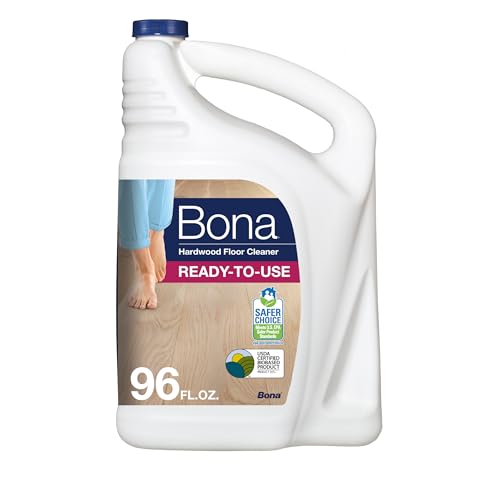
- Bona Hardwood Floor Cleaner — Water-based, residue-free, safe for all polyurethane-finished hardwood. The industry standard recommended by most flooring manufacturers. Available as a spray bottle or refillable cartridge for the Bona Spray Mop.
- Method Squirt + Mop Wood Floor Cleaner — A plant-based, almond-scented cleaner that’s gentle on finishes and leaves no residue. Squirt directly on the floor and mop up.
- Pledge Gentle Wood Floor Cleaner — A pH-balanced formula safe for finished hardwood. Cleans effectively without buildup.
Products to Avoid on Hardwood
- Vinegar — Acidic. Dulls polyurethane finishes over time and can etch the surface.
- Murphy Oil Soap — Despite its reputation, it leaves a residue that builds up over time, creating a dull, sticky film.
- Pine-Sol and similar pine cleaners — Too harsh for hardwood finishes.
- Wet Swiffer pads — Release too much liquid for hardwood. The chemical formula can also leave a hazy residue.
- Dish soap solutions — Can dull the finish and leave streaks.
- Ammonia-based cleaners — Strip finish and discolor wood.
Deep Cleaning Without Steam
For heavily soiled hardwood that needs more than routine cleaning:
- Bona PowerPlus Deep Clean — A concentrated hardwood cleaner designed for deep cleaning. Spray and scrub with a microfiber pad for stubborn spots.
- Spot treatment — For sticky residue, scuff marks, or stubborn spots, apply a small amount of hardwood cleaner to a cloth and rub the specific area.
- Screen and recoat — For floors that look dull despite cleaning, the issue is likely worn finish, not dirt. A professional screen and recoat (lightly abrading the existing finish and applying a new coat) restores the look without full sanding and refinishing.
Repairing Steam Damage on Hardwood
If you’ve already used a steam cleaner and see damage, here are your options depending on severity:
Mild Clouding or Whitening
If the finish has turned cloudy but isn’t peeling, you may be able to buff it out. Apply a thin coat of hardwood floor polish (Bona Polish or Rejuvenate) and buff with a microfiber cloth. This can temporarily mask mild blushing. For a permanent fix, a screen and recoat may be needed.
Finish Peeling or Flaking
If the finish is lifting off the wood, spot repairs with polyurethane are possible but tricky to blend. A full screen and recoat of the affected area (or the entire room for seamless results) is the better approach. Cost ranges from $1 to $3 per square foot professionally.
Board Cupping or Warping
Mild cupping may resolve on its own as the wood dries out — this can take weeks to months. Do not sand cupped floors until they’ve had time to dry and stabilize, or you’ll create crowning when the boards flatten. Severe warping may require board replacement.
Dark Water Stains
Dark stains that have penetrated the wood require sanding below the stain depth, which usually means replacing individual boards or refinishing the entire floor. Oxalic acid (wood bleach) can lighten some water stains but often can’t eliminate them completely.
The bottom line: steam cleaners and hardwood floors are a bad combination. The cleaning methods that actually work — microfiber dust mopping and damp mopping with a quality hardwood cleaner — are just as easy, take the same amount of time, and won’t cost you a warranty claim or a refinishing bill.
Prefer to explore on your own?
See how new flooring looks in your actual room in seconds — free, no signup.
Try the free Floor Studio →

