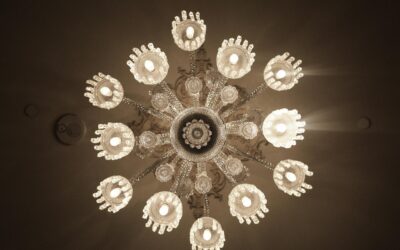
The most common regret with a high ceiling chandelier is buying a fixture that looked enormous in the box and then seeing it shrink to the size of a dinner plate once it hangs 18 feet up. Tall rooms swallow light fixtures. A size that looks generous in an 8 foot dining room disappears in a two-story foyer, and a drop that seems dramatic in the showroom can leave the fixture floating awkwardly halfway between the floor and the ceiling.
The fix is a few numbers worked out before you shop: the diameter based on the room, the fixture height based on the ceiling, the drop based on what is under it and who walks past, and the relationship to any upper windows. Get those right and the fixture fills the volume of the room the way it should.
- High Ceiling Chandelier Sizing Formulas
- How Low Should It Hang?
- Upper Windows and Sight Lines
- Choosing a Style That Fills the Space
- Light Output and Controls
- Weight, Boxes and Structure
- Installation Safety in Tall Rooms
- Common Sizing Mistakes and Fixes
- Costs for Large Fixtures and Installation
- When to Call a Licensed Professional
- Frequently Asked Questions
High Ceiling Chandelier Sizing Formulas
Lighting designers rely on three quick rules for a high ceiling chandelier. None of them is a law, but together they give you a range that almost always looks right.
Diameter
Add the length and width of the room in feet. Use that total as the chandelier diameter in inches. A 16 by 18 foot foyer gives you 34, so a fixture about 34 inches across is the starting point. In two-story spaces, many designers push the result up by 15 to 25 percent because the vertical volume makes everything look smaller. That same foyer could comfortably carry a fixture of 38 to 42 inches.
Fixture Height
Multiply the ceiling height in feet by 2.5 to 3. Use the result as the height of the fixture body in inches. An 18 foot ceiling suggests a chandelier 45 to 54 inches tall. Tiered and multi-level designs are popular in tall rooms precisely because they add height without making the diameter too wide for the floor plan.
Weight of Presence
Open designs such as thin metal rings, sphere frames and widely spaced arms look lighter than solid drums or dense crystal of the same size. If you choose an airy style, size up. If you choose a heavy, solid look, stay closer to the formula.
| Ceiling height | Suggested fixture height | Typical diameter range |
|---|---|---|
| 12 feet | 30 to 36 inches | 28 to 36 inches |
| 16 feet | 40 to 48 inches | 34 to 44 inches |
| 18 to 20 feet | 45 to 60 inches | 38 to 50 inches |
| 24 feet and up | 60 inches or more | 48 inches and larger |
How Low Should It Hang?
The drop is where most tall-room fixtures go wrong. Hanging too high leaves the chandelier stuck to the ceiling where nobody notices it. Hanging too low makes it a hazard and blocks views.
- Foyers and walkways: keep at least 7 feet from the floor to the bottom of the fixture. In a two-story entry, most designers aim for the bottom to sit roughly level with or just above the second-floor landing, often 9 to 12 feet off the floor.
- Over a dining table: the bottom typically sits 30 to 36 inches above the tabletop on an 8 foot ceiling. Add about 3 inches for every extra foot of ceiling height, but stop before the fixture looks detached from the table. In very tall rooms, a long linear fixture or a tiered design helps bridge the gap.
- Great rooms with no table: center the fixture in the volume and keep the bottom at least 7 feet above the floor, often higher if people walk under it to reach a sofa or fireplace.
A simple rule for multi-story entries is to divide the space visually into thirds and let the fixture occupy the middle third. That keeps it visible from the front door and from the landing above.
Upper Windows and Sight Lines
Two-story foyers and great rooms often have a transom or a tall window above the front door. A large foyer chandelier should be centered on that window when possible, so it reads as a lit focal point from the street at night. Keep the widest part of the fixture clear of the window frame by at least a foot so it does not look jammed against the glass.
Check the view from the upper hallway or balcony. If the fixture hangs at eye level from the landing, people will look straight into the bulbs. Shaded designs, frosted glass or a slightly lower drop solve this. Also think about the stair: someone climbing should not pass close enough to bump the fixture or reach it, which matters for both safety and cleaning.
Choosing a Style That Fills the Space
Extra large chandeliers come in a few broad families, and each handles a tall room differently.
- Tiered crystal or candle styles: traditional and formal, with height that fills a vertical space. They are heavy, so check the box and structure.
- Orb and sphere frames: open metal globes that look large without heavy visual weight, a good fit for transitional homes.
- Linear and cascading: long drops of pendants or rods that fill height rather than width, useful in narrow foyers.
- Modern rings: one or more LED rings at staggered heights. An entryway chandelier modern in style often uses this approach because it gives a sculptural look and even light.
A large entryway chandelier should also suit the scale of the staircase, the front door and any nearby fixtures. If your stair rail is heavy iron, a delicate glass fixture can look out of place, and a massive iron fixture can overwhelm a light, contemporary stair.
Light Output and Controls
A tall room needs more light than its floor area suggests because the light has farther to travel. Plan for roughly 20 lumens per square foot of floor in an entry, then layer with wall sconces or recessed lights so the chandelier is not doing all the work. Warm white LED bulbs at 2700K to 3000K look welcoming, and a color rendering index of 90 or higher keeps wood and paint colors true.
Install a dimmer rated for LED loads. A big fixture at full brightness can feel glaring at night. Since bulbs in a two-story room are hard to reach, long-life LEDs save you from frequent ladder trips. Some homeowners add a motorized lift that lowers the fixture for cleaning and relamping; that is a significant installation that a licensed electrician should handle.
Weight, Boxes and Structure
Large fixtures are heavy. Big crystal designs can weigh 50 to 150 pounds or more. A standard plastic or light-duty box is not meant for that. The fixture needs a metal box rated for the weight and fastened directly to framing, or a separate support that carries the load to the structure. Read the weight on the fixture spec sheet and match it to the box rating before anything goes up.
If the ceiling has no attic access above it, adding blocking or a heavy-duty brace may require opening the drywall. That repair cost belongs in your budget.
Installation Safety in Tall Rooms
Hanging a fixture 16 to 24 feet up is a different job from swapping a dining light. Before any work begins, turn off the breaker for the circuit and confirm power is off with a non-contact voltage tester. Never work on wiring that is still powered. Connections follow the usual pattern of ground, neutral and hot, but holding a heavy fixture at height while wiring is where accidents happen.
- Use rolling scaffolding or a properly rated extension ladder set on a stable, level base, not a stepladder balanced on stairs or furniture.
- Work with at least one helper to support the fixture while the other person connects it.
- Never lean or overreach from a ladder; move it instead.
- For ceilings over two stories or fixtures over about 50 pounds, hire professionals with the right equipment.
Common Sizing Mistakes and Fixes
- Fixture looks too small: it was sized with the floor formula only. Add a second fixture, choose a taller design, or lower the drop slightly to bring it into view.
- Fixture blocks the window view: raise it or switch to an open frame design.
- Glare from the balcony: use shaded or frosted lamps, or lower the bulbs’ brightness on a dimmer.
- Room still feels dark: add wall sconces at 6 feet or recessed lights around the perimeter.
- Fixture sways or tilts: chain links are uneven or the canopy is loose. Adjust and tighten with power off.
Costs for Large Fixtures and Installation
Large foyer fixtures range widely. Simple metal orbs in the 30 to 40 inch range often cost a few hundred dollars. Big crystal or designer pieces can run from $1,000 to several thousand dollars. Installation in a tall room usually costs more than a standard swap because of scaffolding, extra labor and heavier support. Expect a few hundred dollars for a straightforward replacement and more if new blocking, a heavier box or a lift is required.
When to Call a Licensed Professional
Call a licensed electrician if the existing box is not rated for the new fixture’s weight, if you need new framing support, if you want to add a switch, dimmer or new circuit, or if the ceiling height requires scaffolding. Many areas require permits for new fixture locations and circuits. A pro also brings the right lift equipment, insurance and experience with heavy fixtures, which is worth a lot when the ceiling is 20 feet up.
Run the numbers, mock up the size with a cardboard circle or painter’s tape outline, and a high ceiling chandelier will look intentional from the door, the stair and the street.
Frequently Asked Questions
What size chandelier do I need for a two-story foyer?
Add the room’s length and width in feet and use the total as the diameter in inches, then go 15 to 25 percent larger for a two-story space. A 15 by 15 foot foyer often suits a fixture of 34 to 38 inches.
How high should a foyer chandelier hang in a tall entry?
Keep at least 7 feet of clearance above the floor. In two-story entries, many designers set the bottom of the fixture roughly level with the second-floor landing.
How tall should a chandelier be for an 18 foot ceiling?
Multiply the ceiling height by 2.5 to 3 and use the result in inches. For 18 feet, that gives about 45 to 54 inches of fixture height.
Can I install a large chandelier myself?
Small swaps on reachable ceilings can be DIY with the power off. Heavy fixtures, two-story heights or new support framing are better left to a licensed electrician with scaffolding.
Should a chandelier be centered on the window above the door?
When possible, yes. Centering on a transom or tall window makes the fixture a focal point from outside and keeps the composition balanced from inside.