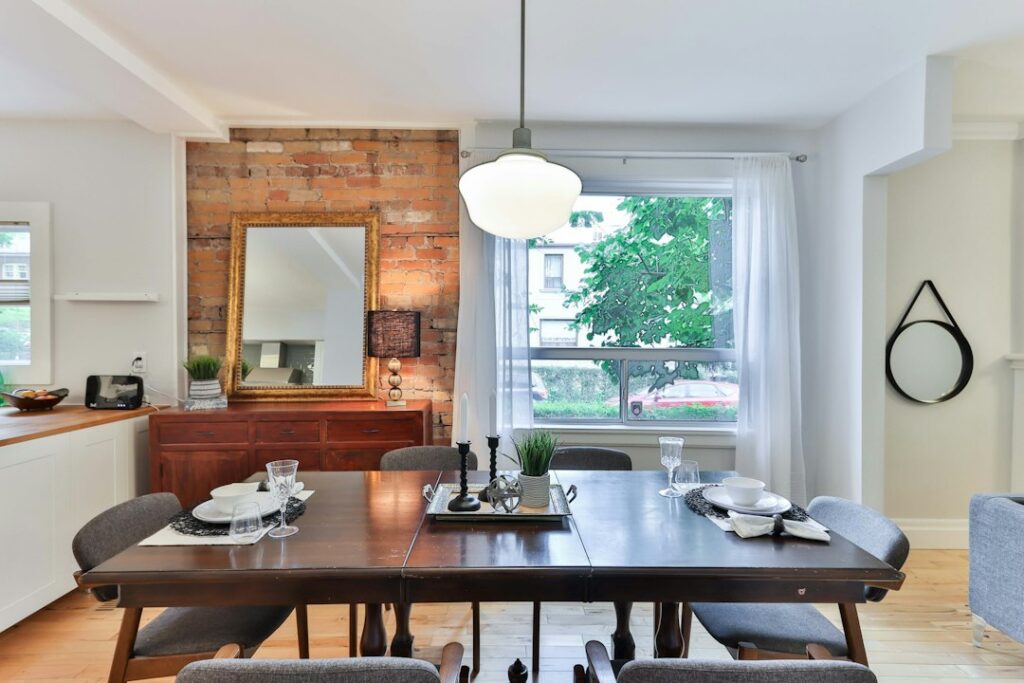
The most common lighting mistake in dining rooms is a chandelier that is too small. It looks fine in the store, then hangs over the table like an afterthought. The quickest rule for dining room chandelier size is to choose a fixture whose diameter is one-half to two-thirds of your table’s width. For a typical 40 to 42 inch wide table, that points to a chandelier roughly 20 to 28 inches across.
A second check uses the room itself: add the room’s length and width in feet, and use that number in inches as the approximate diameter. A 12 by 14 foot dining room suggests a fixture around 26 inches wide. When the two methods agree, you have your answer. When they disagree, let the table win, because the chandelier relates visually to the table it hangs over.
- Dining Room Chandelier Size Rules That Work
- How Big Should a Chandelier Be Over a Dining Table That Is Long?
- Hanging Height Over the Table
- Choosing Style, Scale and Light Output
- Sizing in Open-Concept Spaces
- Installation Steps and Electrical Safety
- Troubleshooting Size and Placement Problems
- Cost Ranges
- When to Call a Licensed Electrician
- Frequently Asked Questions
Long rectangular tables add a twist. A single round fixture can leave the ends dim, so linear chandeliers or a pair of smaller fixtures often work better, and they have their own sizing rules.
Dining Room Chandelier Size Rules That Work
Three simple formulas cover most situations. Use at least two of them together to land on a size you can trust.
1. The table width rule
Multiply the table width by 0.5 and 0.67. The result is your diameter range. A 36 inch round table suits an 18 to 24 inch chandelier, while a 48 inch round table handles 24 to 32 inches. Keep at least 6 inches between the edge of the fixture and the edge of the table on each side so diners do not bump their heads when they stand up.
2. The room size rule
Add the room’s length and width in feet. That sum, in inches, is a good diameter. A 10 by 12 foot room points to about 22 inches; a 14 by 16 foot room suggests about 30 inches. The rule works best in dedicated dining rooms and less well in open plans, where the table zone is what matters.
3. The fixture height rule
For the fixture’s own height, allow about 2.5 to 3 inches for every foot of ceiling height. An 8 foot ceiling suits a chandelier about 20 to 24 inches tall; a 10 foot ceiling handles 25 to 30 inches. Tall ceilings beyond this range belong to foyer and great room sizing, which follows different proportions.
| Table width | Chandelier diameter |
|---|---|
| 36 in | 18 to 24 in |
| 42 in | 21 to 28 in |
| 48 in | 24 to 32 in |
| 54 to 60 in | 27 to 40 in |
How Big Should a Chandelier Be Over a Dining Table That Is Long?
Rectangular tables longer than about 72 inches stretch the limits of a single round fixture. You have three good options.
Linear chandeliers
A linear or rectangular fixture mirrors the table’s shape. Size its length at roughly one-half to two-thirds of the table length, and keep it at least 6 inches, ideally 12, short of each table end. For an 84 inch table, a linear fixture 42 to 56 inches long fits well. Its width should stay well under the table width, typically 12 to 18 inches for most tables.
A large round or oval chandelier
A large dining chandelier with a round or oval body can work over long tables if it is generously sized, usually toward the two-thirds end of the width rule. It creates a stronger focal point but leaves table ends with less direct light, so plan for wall sconces or recessed lights to fill in.
Two matching fixtures
For tables 8 feet or longer, two identical smaller chandeliers or pendants often look more balanced. Divide the table into halves and center each fixture over its half. Each fixture can be sized using the width rule, sometimes a touch smaller so the pair does not overwhelm the room.
Hanging Height Over the Table
Size and height work together. Hang the bottom of the chandelier 30 to 36 inches above the tabletop with an 8 foot ceiling. Add about 3 inches for each additional foot of ceiling. With a 9 foot ceiling, aim for 33 to 39 inches; with 10 feet, 36 to 42 inches.
Larger fixtures can sit slightly higher within the range so they do not block views across the table. Small or open-frame designs can hang a little lower. Always center the fixture over the table, not the room; if the table is off-center, a licensed electrician can move the box, or you can use a swag hook kit designed for that purpose.
Choosing Style, Scale and Light Output
Visual weight changes how big a chandelier looks. A heavy, solid drum shade reads larger than an airy wire frame of the same diameter, so you can push open designs toward the top of your size range and keep solid ones toward the middle. Crystal and glass fixtures scatter light and feel lighter, while dark metal reads bolder.
When shopping for a dining room chandelier, also think about light output. A dining area generally needs around 30 to 40 lumens per square foot of ambient light, so a 12 by 14 foot room calls for roughly 5,000 to 6,700 lumens total from all sources. Most chandeliers are not the only light source, but they should carry a good share. A dimmer is essential: bright for homework and cleanup, low and warm for dinner. Warm white bulbs around 2700K flatter food and skin tones.
Mockup before you buy
Cut a cardboard circle or rectangle in your target size, or tie balloons to a string at the target diameter, and hold it over the table. Look at it while seated and from the doorway. This five-minute test catches most sizing mistakes.
Sizing in Open-Concept Spaces
In an open kitchen, dining and living layout, the room formula breaks down because there are no walls to measure. Instead, define the dining zone by the rug or by about 3 feet of clearance around the table on every side, and use those dimensions in the room formula. Then cross-check against the table width rule. Consider sightlines as well: a fixture hung in line with kitchen pendants should relate to them in finish or shape, and its bottom should sit at a similar visual height so the ceiling line does not look cluttered.
Rugs, artwork and window treatments all change how large a fixture appears. A big rug and bold art can handle a bolder chandelier, while a minimal room often looks best with an open, lighter design at the upper end of the size range.
Installation Steps and Electrical Safety
Chandeliers are line-voltage fixtures on standard 120 volt household wiring. Many weigh 20 to 50 pounds, and some far more, so the ceiling box must be rated for the fixture.
- Turn off the breaker for the dining room circuit and confirm power is off at the box with a non-contact voltage tester. Never work on live wires.
- Check the box rating. Standard light boxes may not support heavy fixtures. Fixtures over the box’s rated weight need a fixture-rated box or brace attached to framing.
- Measure and set the chain or rod length so the bottom lands at your target height, with a helper holding the fixture.
- Connect wires per the manufacturer’s diagram, including the ground.
- Mount and secure the crossbar or mounting strap, then raise and attach the canopy.
- Install bulbs within the fixture’s rated wattage, restore power and test the dimmer.
Use a sturdy ladder on a level floor, never on the dining table, and get a second person for anything heavy. New boxes, new circuits or added switches are jobs for a licensed electrician, and many areas require a permit.
Troubleshooting Size and Placement Problems
- Chandelier looks too small: add matching sconces to build visual weight or upgrade to a fixture near two-thirds of the table width.
- Fixture feels overwhelming: raise it a few inches or choose an open-frame design of similar size.
- Glare while seated: use frosted or shaded bulbs, lower the brightness with a dimmer or raise the fixture slightly.
- Table ends are dim: switch to a linear fixture or add recessed lights at each end.
- Fixture is off-center: relocate the box or use a swag kit instead of moving the table.
Cost Ranges
Chandelier prices vary enormously. Simple fixtures may cost under $200, mid-range designs commonly run a few hundred to around $1,000, and large crystal or custom linear fixtures can exceed several thousand dollars. Professional installation on an existing, properly rated box usually adds a modest fee, while new bracing, box relocation or dimmer wiring can bring labor into the several hundred dollar range or higher, depending on ceiling access.
When to Call a Licensed Electrician
Replacing a light fixture on an existing rated box is a reasonable DIY job for many homeowners. Hire a licensed electrician to add or move a ceiling box, brace a heavy fixture, run a new circuit, add a dimmer for multiple loads or work in homes with aluminum or very old wiring. Very heavy fixtures, or anything hung from high ceilings, are also worth handing to a pro.
Pin down your dining room chandelier size with the width and room formulas, confirm it with a mockup, and you will end up with a fixture that feels intentional rather than accidental.
Frequently Asked Questions
How big should a chandelier be over a dining table?
Choose a diameter of one-half to two-thirds of the table width. A 42 inch wide table typically suits a chandelier about 21 to 28 inches across.
What size chandelier do I need for a 12 by 12 dining room?
Add the length and width in feet (12 plus 12 equals 24), then use that number in inches. A fixture around 24 inches in diameter is a good fit.
Is a linear chandelier better for a long table?
For tables longer than about 72 inches, a linear fixture sized at one-half to two-thirds of the table length often lights the whole surface more evenly than one round fixture.
How high should a dining chandelier hang?
Hang the bottom 30 to 36 inches above the tabletop with an 8 foot ceiling, adding about 3 inches for each additional foot of ceiling height.
Can my ceiling box hold a heavy chandelier?
Not always. Check the box’s weight rating. Heavier fixtures need a fixture-rated box or brace secured to framing, which a licensed electrician can install.