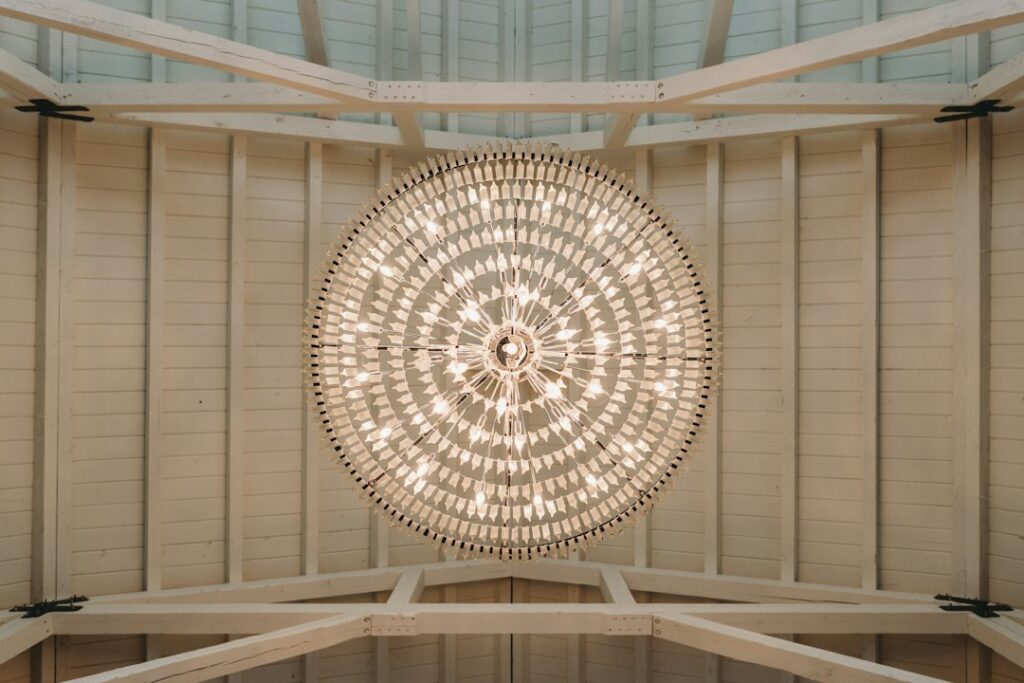
A vaulted ceiling chandelier fills the tall, empty volume that makes cathedral rooms feel cold, but sloped ceilings add problems flat ceilings never have. The canopy has to sit flush on an angle, the fixture has to hang plumb instead of tilting with the roof line, and the drop length has to bring light down to living height without looking like it is floating in midair.
The short answer: use a fixture with a swivel or sloped-ceiling canopy (or add a sloped ceiling chandelier adapter), mount it to a box fastened to framing, size the diameter by adding the room’s length and width in feet and converting to inches, and hang the bottom at least 7 feet above the floor in open areas or 30 to 34 inches above a dining table. Most vaulted installs need extra chain or rod, a second set of hands and a ladder or scaffold that is taller than you think.
- How a Vaulted Ceiling Chandelier Mounts on a Slope
- Centering on a Pitched Ceiling
- Sizing a Chandelier for a Tall Room
- Drop Length and Hang Height
- Tools and Materials
- Step-by-Step Installation
- Ladder and Fall Safety
- Troubleshooting
- Cost Ranges
- When to Call a Licensed Electrician
- Frequently Asked Questions
How a Vaulted Ceiling Chandelier Mounts on a Slope
Every chandelier hangs from a fixed point, and gravity pulls it straight down. On a pitched ceiling, the trick is letting the hanging point pivot while the canopy covers the box at the ceiling’s angle. There are three common approaches:
- Chain-hung fixtures with a hook canopy: the chain naturally hangs plumb from a loop, so many chain fixtures handle moderate slopes as long as the canopy can cover the box. Check the listed maximum slope, often around 30 to 45 degrees.
- Swivel or ball-joint canopies: rod-hung fixtures with a ball joint at the canopy let the rod hang vertically on pitched ceilings. Many modern fixtures include one; confirm the angle rating.
- Sloped ceiling adapters: an angled plate or wedge mounts to the box and gives a level surface for a flat canopy. These are useful when you love a fixture that was not designed for a vault.
Read the slope rating before you buy. A 6/12 roof pitch is about 27 degrees; 8/12 is about 34 degrees; 12/12 is 45 degrees. If the ceiling is steeper than the fixture’s rating, the canopy will gap or the rod will bind and tilt.
Centering on a Pitched Ceiling
On a flat ceiling, centering is simple geometry. Under a vault, what matters is how the fixture lines up with what sits below it. Mark the target on the floor first: the center of the dining table, the middle of the seating group or the midpoint of the room. Then transfer that point to the ceiling with a plumb bob or a laser level, not by measuring along the sloped surface, which will throw you off.
Watch for framing. On a cathedral ceiling, rafters typically run 16 or 24 inches on center from the wall up to the ridge, and the box needs to land on a rafter or on a brace between two of them. If the ideal spot falls just beside a rafter, a sliding brace bar can shift the box a few inches. If the vault has a ridge beam, a fixture centered on the ridge often looks the most intentional, especially in great rooms.
Sizing a Chandelier for a Tall Room
Rooms with high ceilings swallow small fixtures. Use these rules of thumb:
- Diameter: add the room’s length and width in feet and use that number in inches. A 16 by 20 foot great room suggests about 36 inches.
- Height of the fixture body: allow roughly 2.5 to 3 inches of fixture height per foot of ceiling height. A room peaking at 16 feet can carry a fixture 40 to 48 inches tall.
- Over a table: keep the diameter at least 12 inches narrower than the table so guests do not bump it.
- Large or long rooms: consider two matching fixtures, or a linear fixture parallel to the ridge.
Scale up slightly when the room has a lot of glass or bright white walls; open fixtures with thin arms read smaller than solid drum or orb designs of the same diameter.
Drop Length and Hang Height
Drop length is the distance from the ceiling to the bottom of the fixture. On a vault, the ceiling height varies, so always measure from the exact mounting point. Then work backward from the hang height you want:
- Open living or great room: bottom of the fixture at least 7 feet above the floor; 8 to 9 feet often looks better in very tall rooms.
- Over a dining table: 30 to 34 inches above the tabletop, sometimes up to 36 inches with very tall ceilings.
- Two-story entry: bottom no lower than about the second-floor level, so the fixture is visible from upstairs and through any window above the door.
- Over a kitchen island: 30 to 36 inches above the countertop.
Buy enough chain or rod. Many fixtures ship with 3 to 6 feet, which is fine for 8-foot ceilings but too short for a 14-foot peak. Order extension rods or extra chain from the manufacturer in the matching finish, and make sure the fixture wire is long enough; adding wire to a fixture should be done with the same gauge and rating.
Tools and Materials
- Non-contact voltage tester
- Extension ladder with a leveler, a tall step ladder or rented scaffolding
- Fan-rated or fixture-rated box and brace for the weight
- Sloped ceiling chandelier adapter or swivel canopy kit if needed
- Extra chain or down rods and fixture wire
- Laser level or plumb bob, stud finder, drill and driver
- Wire strippers and connectors
- A helper, and a fixture-lift rope or hoist for heavy pieces
Step-by-Step Installation
- Shut off power. Turn off the breaker feeding the circuit and confirm power is off at the wires with a non-contact voltage tester. Never work on wiring that is still powered.
- Check the box. It must be rated for the fixture weight and anchored to a rafter or a brace. Fixtures over 50 pounds need a box listed for that load.
- Install the adapter if needed. Attach the sloped plate or swivel canopy hardware to the box per its instructions, orienting the angle with the slope.
- Assemble on the ground. Build the fixture, set the chain or rod length and thread the wire before going up the ladder.
- Lift with help. One person supports the fixture while the other attaches it to the hook or nipple. For heavy pieces, use a rope over the scaffold rail to take the weight off your arms.
- Connect wires. Hot to hot, neutral to neutral and ground to the box and fixture ground. Tug-test each connection.
- Plumb and secure. Confirm the fixture hangs vertically, then snug the canopy against the slope.
- Bulbs and power. Install bulbs rated for the sockets, restore the breaker and test, including any dimmer.
Ladder and Fall Safety
Vaulted ceilings put you high off the floor, and falls from ladders are among the most common home-improvement injuries. Set extension ladders at a 4-to-1 angle (one foot out for every four feet up), use levelers on stairs, and never stand on the top rungs. For work over about 12 feet, or in stairwells and two-story rooms, rent a rolling scaffold with locked wheels and guardrails or hire a pro. Two people should always be present.
Troubleshooting
The fixture tilts
The canopy is not designed for the slope or the swivel is binding. Add a sloped adapter or a swivel kit, or switch to chain hanging.
Gap between the canopy and the ceiling
The slope exceeds the canopy rating. A larger canopy, a wedge adapter or a decorative medallion can cover it.
Dim or uneven light
Tall rooms need more total lumens. Add bulbs with higher output, choose an open fixture or supplement with wall sconces and recessed lights.
Hard to change bulbs
Use long-life LEDs, or install a motorized chandelier lift that lowers the fixture for maintenance.
Cost Ranges
Fixtures sized for tall rooms range from a few hundred dollars for basic designs to several thousand for large crystal or custom pieces. Sloped adapters and extension rods are usually inexpensive add-ons. Professional installation on a vaulted ceiling typically costs more than a standard swap because of height, scaffolding and the time to add a brace or new box; expect a few hundred dollars and more if wiring must be added. A motorized lift adds a significant but sometimes worthwhile cost.
When to Call a Licensed Electrician
Call a licensed electrician if there is no box at the mounting point, if a new circuit, switch or dimmer is needed, if the fixture is very heavy, or if the ceiling is high enough to require scaffolding. Wiring into an insulated cathedral ceiling can also require care around vapor barriers and insulation clearances. An electrician can pull permits, install a properly rated brace and make sure the vaulted ceiling chandelier is grounded and secure.
Frequently Asked Questions
Can any chandelier hang on a sloped ceiling?
Not without help. Choose a fixture rated for sloped ceilings, a chain-hung model, or add a sloped ceiling adapter or swivel canopy that matches your ceiling’s angle.
How low should a chandelier hang in a room with a vaulted ceiling?
Keep at least 7 feet of clearance in open areas, often 8 to 9 feet in very tall rooms, and 30 to 34 inches above a dining table.
What size chandelier works in a great room?
Add the room’s length and width in feet and use that number in inches for the diameter, then allow about 2.5 to 3 inches of fixture height per foot of ceiling.
How do I center a light on a pitched ceiling?
Mark the center point on the floor or table and transfer it straight up with a laser or plumb bob rather than measuring along the sloped surface.
Do I need a special box for a heavy chandelier?
Yes. Fixtures over about 50 pounds require a box rated for that weight and anchored to framing, and a fan-rated box is a smart upgrade for any heavy fixture.