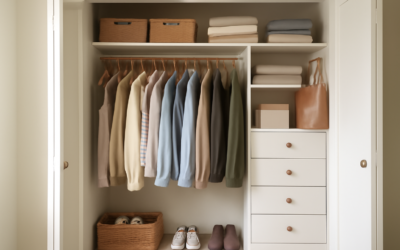
Older homes, basement apartments, and converted lofts share a common problem: bedrooms without closets. Building a closet from scratch can cost $1,500 to $4,000 for a basic reach-in. Figuring out how to organize clothes without a closet using freestanding furniture and wall-mounted systems usually delivers more usable storage at a fraction of the cost, and adds flexibility renters cannot get from a built-in. The key is treating clothing storage as four distinct categories and solving each one deliberately rather than buying a single furniture piece and hoping for the best.
- Step 1: Take Inventory by Storage Type
- Step 2: Choose Your Anchor Storage
- Step 3: Get the Hanging Right
- Step 4: Add Vertical Storage
- Step 5: Solve the Drawer Problem
- Step 6: Shoe Storage
- Step 7: Specialty Items
- Step 8: Make It Look Intentional
- A Sample Setup for a 12×12 Bedroom Without a Closet
- Bottom Line
Step 1: Take Inventory by Storage Type
Before buying anything, sort your clothes into four piles based on how they store best:
- Hanging: dresses, suits, button-downs, jackets, anything that wrinkles when folded
- Folded long-term: sweaters, denim, t-shirts, hoodies
- Folded short-term: underwear, socks, athletic wear
- Specialty: shoes, handbags, hats, scarves, ties, belts
Count the linear inches of hanging needed (a normal hanger occupies 1 inch, a thick coat 2 inches) and count the drawers or shelves needed for each folded category. This number drives every purchase that follows.
Step 2: Choose Your Anchor Storage
The largest piece of clothing storage furniture in the room is the anchor. Three good options depending on space and aesthetic:
- Wardrobe (armoire): a closed cabinet 36 to 60 inches wide with hanging space and shelves. IKEA PAX runs $300 to $1,000 depending on configuration. Solid wood from Pottery Barn or West Elm runs $1,500 to $4,000.
- Dresser plus garment rack: a 6 or 8 drawer dresser handles folded clothes; a 4 to 6 foot rolling garment rack handles hanging. Total cost $400 to $1,200.
- Wall-mounted track system: Container Store Elfa, IKEA Boaxel, or Rubbermaid HomeFree. $250 to $900 for a full wall, customizable, looks intentional.
For renters, the dresser-plus-garment-rack combination is the most flexible. For longer-term living situations, an IKEA PAX wardrobe or wall-mounted track system delivers more storage per square foot.
Step 3: Get the Hanging Right
Hanging storage outside a closet has its own problems. A standard garment rack tips easily, looks cluttered, and turns into a junk magnet within weeks. Better options ranked by quality:
- Heavy-duty rolling rack (Whitmor or commercial chrome): $80 to $180, holds 150 to 250 lbs, has a lower shelf for shoes
- Pipe-style garment rack (industrial look): $90 to $250, very stable, wall or floor mount options
- Wall-mounted rod between two side panels: $80 to $200 in basic materials, custom look
- Freestanding clothing rail with shelving above (Song Mics or similar): $130 to $280, doubles capacity
For a finished look, drape a curtain across the front of the rack to hide hanging clothes when not in use. A simple ceiling-mounted curtain rod with linen drapes at $60 to $120 transforms a garment rack into a closet-like presence.
Step 4: Add Vertical Storage
The space above eye level (about 5.5 ft) is almost always wasted in rooms without closets. Adding it back doubles useful storage. Real options:
- Wall-mounted shelves above the garment rack: stack folded sweaters and bins. Two 12-inch deep, 4-ft wide shelves at $30 to $80 each.
- Stackable storage bins (canvas, fabric, or hard plastic): label each bin by season or category. Storage cubes from Target or Container Store at $8 to $20 each.
- Over-the-door organizers on the bedroom door for shoes, belts, or accessories. $20 to $50.
- Floating shelves with hooks beneath for hats, scarves, and bags. $30 to $80 per shelf.
Store off-season clothes in the high bins to free up daily-access space. A complete winter coat and sweater rotation lives in two large bins above eye level.
Step 5: Solve the Drawer Problem
For folded clothes, drawers are still the most efficient solution. But not all dressers work in a small bedroom. Sized options:
- 3-drawer narrow chest (24 inches wide): fits any space, $80 to $250
- 6-drawer dresser (36 to 48 inches wide): the workhorse, $200 to $700
- Tall chest of drawers (5 to 7 drawer, 30 inches wide): vertical storage saves floor space, $250 to $900
- Under-bed storage drawers (4 to 6 inches tall, slide under bed): $40 to $120 each
For limited rooms, prioritize a tall chest over a wide dresser. Use Marie Kondo’s vertical folding technique to fit 30 to 50 percent more in each drawer.
Step 6: Shoe Storage
Shoes consume more floor space than any other clothing category. Solutions ranked by space efficiency:
- Over-the-door shoe pockets: 24 pairs for $20, but obscures the door
- Wall-mounted shoe shelves (IKEA Trones): 3-pair tilt-out cabinets, 28 inches wide, $25 each
- Tiered freestanding shoe rack: 3 to 5 tiers, $30 to $90, holds 12 to 25 pairs
- Bench with shoe storage below: doubles as seating, $100 to $300
- Stackable acrylic boxes: $4 to $10 each, see-through, very organized
For most rooms without entry hall closets, an IKEA Trones row along a hallway wall or under a bench solves shoe storage cleanly.
Step 7: Specialty Items
The last 15 percent of clothing storage is often the hardest. Handbags, ties, belts, jewelry, and hats need dedicated solutions:
- Handbags: upper shelf in bins, or wall-mounted hooks behind a door
- Ties and belts: tie rack on inside of wardrobe door, or wall-mounted hooks
- Jewelry: a 3-drawer organizer on top of the dresser, or wall-mounted jewelry cabinet
- Hats: hooks on the wall, or a tiered hat stand
- Scarves: hung over a rod, or rolled in a drawer divider
Step 8: Make It Look Intentional
Open clothing storage can look great or it can look like a moving day in progress. Three rules:
- Match your hangers. All wood, all velvet, all white plastic – one type only. A row of unified hangers visually cleans up everything behind them.
- Use matching storage bins. A row of identical canvas bins on top of a wardrobe looks far better than 8 random storage containers.
- Hide the garment rack with a curtain when the room is being used as a bedroom, not just a dressing area.
A Sample Setup for a 12×12 Bedroom Without a Closet
For a typical converted bedroom:
- One IKEA PAX wardrobe (39 inches wide, 79 inches tall) configured with hanging rod, 3 shelves, and 2 drawers – $450
- One 6-drawer dresser, 48 inches wide – $400
- One IKEA Trones shoe storage in a row of three units – $75
- Two 12-inch deep wall-mounted shelves above the dresser – $80
- Set of matching velvet hangers (40 count from Costco) – $25
- Four matching canvas storage bins for upper shelves – $40
Total: about $1,070. That delivers more storage than a typical 6-foot reach-in closet would, with significantly more flexibility for future moves.
Bottom Line
You do not need a built-in closet to have well-organized clothing. A wardrobe or dresser-plus-garment-rack as the anchor, vertical storage for off-season items, a deliberate shoe solution, and unified hangers transform a closet-less room. Budget $400 to $1,500 for a complete setup that holds up over a decade of use.