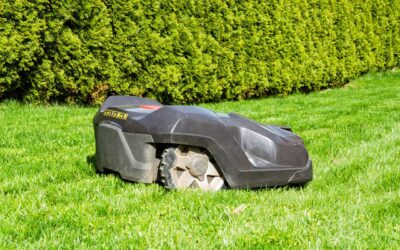
A Husqvarna robot lawn mower, sold under the Automower name, is the closest thing to set-and-forget lawn care that actually works. Husqvarna has been building these longer than anyone, and after installing and living with several models, I can tell you they cut better than most people expect and free up hours of weekend time. They are not cheap, but for the right property they earn their keep fast.
This guide breaks down the model lineup, the two navigation systems, what they handle on slopes, and what installation really involves.
How an Automower Actually Cuts
These robots do not mow the way you do. Instead of one weekly buzz-cut, an Automower runs a little bit almost every day on a random or systematic pattern, trimming just a millimeter or two off the top each pass. Three small razor blades on a spinning disc slice the tips cleanly and drop the clippings back as fine mulch that feeds the lawn. The result over a few weeks is a dense, carpet-like turf that a weekly gas mower struggles to match.
Because it works in small increments, the robot handles rain, runs quietly at around 58-60 decibels, and returns to its charging dock on its own when the battery runs low. You set the schedule once and largely forget it. A typical charge cycle runs the mower 60-70 minutes and then charges for 50-60 minutes, and it repeats that loop through its scheduled hours until the whole lawn is covered.
There is also a real agronomic benefit people overlook. Frequent micro-cutting and mulching the fine clippings back into the turf returns nitrogen to the soil, so many Automower owners find they fertilize less and see fewer weeds. The constant light trimming encourages the grass to grow sideways and thicken rather than shoot up, which is how you get that dense, striped-golf-course look without ever bagging a single clipping.
Boundary Wire vs. EPOS GPS
The single biggest decision is how the mower knows where your lawn ends. Husqvarna offers two systems:
- Boundary wire (guide wire): a thin perimeter wire pegged or buried an inch or two down around the lawn edge and any garden beds. The mower senses the wire’s signal and stays inside it. Proven, reliable, and used on most consumer models.
- EPOS (satellite/GPS): a wire-free system that uses RTK satellite positioning corrected by a reference station. You draw virtual boundaries in the app, so there is no wire to install or repair, and you can change zones anytime from your phone.
Wire-based models cost less and work anywhere, including under heavy tree cover where GPS can struggle. EPOS costs more and needs a decent view of the sky, but it eliminates the most tedious part of setup. For simple, open lawns EPOS is the future; for wooded or complex lots, wire is still the safe bet.
The Model Lineup
Husqvarna spreads the Automower range across lawn size and features. The key models:
- Automower 115H: the entry model, boundary wire, covers about 0.4 acre (roughly 17,000 sq ft), handles slopes up to 30 percent. Around $1,000-$1,300.
- Automower 315: covers about 0.4 acre with a smarter app and better weather timer, typically $1,500-$1,800.
- Automower 430X: covers roughly 0.8 acre (about 32,000 sq ft), climbs 45 percent slopes, GPS-assisted navigation, and object-avoidance. Usually $2,500-$3,000.
- Automower 450X: the workhorse, covering up to about 1.25 acres (54,000 sq ft) on 45 percent slopes. Around $3,500-$4,000.
- Automower 450X EPOS: the wire-free flagship, same coverage class, roughly $4,000-$4,500 with the reference station.
The X models add cellular connectivity, GPS theft tracking, headlights, and finer slope handling. For a small, flat lawn the 115H does everything most people need; the bigger numbers buy coverage, slope capability, and smarts.
Slopes, Obstacles, and Edges
Slope rating is where the models separate. The 115H manages a 30 percent grade, while the 430X and 450X handle 45 percent, which is genuinely steep terrain most push mowers would slip on. If your yard has hills, do not undersize the robot or it will get stuck and call for help.
The X-series adds ultrasonic sensors and object avoidance so the mower slows and steers around toys, hoses, and garden furniture instead of bumping through them. One honest limitation on every model is edging: the cutting disc sits inboard of the wheels, so a robot cannot mow flush to a wall or fence. Plan on a few minutes of string trimming along hard edges every couple of weeks. You can minimize even that by installing a paver or brick mowing strip flush with the turf along walls and beds, which lets the mower run its wheel right to the edge and trim the last inch. Many owners lay a two-brick-wide border during setup and rarely touch a trimmer again.
Installation: DIY or Pro
Setup depends on which system you chose. A wire model is a doable weekend DIY project:
- Place the charging dock near an outdoor outlet with clearance on all sides.
- Lay the boundary wire around the perimeter and any obstacles, either pegged on top of the turf or buried a couple inches down.
- Run the guide wire from the dock into the lawn so the mower can find its way home.
- Connect everything to the base station, set the schedule and cutting height in the Automower Connect app, and let it run a test lap.
A typical quarter-acre wire install takes a half day and a few hundred feet of wire. Complex or large lots are worth paying a Husqvarna dealer to install, usually $300-$800 depending on wire length and obstacles. EPOS models skip the wire entirely but need the reference station mounted with sky visibility, and dealer setup is common there too.
Run cost is trivial. An Automower draws only about 5-20 watts averaged over its cycle, so most owners report adding just a few dollars a month to their electric bill even running daily. Compare that to the $50-$150 a season a gas mower burns in fuel, plus oil and tune-ups, and the ongoing operating cost tilts clearly toward the robot.
Is It Worth the Money
A Husqvarna robot lawn mower is a real investment, $1,000 on the low end to $4,500 for the EPOS flagship, plus installation. But weigh it against what you spend now: a decent gas mower, fuel, maintenance, and every Saturday morning from spring to fall. For homeowners who value that time back, or physically cannot push a mower anymore, the Automower pays off in freedom as much as dollars. Match the model to your lawn size and slope, budget for a little edge trimming, and it will quietly keep your grass looking better than you ever managed by hand.
Winter Storage and Maintenance
These robots need a little care to last, and the good news is it is minimal. In most of the country you bring the Automower and its charging station indoors for winter once the grass stops growing. Charge the battery fully before storage and keep it in a dry space above freezing. Husqvarna rates the lithium battery for roughly two to four seasons of daily use before it needs replacement, and packs run about $150-$300 depending on model.
During the season the maintenance list is short: swap the three pivoting razor blades every one to two months (a bag of replacements is only $10-$15), brush grass buildup off the underside, and keep the wheels and sensors clean. Because the blades are small and cheap, you never sharpen anything the way you would a deck mower. A quick wipe-down every few weeks keeps everything running.
Security and Smart Features
Theft is a fair worry when a $3,000 machine sits in your yard unattended. Husqvarna builds in real protection. Every mower is PIN-locked and will alarm loudly and stop if it is lifted off the lawn. The X-series and EPOS models add GPS tracking and cellular connectivity, so if a unit does walk off, you can locate it and it is useless to a thief without your PIN. The Automower Connect app also lets you start, stop, and reschedule the mower from your phone, check its status, and get alerts if it gets stuck or needs attention. For a set-and-forget tool, that remote visibility is more useful than it sounds, especially if you travel and want the lawn cut while you are away.