I have put interlocking foam mats into home gyms, playrooms, workshops, trade show booths, and one memorable laundry room, and I have also pulled up plenty that failed because someone bought the wrong thickness or expected foam to do a rubber floor’s job. Puzzle mats are the cheapest way in America to make a hard floor comfortable — often under a dollar per square foot — and they are genuinely good at several things. They are also oversold for uses that destroy them in months. This is the guide I wish came in the box.
- What They Are: EVA, Density, and Why Two Identical-Looking Tiles Behave Differently
- Picking Thickness by Actual Use
- What Foam Mats Are Genuinely Great At
- Where They Fail — and What to Use Instead
- The Off-Gassing Question
- Installing Them So They Stay Flat
- Cleaning and Lifespan
- Budgeting a Room, With Real Numbers
What They Are: EVA, Density, and Why Two Identical-Looking Tiles Behave Differently
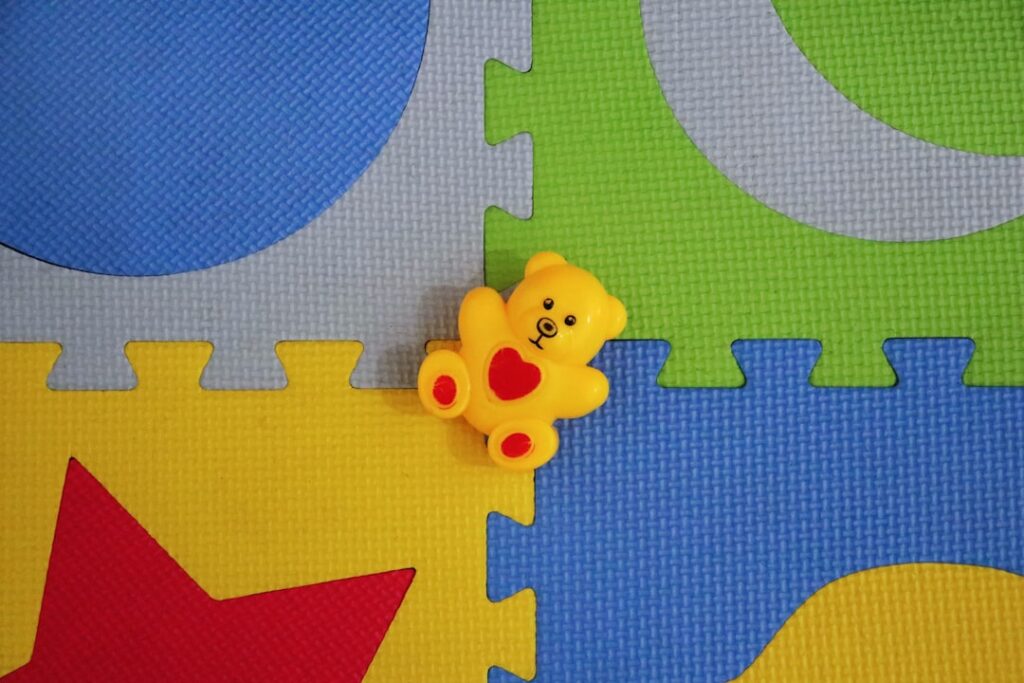
Nearly all puzzle mats are EVA — ethylene-vinyl acetate, a closed-cell foam that is soft, waterproof through its body, and easy to mold with interlocking edges. The tiles are usually 12×12, 24×24 (the most common), or 40×40 inches, in thicknesses from 3/8 inch to 1.5 inches, typically with a leather- or diamond-textured top.
The spec that separates the good from the junk is density, and it is the one number most listings hide. Cheap playroom foam runs soft and squishy — comfortable for a toddler, terrible under a squat rack, and quick to compress permanently. High-density EVA (roughly twice as firm) is what martial arts and gym tiles use; it supports adult weight without bottoming out and recovers instead of denting. You can test it in seconds: press a thumbnail hard into the tile. Quality high-density foam resists and rebounds; bargain foam takes a crescent-shaped dent and keeps it. If you are buying online where you cannot press anything, weight is your proxy — a denser 24x24x3/4-inch tile simply weighs more, and sellers of good foam usually state density or firmness outright.
Picking Thickness by Actual Use
| Thickness | Best For | Notes |
|---|---|---|
| 3/8 inch (10mm) | Playrooms, under desks, trade shows | Comfort layer only; cheapest tier |
| 1/2 inch (12mm) | General home gym, yoga, standing workshops | The default choice; stable underfoot |
| 3/4 inch (20mm) | Bodyweight training, light dumbbell work, kids’ tumbling | Best comfort-to-stability balance in high density |
| 1 inch (25mm) | Grappling drills, judo breakfalls at home, active play | Only worthwhile in high-density foam |
| 1.5 inch (40mm) | Throws and takedown practice (tatami-style tiles) | Specialty martial-arts product, $6-$10/sq ft |
Two warnings hide in that table. First, thicker is not automatically better: under barbells and heavy machines, thick soft foam is unstable and unsafe — a loaded squat wobbling on one inch of playroom foam is a sprained ankle waiting. Heavy lifting belongs on 3/8- or 1/2-inch rubber, not foam, full stop. Second, for anything involving falls, thickness cannot substitute for density; a 1-inch soft tile bottoms out under an adult breakfall while a 1-inch high-density tatami tile absorbs it.
What Foam Mats Are Genuinely Great At
- Playrooms and nurseries. The original use case, still the best. Soft landings for new walkers, warm over concrete or tile, wipes clean, and a spilled sippy cup cannot hurt it.
- Basement and garage comfort. EVA is closed-cell, so the tiles themselves do not absorb water or support mold, and they insulate feet from cold slabs remarkably well. A 400-square-foot basement play zone costs $300 to $500 in tiles versus thousands in flooring.
- Bodyweight fitness and stretching. Yoga, calisthenics, kettlebell flows with controlled sets — half- to three-quarter-inch high-density tiles are ideal.
- Standing fatigue relief. Workbenches, laundry stations, craft tables. Same physics as an anti-fatigue mat at a fraction of the price per square foot.
- Temporary and rental spaces. No adhesive, no tools, packs into a closet. Puzzle mats are the best floor you can take with you when the lease ends.
Where They Fail — and What to Use Instead
Foam dents. Anything with concentrated weight — squat rack feet, treadmill rollers, furniture legs, bike kickstands — presses a permanent divot into EVA within days. Under cardio machines and racks, use rubber tiles or stall mats (3/4-inch rubber, about $40-$60 for a 4×6 at farm stores) and save the foam for the open floor. Foam also cuts and gouges easily: dog claws, chair casters, and dropped tools all leave marks, and office chairs on puzzle mats destroy them within weeks. Sharp lateral athletic moves — think HIIT with shoes — can separate seams and tear puzzle teeth on cheap tiles. And while the foam body is waterproof, water that gets through seams sits trapped underneath; on moisture-prone slabs, pull tiles up occasionally to dry, or you will find the slab sweating beneath.
Sunlight is the quiet killer nobody warns you about: UV through a window fades EVA and makes it brittle over a year or two. Keep foam out of sunrooms or accept it as a consumable there.
The Off-Gassing Question
New foam mats smell. That odor is mostly residual process chemicals evaporating, and with reputable brands it dissipates in a few days to two weeks. Years ago, some EVA mats made headlines over formamide, a processing chemical restricted in the EU; since then, major US-market brands sell formamide-compliant, independently tested foam. For a nursery, buy from established names — ProsourceFit, BalanceFrom, We Sell Mats, Norsk, Yes4All among the big sellers — look for ASTM F963 or EN71 testing claims, and air new tiles out in a garage for 48 to 72 hours before the baby crawls on them. That routine addresses essentially all of the real concern.
Installing Them So They Stay Flat
Puzzle mats are a floating floor, and the rules of floating floors apply in miniature. Let the tiles acclimate in the room for a day; EVA expands and contracts with temperature more than people expect. Leave a small gap — about 1/4 to 1/2 inch — at walls in rooms that get warm or see sun, or the field will buckle into little tents by afternoon. Assemble in rows, seat each seam fully with your palm (a half-seated seam is what makes edges lift and trip toes), and alternate tile orientation if your brand’s texture shows direction. Most tiles ship with straight border strips; use them, because raw puzzle edges collect crumbs and catch vacuum heads. On smooth concrete or tile, big fields stay put by friction; small setups (under a bike trainer, say) may want a few squares of carpet tape under the corners.
Cutting is easy and satisfying: score with a sharp utility knife against a straightedge and snap, or make three passes for thick tiles. Cut edges go against walls where the border hides them.
Cleaning and Lifespan
Vacuum with suction only — beater bars chew the texture — or just sweep. Damp-mop with diluted dish soap or an all-purpose cleaner; skip bleach at strength and anything solvent-based, which can discolor or attack the foam. For gym use, a spray of quat disinfectant after sweaty sessions keeps things sanitary. Expect three to seven years of good service from quality high-density tiles in a home gym, ten or more in a low-traffic playroom, and less in sunny rooms or under rolling loads. When one tile finally wears or tears, that is the whole genius of the format: you replace one $4 tile, not a floor.
Budgeting a Room, With Real Numbers
Pricing scales almost linearly with thickness and density, so a quick planning table from recent purchases: basic 3/8-inch playroom tiles run $0.80 to $1.50 per square foot in the multi-packs; 1/2-inch high-density gym tiles, $1.20 to $2.50; 3/4-inch high-density, $2 to $3.50; and the 1.5-inch tatami-style martial arts tiles, $6 to $10. A 10×12 playroom therefore costs $100 to $180 done properly, a two-car garage gym corner of 200 square feet about $250 to $500 in 1/2-inch tiles plus $120 or so of stall mats for under the weights. Buy 5 to 10 percent extra for cuts and future replacements in the same color lot, because tile colors shift subtly between production runs and a patched-in newer black tile can read charcoal next to the originals. The large 40×40-inch format is worth the slight per-foot premium in big rooms — fewer seams to seat, fewer edges to creep — while 24×24 remains the right call anywhere you will cut around obstacles.
My standing advice: spend the extra 30 to 50 percent for high-density EVA from a known brand, buy 1/2 or 3/4 inch unless you have a martial-arts reason for more, keep point loads and office chairs off it, and put rubber where the iron lives. Do that, and interlocking foam mats are the best dollars-per-comfort flooring purchase in the house.