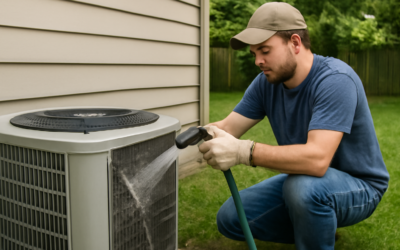
If you have ever wondered is it necessary to clean AC outdoor unit components, the short answer is yes. That outdoor box — the condenser — sheds heat from your home, and it can only do that job if air flows freely through its fins and coil. When grass clippings, leaves, dust, and pollen clog it, the unit works harder, cools less, runs longer, and costs more to operate. Cleaning it once a year is one of the easiest, highest-value pieces of AC maintenance a homeowner can do.
Part of our Windows & Doors guide — explore the full guide →
Here is why it matters and exactly how to clean the unit safely.
- Why a Dirty Condenser Hurts Performance
- Step 1: Turn Off the Power — Always First
- Step 2: Clear Away Debris
- Step 3: Gently Clean and Rinse the Fins
- The Critical Don'ts
- Straightening Bent Fins
- How Often and When
- When to Call a Pro
- Signs Your Unit Needs Cleaning
- Cleaning vs. a Full Tune-Up
- The Bottom Line
Why a Dirty Condenser Hurts Performance
The outdoor unit’s job is to release the heat your system pulls from inside the house. Refrigerant carries that heat to the condenser coil, and a fan blows outdoor air across the coil’s thin metal fins to dump the heat outside. When the fins and coil are caked with dirt and debris, airflow drops and heat cannot escape efficiently. The consequences:
- Reduced cooling capacity — the house does not cool as well.
- Higher energy bills as the system runs longer to compensate.
- More strain on the compressor, shortening the unit’s lifespan.
- Higher risk of breakdowns, especially during peak summer heat.
A clean condenser, by contrast, runs efficiently and lasts longer. The payoff is real and measurable on your utility bill.
Step 1: Turn Off the Power — Always First
Safety comes before anything else. The condenser has a spinning fan and live electrical components. Before you touch it:
- Shut off power at the outdoor disconnect box mounted near the unit (usually a pull-out or switch).
- For extra safety, also switch off the corresponding breaker in your main electrical panel.
- Turn the thermostat off as well.
Never clean or rinse a unit that still has power running to it.
Step 2: Clear Away Debris
Start with the easy stuff. Remove leaves, grass, twigs, and trash from around and inside the unit. Pull any weeds or plants growing against it, and trim back shrubs so there is clearance for airflow — a general guideline is keeping plants and obstructions a couple of feet away on all sides. Lift off the top grille if needed (it often unscrews) to clear leaves that have collected inside near the fan.
Step 3: Gently Clean and Rinse the Fins
The coil fins are the delicate part — thin aluminum that bends easily. Clean them carefully:
- Use a soft brush or the brush attachment on a vacuum to remove loose dirt from the fins.
- Rinse with a regular garden hose at normal pressure, spraying from the inside out where possible so debris is pushed away from the coil rather than deeper into it.
- For greasy or stubborn buildup, a coil cleaner made for AC condensers can help — follow its directions.
- Let the unit dry before restoring power.
The Critical Don’ts
A few mistakes can do more harm than the dirt itself:
- Do not use a pressure washer. The high pressure bends and flattens the fins, which blocks airflow worse than dirt and is hard to fix.
- Do not bend the fins. Be gentle with brushes and the hose. Crushed fins reduce airflow.
- Do not use harsh chemicals not intended for AC coils, which can corrode the metal.
- Do not skip turning off the power — this is a serious safety hazard.
Straightening Bent Fins
If you notice fins that are already bent or crushed, you can gently straighten them with a tool called a fin comb, sized to your fin spacing. Work slowly and carefully — the goal is to restore airflow without tearing the soft metal. Do not force it; if large areas are badly damaged, a technician can address it during a service visit.
How Often and When
Clean the outdoor unit at least once a year, ideally in spring before cooling season begins. If your unit sits under trees, near a dirt road, or in a high-pollen area, a mid-season check is worthwhile. Pair this DIY cleaning with the rest of basic AC care — change your indoor air filter regularly, since a clogged filter strains the whole system, and keep the area around the condenser clear year-round.
When to Call a Pro
DIY cleaning handles the exterior coil and debris, but an annual professional tune-up covers what you cannot: checking refrigerant levels, electrical connections, the compressor, and deep coil cleaning. If your system still cools poorly after cleaning, or you notice unusual noises, ice on the lines, or rising bills, have an HVAC technician take a look.
Signs Your Unit Needs Cleaning
Beyond the annual schedule, the unit itself often signals when it is overdue:
- Visible leaves, grass, dirt, or cottonwood fluff matted against the fins.
- Weaker cooling or air conditioning that struggles to keep up on hot days.
- The system running noticeably longer cycles or short-cycling on and off.
- A rise in energy bills with no change in your usage.
- The unit feeling unusually hot or the fan laboring.
If you notice these, a cleaning is the cheapest first thing to try before assuming a bigger repair.
Cleaning vs. a Full Tune-Up
It helps to understand what your DIY cleaning does and does not cover. Clearing debris and rinsing the coil restores airflow and is genuinely valuable — but it is only the exterior. A professional tune-up goes deeper: checking refrigerant charge, inspecting electrical connections and the capacitor, testing the compressor and fan motor, and cleaning the coil more thoroughly than a garden hose allows. The two work together. Doing your own debris-and-fin cleaning a couple of times a season keeps efficiency high between visits, while an annual professional service catches the mechanical and electrical issues you cannot see or safely test yourself.
The Bottom Line
So is it necessary to clean AC outdoor unit hardware? Absolutely — a dirty condenser cuts efficiency, raises your bills, and strains the system. Cut the power first, clear the debris, gently brush and rinse the fins from the inside out, and avoid pressure washers and bent fins. Do this once a year and your AC will cool better, cost less to run, and last longer.