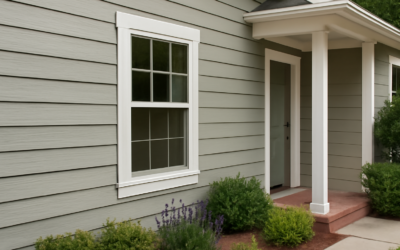
Texture is the one siding decision you cannot repaint your way out of later. James Hardie smooth siding has a flat, grain-free face that reads crisp and modern, while Select Cedarmill carries an embossed woodgrain that looks like painted cedar. Both are fiber cement, both come in Hardie Plank lap siding and Hardie Panel vertical siding, and both carry the same substrate warranty. The choice comes down to architectural style, how much you want the paint color to dominate, and how forgiving you need the surface to be.
Choose Smooth for modern, contemporary, modern farmhouse and transitional homes, especially with board and batten panels or crisp lap lines. Choose Select Cedarmill for traditional, Craftsman, coastal and rustic homes where a wood look fits. Choose a beaded profile if you want a period detail along the bottom edge of each board.
- James Hardie Smooth Siding vs Other Textures: Comparison Table
- What Smooth Hardie Board Looks Like on a House
- What Select Cedarmill Brings Instead
- Sizes, Finishes and Specs to Confirm
- Installation Tips for Smooth Fiber Cement
- Trim, Color and Mixing Textures
- Troubleshooting Smooth Siding Issues
- Cost and When to Hire a Pro
- Frequently Asked Questions
James Hardie Smooth Siding vs Other Textures: Comparison Table
James Hardie lists these textures on its product pages. Availability varies by region, so confirm with a local dealer before you design around one.
| Product and texture | Look | Paint and color | Style fit |
|---|---|---|---|
| Hardie Plank, Smooth | Flat, clean face with sharp shadow lines | Shows color clearly; also shows surface flaws and touch-ups more | Modern, contemporary, modern farmhouse |
| Hardie Plank, Select Cedarmill | Embossed cedar woodgrain | Grain breaks up light and hides minor marks | Traditional, Craftsman, rustic, coastal |
| Hardie Plank, Beaded Smooth | Smooth board with a rounded bead at the lower edge | Bead adds a shadow detail; smooth face shows color | Colonial, Victorian, historic districts |
| Hardie Plank, Beaded Cedarmill | Woodgrain with a beaded lower edge | Textured face hides marks | Coastal, cottage, traditional |
| Hardie Plank, Custom Colonial Smooth or Roughsawn | Colonial-style profile, smooth or rough-sawn face | Depends on face texture | Historic and colonial designs |
| Hardie Panel, Smooth | Flat vertical sheet, often with battens | Clean modern look; seams and battens define the pattern | Board and batten, modern farmhouse |
| Hardie Panel, Select Cedarmill | Woodgrain vertical sheet | Rustic feel; hides minor marks | Barn-style, rustic, gable accents |
| Hardie Panel, Stucco or Sierra 8 | Stucco texture, or grooved vertical lines | Specialty looks for accents or full walls | Southwest, Mediterranean, mid-century |
James Hardie states a 30-year non-prorated, limited, transferable substrate warranty on these siding products. Finish coverage differs between primed and factory-colored products, so read the current warranty document for your exact product.
What Smooth Hardie Board Looks Like on a House
On lap siding, a smooth face makes the horizontal shadow lines the main feature. The result looks tailored and clean, close to painted smooth wood or high-end composite trim. Darker colors look rich and solid on a smooth surface, while very light colors look crisp and bright.
On a smooth Hardie panel, the flat sheet becomes a backdrop for battens. Board and batten exteriors, a signature of the modern farmhouse style, almost always use smooth panels with smooth trim battens so the vertical rhythm reads sharply. Mixing smooth vertical panels on gables with smooth lap siding on the main walls is a common, cohesive combination.
What Select Cedarmill Brings Instead
Select Cedarmill is the textured, woodgrain option, and it is the texture James Hardie uses for its samples. The grain adds visual warmth and makes the wall look like painted cedar from the street. Texture also scatters light, which hides small dents, uneven paint and dirt better than a flat face. Many homeowners who want a classic look, or who live on dusty rural roads, prefer it for that reason.
The trade-off is style. On a sleek modern home, woodgrain can feel out of place, and on very dark colors the grain can show subtle light-and-dark variation in strong sun.
Sizes, Finishes and Specs to Confirm
- Thickness: Hardie Plank and Hardie Panel are commonly specified at 5/16 inch. Check the current spec sheet for your product.
- Length and sheet size: Planks are typically 12 feet long; panels are offered in 4 by 8, 4 by 9 and 4 by 10 foot sheets per James Hardie catalog listings.
- Widths: Smooth and Select Cedarmill lap planks come in several widths, with beaded profiles offered in fewer sizes. Width and exposure options vary by region.
- Finish: Products come primed for paint or factory-finished with ColorPlus technology, which James Hardie describes as a baked-on color applied and cured in the factory. Some color collections are limited to certain markets.
- Fire: James Hardie describes its fiber cement siding as noncombustible, though applied paints and coatings can still be damaged by flame.
Installation Tips for Smooth Fiber Cement
- Store boards flat and dry. Keep them off the ground and covered so they do not absorb moisture or warp before installation.
- Handle on edge. Carry planks on edge with two people for long lengths to avoid snapping or scuffing the face. Smooth faces show handling marks more readily.
- Cut with dust control. Fiber cement shears produce very little dust and are ideal for straight cuts. For other cuts, use a fiber cement blade on a saw with a dust collection shroud and vacuum.
- Follow the install guide. James Hardie publishes nailing schedules, clearances and gapping rules. Following them is usually a condition of warranty coverage.
- Keep clearances. Maintain required gaps above roofs, decks, patios and grade so boards do not wick water.
- Plan joints. On smooth lap siding, butt joints are more visible. Stagger them and use the joint treatment called for in the install instructions.
- Paint primed boards promptly. Use a 100 percent acrylic exterior paint and follow the recommended timeline for top-coating primed fiber cement.
Safety on the job
Fiber cement contains crystalline silica, and cutting, grinding or sanding it releases fine dust that is harmful to breathe. Cut outdoors, use shears or dust-reducing tools wherever possible, wear at least an N95 respirator (a P100 is better for prolonged sawing), wear eye protection, and clean up with a HEPA vacuum or wet methods rather than dry sweeping. For work at height, set ladders on firm, level ground at about a 4 to 1 angle, keep three points of contact, and never overreach. On two-story walls, use scaffolding or pump jacks, or leave the upper courses to a crew with fall protection.
Trim, Color and Mixing Textures
Smooth siding pairs naturally with smooth trim boards, which keep corners, window casings and fascia crisp. Many homes mix textures on purpose: smooth lap on the main walls with board and batten panels on gables, or woodgrain shingles as an accent over smooth lap. Keep the palette simple when you mix, since texture changes already add interest. Deep colors such as charcoal, navy and black look especially strong on a smooth face, while warm whites and soft grays give a clean modern farmhouse look.
Troubleshooting Smooth Siding Issues
- Visible nail heads or dents: Smooth faces highlight overdriven nails. Set nail guns to drive flush, not countersunk.
- Uneven sheen after touch-ups: Use paint from the same batch and feather touch-ups, or repaint the full board for a uniform look.
- Visible butt joints: Stagger joints, follow recommended joint flashing, and consider longer runs on prominent walls.
- Paint peeling at cut ends: Field-cut edges need to be primed or sealed per the install guide.
- Cracking near fasteners: Usually from nailing too close to the edge or ends. Follow edge distance rules.
Cost and When to Hire a Pro
Smooth and Select Cedarmill are generally priced in a similar range within the same product line, while ColorPlus factory finishes cost more up front than primed boards but save a field paint job. Installed fiber cement siding typically costs several dollars or more per square foot depending on house complexity, trim details, tear-out and region. Board and batten designs add labor for battens and layout.
Most homeowners hire a contractor for full siding projects because of the weight of the boards, specialized cutting tools, flashing details and height. Look for an installer familiar with James Hardie products, ask how they handle silica dust, and confirm they follow the published installation instructions so warranty coverage is protected. If your house was built before the 1980s, have old siding and underlying materials checked for asbestos before tear-off, and test pre-1978 painted trim for lead.
Pick Smooth if you want a clean, modern face that lets color and shadow lines lead. Pick Select Cedarmill if you want a wood look that forgives everyday wear. Order samples, view them on your own walls, and confirm regional availability before finalizing the plan.
Frequently Asked Questions
Does James Hardie make smooth siding?
Yes. Hardie Plank lap siding and Hardie Panel vertical siding are both offered in a Smooth texture, alongside Select Cedarmill and other textures.
Is smooth or Cedarmill Hardie siding better?
Neither is better overall. Smooth suits modern styles and shows color crisply; Select Cedarmill suits traditional styles and hides minor marks better.
Is smooth Hardie siding more expensive than Cedarmill?
Prices are generally similar within the same product line. Finish type, width, region and installation complexity affect cost more than texture.
Can you get beaded smooth Hardie lap siding?
Yes, James Hardie lists a Beaded Smooth profile for Hardie Plank. Sizes and availability are more limited, so check with a local dealer.
What is the warranty on James Hardie smooth siding?
James Hardie states a 30-year non-prorated, limited, transferable substrate warranty. Finish warranties differ, so review the current document for your product.