The backsplash is the most visible piece of tile in the average American home, and it’s also one of the easiest places to modernize a kitchen without gutting cabinets or counters. Kitchen backsplashes ideas span everything from classic white subway tile to handmade zellige, peel-and-stick vinyl, and full-slab marble—each bringing a different look, price point, and maintenance profile. This guide walks through the most popular and enduring styles, realistic price ranges, and tips for pairing backsplash with existing countertops and cabinetry.
Part of our Kitchen Remodeling guide — explore the full guide →
- Subway Tile: Still the Safest Bet
- Handmade Zellige and Clé Tile
- Mosaic and Penny Rounds
- Peel-and-Stick for Rentals and Budget Refreshes
- Slab Backsplash
- Picket and Arabesque Shapes
- Metal and Stainless Steel
- Brick and Thin Brick Veneer
- Coordinating with Countertops and Cabinets
- How High Should a Backsplash Go
- Final Thoughts
Subway Tile: Still the Safest Bet
White 3×6 subway tile first appeared in New York City’s subway stations in 1904, and it has never stopped being a kitchen favorite. A gloss-white subway backsplash with light gray grout works with almost any cabinet color, doesn’t date quickly, and costs $2-5 per square foot for the tile itself plus $5-10 per square foot for installation.
To make subway feel fresh, vary the layout. Instead of the standard half-offset brick pattern, try vertical stacked, herringbone, or chevron. Each layout changes the visual rhythm while keeping the timeless material. Dark grout (charcoal, slate) highlights the grid; matching white grout makes the whole wall read as one surface.
Handmade Zellige and Clé Tile
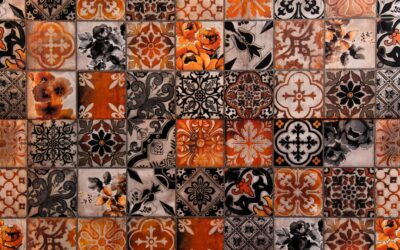
Moroccan zellige and similar handmade ceramics have become the designer favorite of the last five years. Each tile is slightly different in color, thickness, and surface texture—giving the wall organic movement no machine-made tile can replicate. Brands like Clé, Zellige Morocco, and Bedrosians sell 2×6 and 4×4 zellige in whites, greens, blues, and terracottas.
Expect to pay $20-40 per square foot for authentic zellige, plus a 20-30% overage allowance because the variation is part of the look. Installation requires a tile setter familiar with the product—standard spacers don’t work, and the grout lines are tighter than typical ceramic. The result is a kitchen wall that looks like it’s been there for a century.
Mosaic and Penny Rounds
Mosaic sheets—small tiles mounted on mesh backing in 12×12 squares—offer pattern and texture without the labor of setting individual pieces. Popular choices:
- Penny rounds: small circular tiles, vintage feel, works well in black-and-white bathrooms and kitchens
- Hexagon: modern geometric look, 2″ hex is most popular for backsplashes
- Fish scale (scallop): dramatic curves, great for feature walls above a stove
- Glass mosaic: reflective, brightens dark kitchens, $15-25/sq ft
- Marble mosaic: natural stone in honed or polished, $20-45/sq ft
Mosaic installation is faster than individual tiles but the grout work is more intensive. Budget extra grout and sealer for any stone mosaic.
Peel-and-Stick for Rentals and Budget Refreshes
Peel-and-stick vinyl backsplash has improved dramatically in the last decade. Brands like Smart Tiles, RoomMates, and FloorPops sell vinyl sheets that mimic subway tile, zellige, marble slab, or metal in 10×10 inch to 10×30 inch sections. Cost: $6-12 per square foot, installable by one person in an afternoon with scissors and pressure.
Best use cases: rental kitchens (fully removable), temporary refreshes before listing a home, or areas away from the cooktop where grease exposure is minimal. Not recommended behind gas ranges or in constantly humid kitchens—heat and steam loosen the adhesive over time. Expect a 3-5 year lifespan in high-use areas.
Slab Backsplash
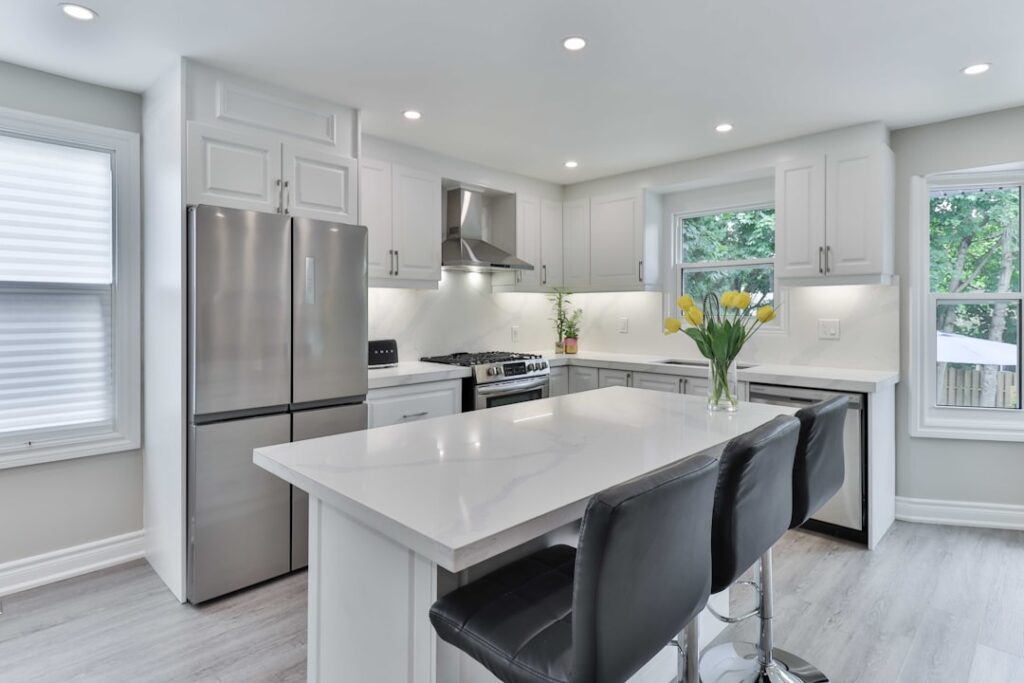
Extending your countertop material up the wall creates the cleanest, most luxurious look in modern kitchens. Quartz slabs from Cambria, Caesarstone, or Silestone can run from countertop all the way to the cabinet bottoms or up to the range hood. Natural marble, granite, and soapstone work the same way.
Slab backsplash eliminates grout lines entirely, which means easier cleaning and a seamless visual flow. Cost is the tradeoff: $60-150 per square foot installed depending on the material. Templating, fabrication, and installation require a professional stone shop. This is the premium choice for a long-term forever kitchen.
Picket and Arabesque Shapes
Picket tiles (elongated diamond/spear shapes) and arabesque (lantern shapes) add architectural interest without going full Moroccan. Both work especially well in neutral palettes—white, cream, soft gray—where the shape itself becomes the feature.
Daltile, MSI, and Bedrosians all carry picket in ceramic and marble versions. Pricing starts around $8 per square foot for ceramic and climbs to $25-40 for marble. The cut edges require tile setters willing to miter or trim for outlet and corner work.
Metal and Stainless Steel
A stainless steel backsplash behind a pro-style range gives a commercial kitchen feel and is bulletproof against heat and grease. Full stainless panels run $25-60 per square foot installed. Copper, brass, and zinc options develop patinas over time and work beautifully in farmhouse or industrial kitchens.
For a less expensive metal look, pressed tin tiles (Aspect, Fasade) install with adhesive at $10-15 per square foot. They don’t hold up quite like real metal but deliver the aesthetic at a fraction of the cost.
Brick and Thin Brick Veneer
Thin brick veneer creates a rustic, farmhouse, or New York loft feel that full-wall tile can’t match. Products like Old Mill Thin Brick or General Shale Thin Brick are 1/2-inch thick slices of real brick that install with mortar. Whitewashed or limewashed brick lightens the look for a modern farmhouse kitchen.
Thin brick runs $8-15 per square foot for materials plus skilled masonry labor. Sealing with a penetrating sealer (not a glossy topcoat) keeps grease from absorbing into the brick pores while maintaining the natural matte look.
Coordinating with Countertops and Cabinets
A few proven pairings that work in almost any kitchen:
- White cabinets + quartz counter + white subway backsplash: timeless, always sells
- Navy cabinets + white marble counter + matte white zellige: modern coastal
- Natural wood cabinets + soapstone counter + handmade terracotta: Mediterranean/farmhouse
- Black cabinets + waterfall quartz counter + full-slab backsplash: minimalist/modern
- Cream cabinets + butcher block counter + vintage penny round: cottage/farmhouse
Let one element be the star. If the countertop has heavy veining (Calacatta, Carrara), pick a simple backsplash. If the cabinets are bold, keep the counter and backsplash quieter.
How High Should a Backsplash Go
Standard backsplash height is 18 inches—the gap between counter and upper cabinets. For kitchens with open shelving or no uppers, extending the backsplash to the ceiling above the range creates a dramatic feature wall. The range wall often gets full-height treatment while side walls stop at standard height.
Above the range itself, plan your tile layout so the center of the range aligns with a grout line or a full tile, not a seam. This small detail separates professional installations from amateur.
Final Thoughts
The best of these kitchen backsplashes ideas is the one that fits your cabinets, your countertop, and your tolerance for trend risk. Subway tile and slab continue to sell homes; zellige and handmade ceramics give personality; peel-and-stick solves rental constraints. Budget $500-3,000 for most residential backsplash projects, pick a material you’ll still love in 10 years, and hire a tile setter for anything beyond simple straight runs.