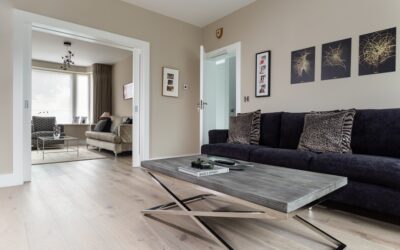
The single biggest jump in laminate over the past decade was not in core construction or click systems; it was in the photograph. Laminate flooring images, the printed decor layer that gives the plank its wood or stone look, now run at 600 to 1,200 dpi resolution with embossed-in-register texture that matches the print perfectly. The result is a floor that fools the eye until you tap it. The catch is that not all laminate prints are equal, and the cheap ones still look like the 2005 catalog.
How the Image Layer Actually Works
A laminate plank is four layers fused under heat and pressure. From bottom up: a melamine balance sheet to prevent cupping, a high-density fiberboard (HDF) core for stability, the printed decor layer, and a clear melamine wear layer infused with aluminum oxide. The image is a photograph of real wood or stone, scanned at high resolution and printed onto resin-impregnated paper.
Premium lines from Pergo, Mohawk RevWood Plus, and Quick-Step use multiple print variations per pattern, typically 8 to 24 unique board images, which prevents the repeating-pattern effect that gave older laminate away. Budget brands often ship only 4 to 6 variations, and you will see the same knot twice within a 10 by 12 room.
The Honest Pros of Modern Laminate Imagery
Pricing relative to realism is unbeatable. A $2.50 per square foot laminate from Pergo Outlast Plus can look indistinguishable from $7 per square foot engineered hardwood at conversational distance. For rental properties, flip houses, and budget-conscious homeowners, the ROI is hard to argue.
Variety is the other major advantage. You can buy laminate that mimics wirebrushed white oak, fumed European oak, distressed hickory, hand-scraped walnut, polished marble, slate, even concrete. Wood species that would cost $14 to $20 per square foot in real lumber show up at $3 to $5 in laminate.
The Cons You Should Know
The image does not extend through the plank. Chip the edge or gouge the surface and you reveal brown HDF underneath. Repair options are limited to wax fill sticks or replacing the entire board.
Water can still wreck the print. Even AquaGuard-rated and waterproof laminates from RevWood Plus and Pergo Extreme have weak points at the locking seams. Standing water over six hours can swell the HDF core and bubble the image layer permanently.
AC Rating and Wear Layer Hierarchy
Image quality is only half the story. The clear wear layer protects the print from abrasion. AC ratings under EN 13329 measure that durability. AC3 is residential moderate use, fine for bedrooms and living rooms. AC4 handles family entryways, kitchens, and light commercial. AC5 is rated for commercial spaces with heavy traffic. For most homes, AC4 is the right pick.
Wear layer thickness matters too, though laminate is typically described in AC rating rather than mil thickness like LVP. Match the AC rating to your traffic pattern and you avoid premature image wear-through.
Brand Spotlight: Pergo Extreme and Mohawk RevWood Plus
For the most realistic laminate images in the US market, Pergo Extreme and Mohawk RevWood Plus lead the field. Pergo uses 12-bevel edge detailing and 22 unique board images per SKU, with embossed-in-register texture aligned to the grain pattern. RevWood Plus uses Mohawk’s Hydroseal technology to waterproof the locking seams while maintaining the same print quality. Both retail at $3 to $5 per square foot, with AC4 to AC5 wear layers and 25 to lifetime residential warranties. For a busy family home where you want the look of $9 per square foot oak without the cost, either is a strong default.
How to Evaluate Image Quality In-Store
Pull at least four planks from different cartons and lay them edge to edge. Look for repeating patterns and obvious tile alignment. Hold the planks at a 45 degree angle to overhead lighting; cheap prints reveal pixelation and fuzzy grain edges, while premium prints stay crisp.
Check the bevel and emboss. Square-edged laminate looks more like sheet vinyl from a distance. Painted micro-bevels mimic real plank seams. Embossed-in-register texture means the surface bumps follow the printed grain, giving tactile authenticity to the visual one.
Pricing Tiers
Budget laminate (AC3, basic print): $0.79 to $1.50 per square foot. Acceptable for rentals.
Mid-grade (AC4, 8 to 12 image variations): $2 to $4 per square foot. Pergo Outlast, Mohawk RevWood, Quick-Step Studio. The sweet spot for most homes.
Premium (AC5, 16+ image variations, waterproof): $4 to $6 per square foot. Pergo Extreme, RevWood Plus, Quick-Step NatureTEK Plus.
Installation Notes
Almost all modern laminate floats on a 3 mm foam or cork underlayment with a 1/4 inch expansion gap at walls. Acclimate planks 48 hours in the install room with HVAC running. Click systems from Uniclic, Valinge 2G, and 5G all work, but the latest 5G drop-lock is the fastest to install.
Concrete subfloors need a 6 mil polyethylene moisture barrier under the underlayment. Test slab moisture per ASTM F2170 (in-situ RH under 75 percent) before install.
Maintenance Reality
Damp mop with Bona Hard-Surface Floor Cleaner or Mohawk FloorCare Essentials, never wet-mop, never use steam mops. Felt pads on furniture, mats at entries to catch grit. Replace damaged boards by disassembling click rows back to the affected plank; difficult but possible if you saved cartons from the original purchase.
Bottom Line
Modern laminate flooring images are good enough that the conversation has shifted from realism to durability and water resistance. Pay for the AC4 or AC5 rating, demand at least 12 image variations per SKU, and pick a brand with documented embossed-in-register texture. The result is a floor that looks like real hardwood at a third of the price and survives kids and dogs better than the real thing.
Prefer to explore on your own?
See how new flooring looks in your actual room in seconds — free, no signup.
Try the free Floor Studio →